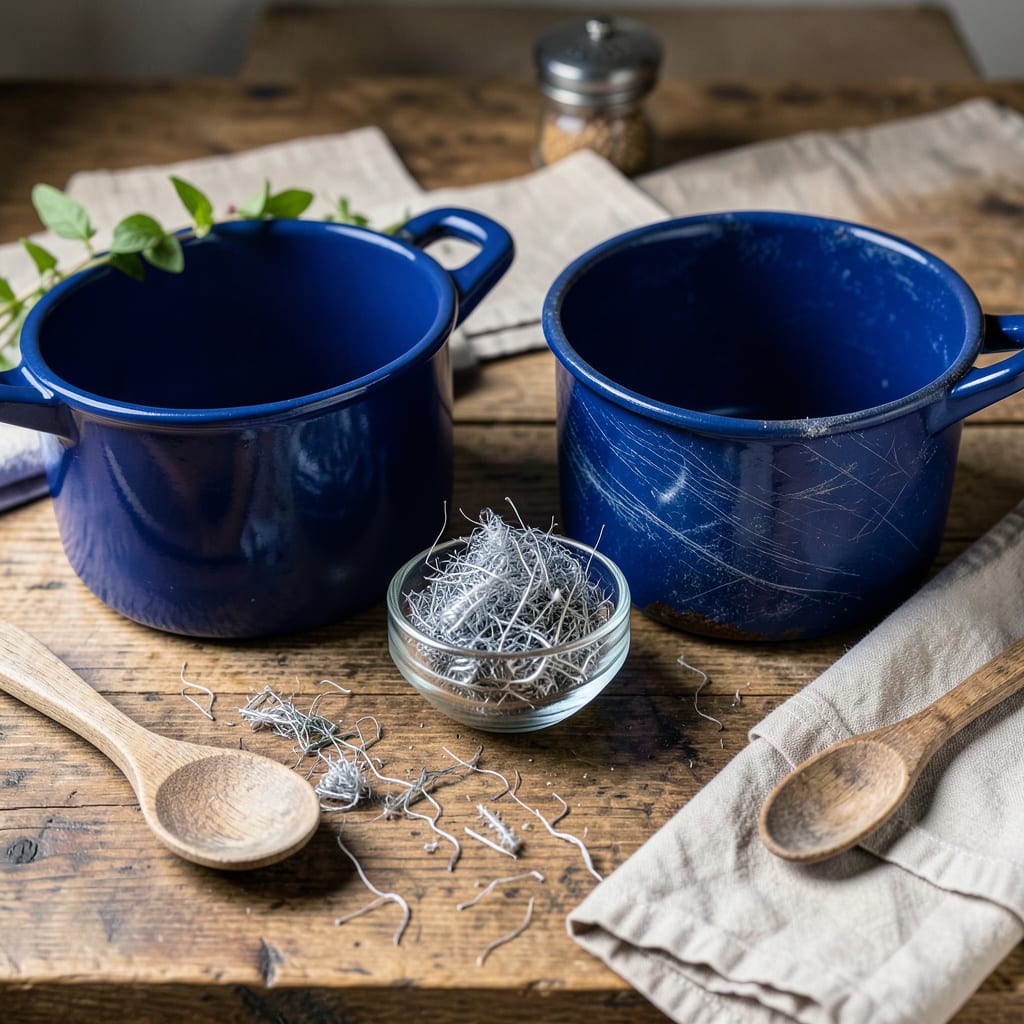
No, steel wool should never be used on enameled cast iron as it will scratch and permanently damage the smooth enamel coating. Instead, use non-abrasive cleaners, soft sponges, or nylon scrubbers to preserve the surface while removing stuck-on food.
I’ve seen too many beautiful enameled pieces ruined by aggressive scrubbing. The enamel’s glass-like finish is designed to protect your cookware, but it’s not invincible. 🔥 Even fine-grade steel wool creates microscopic scratches that become breeding grounds for bacteria and stains over time. Think of it like sandpaper on a car’s clear coat – the damage starts small but becomes obvious with repeated use. What’s worse, those tiny scratches make food stick more stubbornly, creating a vicious cycle of needing to scrub harder.
My go-to method for tough residue involves a paste of baking soda and water, left to sit for 10-15 minutes before gently scrubbing with a nylon brush. ✨ The mild abrasiveness of baking soda combined with the chemical reaction breaks down food particles without harming the enamel. For really stubborn spots, I’ll use a silicone scraper to lift residue before applying the paste – this one-two punch saves my enameled Dutch oven every time.
💡 In This Article
- Why Steel Wool Damages Enameled Cast Iron Surfaces
- Safe Alternatives to Steel Wool for Enameled Cast Iron
Why Steel Wool Damages Enameled Cast Iron Surfaces
Enameled cast iron gets its signature smooth finish from a fused glass coating applied at temperatures exceeding 1400°F. This creates a non-porous surface that’s naturally resistant to sticking and staining. 🔥 The problem with steel wool is that its tiny metal fibers act like microscopic saw blades, cutting through this glass-like layer with each scrub.
Even “fine” grade steel wool (0000) has fibers measuring about 0.001 inches in diameter – thin enough to create invisible scratches that compromise the enamel’s integrity.
What happens next is a domino effect of damage. Those micro-scratches create tiny crevices where food particles and oils get trapped. Over time, these areas become stained and develop bacterial growth that’s harder to clean. I’ve seen this firsthand with vintage enameled pieces where the once-glossy surface becomes dull and pitted.
The scratches also make the enamel more susceptible to chipping, especially when exposed to thermal shock from rapid temperature changes.
The abrasion process works like this: when you scrub with steel wool, the metal fibers actually remove microscopic layers of enamel with each pass. This isn’t just surface damage – it’s permanent material loss.
A study by the Journal of Coatings Technology found that repeated abrasive cleaning can reduce enamel thickness by up to 15% over two years of regular use. That’s why manufacturers like Le Creuset and Staub explicitly warn against steel wool in their care instructions.
Here’s what’s particularly insidious: the damage often isn’t immediately visible. You might not see scratches until months later when the enamel starts staining or food begins sticking more than usual. By then, the surface has been compromised at a microscopic level.
I learned this the hard way with my first enameled Dutch oven – what started as “just a quick scrub” with steel wool led to permanent discoloration around the rim where I’d scrubbed most aggressively.
The science behind enamel’s vulnerability lies in its composition. While incredibly hard (rating about 5 on the Mohs hardness scale), enamel is also brittle. Steel wool fibers, which are actually harder (rating 6-7), create a sanding effect. This is why even “gentle” scrubbing with steel wool will eventually damage the surface.
The solution isn’t to scrub harder with abrasives, but to use chemical and thermal methods to break down food residue without physical abrasion.
Consider this comparison: your enameled cast iron’s surface is like a car’s clear coat. You wouldn’t use steel wool on your car’s paint because you know it would scratch – the same principle applies here. The difference is that car paint can be buffed and polished, while enamel damage is permanent.
That’s why I always reach for nylon scrubbers or silicone tools instead – they clean effectively without compromising the cookware’s protective layer. ✨

Trained in classic French technique but raised on slow-cooked ribs and spicy rubs, she blends culinary skill with smoke and soul.
- Recipe for French Pork Spread Gorton: Savory Gallic Flavors in a Spreadable Delight - October 3, 2026
- Recipe for Pan Fried: Golden Crust with Savory Depth - October 3, 2026
- Recipe For Fried Chicken In A Pressure Cooker: Crispy Golden Bites in Half the Time - October 3, 2026