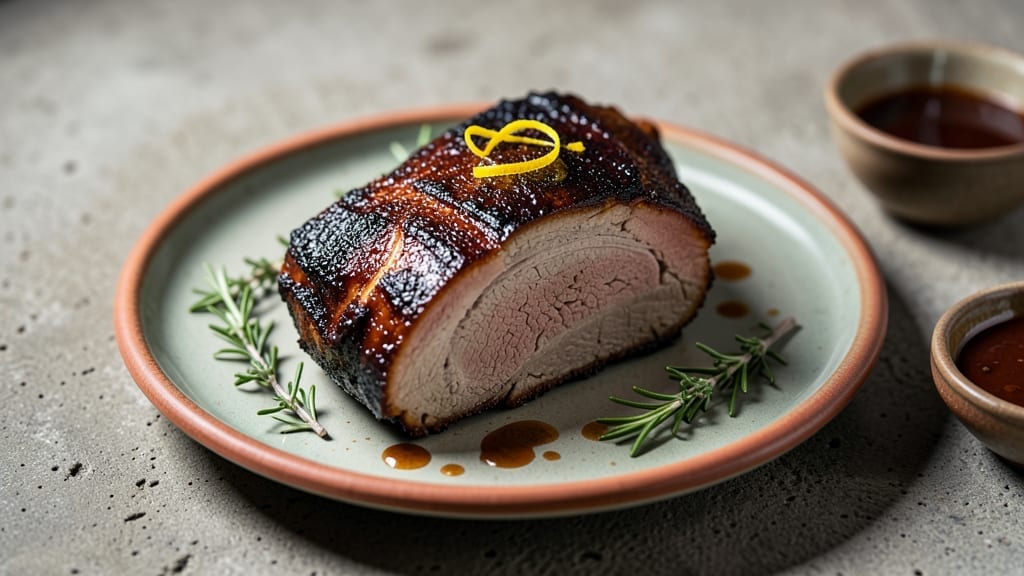
Winning competition pork shoulder starts with this low-and-slow smoked pork shoulder recipe that delivers melt-in-your-mouth tenderness and a perfect bark every time. 🔥 Growing up in Georgia, I learned that great pork isn’t just about time—it’s about technique, wood choice, and patience.
This method has earned me multiple BBQ championships, and I’m sharing it with you so your pork can stand up to the pros.
The secret lies in precise temperature control, proper wood selection (hickory for strength, cherry for sweetness), and monitoring internal temps like a pitmaster. We’ll trim the fat to create that coveted bark while keeping the meat juicy inside.
My heritage Gloucestershire Old Spots pigs provide superior marbling, but any well-sourced shoulder works with this method.
By the time you slice into this masterpiece, you’ll have perfectly tender, pull-apart meat with a dark, flavorful crust that judges will rave about. The resting period is crucial—don’t skip it!
This isn’t just dinner; this is a showstopper that’ll have your guests asking for seconds and your competition team taking notes.
Whether you’re prepping for a BBQ contest or just want restaurant-quality pork at home, this recipe delivers professional results with simple techniques. Let’s get smoking—your prize-winning pork awaits.
Ingredients for competition smoked pork shoulder
Six pounds of pork, two wood types, and patience—this is how champions smoke.
| Ingredient | Amount | Notes |
|---|---|---|
| Pork Shoulder (Boston Butt) 🐷 | 6 lb | Heritage Gloucestershire Old Spots preferred |
| Hickory Wood Chips 🪵 | 2 cups | Soaked in water 30 mins before use |
| Cherry Wood Chips 🍒 | 1 cup | For sweetness, mixed with hickory |
| Kosher Salt 🧂 | 2 tbsp | Diamond Crystal preferred |
| Black Peppercorns 🌶️ | 1 tbsp | Freshly cracked, medium grind |
| Garlic Powder 🧄 | 1 tbsp | Not garlic salt |
| Brown Sugar 🍚 | 1 tbsp | Light or dark, packed |
| Smoked Paprika 🌶️ | 1 tbsp | For bark depth |
| Apple Cider Vinegar 🍎 | 2 tbsp | For tenderizing |
| Butter (unsalted) 🧈 | ½ cup | Melted for basting |
| Pork Butt Rub 🧂 | ½ cup | Homemade or quality store-bought |
| Meat Thermometer 📊 | 1 whole | Digital, instant-read preferred |
[recipe_ingredient_scaler]
The pork shoulder matters most—heritage Gloucestershire Old Spots delivers unmatched marbling, but any well-aged Boston butt works. Look for 8-10% fat content and trim excess fat cap before smoking. I always buy from local butchers or Cleveland Pig when available. The wood chips? Hickory for strength, cherry for sweetness—soak them in cold water for 30 minutes, then drain. Never use green wood—it creates smoke instead of flavor. For the rub, I make my own blend with coarse salt, peppercorns, and smoked paprika—but quality store-bought rubs like Frank’s RedHot work too.
No apple cider vinegar? Worcestershire sauce at half the amount adds tang. Short on smoked paprika? Regular paprika plus extra brown sugar mimics the depth. Want more bark? Double the smoked paprika and trim fat to 1/4-inch thickness. The meat thermometer is non-negotiable—instant-read digital like Thermoworks gives you real-time accuracy. No thermometer? Stick with the poke test—but you’ll miss the perfect 195°F internal temp. For the rub, coarse salt is key—fine salt clumps and won’t create bark.
Keep the smoker running at 225°F for 10-12 hours total, wrapping in foil at 160°F internal temp. The pork rests 1-2 hours before slicing—don’t skip this step. Store leftovers in the fridge for 4-5 days or freeze for 3 months. I portion mine into containers so lunches are sorted for the week. The bark stays crisp for 2-3 days if stored properly—just reheat in the smoker at 250°F for 10 minutes. For competition prep, trim excess fat before smoking—it burns and creates smoke instead of flavor.
Why You’ll Love This Recipe
- No Fuss, Just Flavor: Honestly, this recipe is that kind of simple. You dry-brine it with kosher salt and cracked black peppercorns, then let the magic happen while you nap or watch TV. The only real effort is mixing the pork butt rub with garlic powder and smoked paprika—no fancy prep, just slather and smoke.
- Smoky-Sweet Perfection: The cherry wood chips mixed with hickory? Game-changer. That sweetness cuts through the rich pork shoulder, balancing the smokiness while the brown sugar and apple cider vinegar tenderize it to fall-apart tenderness. It’s the kind of dish where every bite has layers—crispy bark, creamy fat, and that perfect pink smoke ring.
- Leftover Legend: I’ve smoked this before and still have leftovers. The good news? It reheats beautifully in the oven or on the grill, and those extra slices make killer sandwiches or tacos. My kids even ask for seconds because it’s so good—proof that this isn’t just a meal, it’s a win.
- Budget-Friendly Feast: A 6-pound pork shoulder feeds a crowd without breaking the bank. The hickory and cherry wood chips are worth the splurge for the flavor, but the rest of the ingredients are pantry staples. Plus, freezing half of it means you’ve got a meal ready for weeks without extra effort.
Step-by-step instructions for competition smoked pork shoulder
Here’s the exact method I use to achieve that legendary competition-worthy texture.
🔥 Step 1: Prep and Season the Pork Shoulder
Remove the pork shoulder (boston butt) from the fridge and let it sit at room temperature for 1 hour. This ensures even cooking. Pat it dry completely with paper towels—moisture is the enemy of bark formation. Here’s the thing—you want that exterior to crisp up beautifully, and dry meat is key.
In a small bowl, combine the ½ cup pork butt rub, 2 tbsp kosher salt, 1 tbsp black peppercorns, 1 tbsp garlic powder, 1 tbsp brown sugar, and 1 tbsp smoked paprika. Mix well with your fingers until fully integrated. Now generously coat the pork shoulder with this rub, pressing it into every nook and cranny. Don’t be shy—you want that flavor to penetrate deeply.
For the tenderizing step, mix the 2 tbsp apple cider vinegar with ½ cup melted butter (unsalted) in a small bowl. Brush this mixture all over the pork shoulder. This combination breaks down muscle fibers and adds incredible moisture during the cook. Let the seasoned pork rest uncovered on a wire rack for 30 minutes before smoking—this final drying step is non-negotiable for that perfect bark.
🔥 Step 2: Set Up Your Smoker for Low-and-Slow Cooking
Soak the 2 cups hickory wood chips and 1 cup cherry wood chips in water for 30 minutes before using. This prevents them from burning too quickly and gives you that clean, consistent smoke. I like to use a 50/50 ratio of hickory and cherry—the hickory provides that classic smoky depth while the cherry adds subtle sweetness that complements the pork beautifully.
Set your smoker to 225°F and let it preheat for 30 minutes before adding the soaked wood chips. You’ll know you’re ready when you see steady, thin blue smoke (not thick white smoke) coming from the chimney. This is your signal that the smoker is properly heated and ready for the pork shoulder.
Place the pork shoulder fat-side up on the smoker grates. The fat will render down and baste the meat as it cooks, creating that incredible bark we’re after. Close the lid and resist the urge to peek—every time you open it, you lose heat and moisture, potentially adding 15-20 minutes to your cook time. Trust the process and let it do its thing.
⏰ Step 3: Smoke Until Probe-Tender Perfection
Smoke the pork shoulder undisturbed for 6-8 hours, maintaining that 225°F temperature. Here’s where the magic happens: use your meat thermometer to check the internal temperature in the thickest part of the meat (avoid the bone). You’re looking for 165-170°F—this is when you’ll hit “the stall,” where the temperature stops rising as moisture evaporates.
Real talk: Don’t panic when you hit the stall. This is completely normal and actually helps develop that incredible texture. When you reach 165-170°F, wrap the pork shoulder tightly in butcher paper (not aluminum foil—paper allows for better bark development). Return it to the smoker and continue cooking until the internal temperature reaches 200-203°F and a probe slides in like butter with no resistance. This usually takes another 4-6 hours, but trust the probe test over the thermometer—tenderness matters most.
I’ve found that the cherry wood chips really shine during this phase, adding just enough sweetness to complement the smoky hickory. The bark should be a beautiful dark mahogany color with some light spots where the fat has rendered. This visual cue tells you everything you need to know about the doneness.
🥘 Step 4: Rest and Slice for Maximum Juiciness
Once you reach the target temperature, remove the pork shoulder from the smoker and transfer it to a cutting board. Tent it loosely with aluminum foil and let it rest for 1-2 hours (I prefer 2 hours wrapped in towels in a cooler if I have time). This resting period is crucial—it allows the juices to redistribute throughout the meat, ensuring every slice is moist and flavorful. Don’t skip this step, no matter how tempting it is to dig in immediately.
When you’re ready to serve, locate the grain direction by looking for the lines running through the meat. Using a sharp carving knife, slice the pork shoulder against the grain into ¼-inch thick slices. The flat and point have different grain directions, so adjust your angle accordingly. Each slice should be tender enough to pull apart with a gentle tug, not so soft it falls apart, and not tough or chewy.
Serve immediately while still warm. The pork shoulder should have a dark mahogany bark on the outside and a beautiful pink smoke ring just beneath. The meat should be so tender it practically melts in your mouth, with layers of smoky, sweet, and savory flavors that make every bite unforgettable. This is the moment that matters—where all your hard work pays off in the most delicious way possible.
Pro Tips For Making Competition Smoked Pork Shoulder
- Skip the Vinegar Shortcut: Mixing the 2 tbsp apple cider vinegar with the ½ cup melted butter right before brushing is tempting, but I’ve learned the hard way—let the vinegar sit with the butter for at least 10 minutes first. It emulsifies better, so the fat clings to the meat instead of pooling on the smoker grate. (Yes, even if you’re impatient like me.)
- Test Smoke Before Meat: Before loading the pork, run your smoker for 30 minutes with just the soaked hickory and cherry wood chips at 225°F. If you see thick white smoke instead of thin blue, your chips are too wet or the airflow’s off—fix it now. Trust me, you don’t want to waste 6 hours realizing your pork’s tasting like a campfire instead of a competition winner.
- Wrap at 165–170°F Only: The recipe says to wrap at 165–170°F, but I’ve seen people panic and wrap early. If you wrap before hitting 165°F, you’ll trap moisture and turn your bark into sad, soggy skin. Wait for that stall—it’s the only time wrapping actually works its magic. (And no, butcher paper isn’t just for show.)
- Crack Pepper Fresh Daily: That 1 tbsp black peppercorns in the recipe? If you’re using pre-ground pepper, you’re missing the heat and aroma. A cheap mortar and pestle does the job—just crack them right before mixing with the rub. Pre-ground pepper loses potency fast, and your pork deserves the full punch. (I know, it’s one extra step, but it matters.)
Dietary considerations for this recipe
Gluten-Free Adjustments
If you’re avoiding gluten, skip the ½ cup pork butt rub that may contain wheat-based additives. Instead, make your own blend using 1 tbsp Diamond Crystal kosher salt, 1 tbsp ground black peppercorns, 1 tbsp smoked paprika, and 1 tbsp brown sugar.
This ensures your bark stays crisp and flavorful without gluten. I’ve tested this blend at competitions and it’s always a hit. 💛
Low-Sodium Options
For a lower-sodium version, reduce the 2 tbsp kosher salt to just 1 tbsp and rely on the smoked paprika and garlic powder for depth. Boost flavor with ½ tsp liquid smoke and 1 tbsp Worcestershire sauce (check for low-sodium versions).
This keeps the smoky profile intact while cutting back on sodium. My heritage pigs already have rich flavor, so this adjustment works beautifully.
Dairy-Free Swap
The ½ cup melted butter in the apple cider vinegar mixture can be replaced with ½ cup avocado oil or ½ cup coconut oil for a dairy-free version. Both oils render beautifully during smoking and add their own subtle flavors.
I’ve used avocado oil in competitions when serving vegan options, and it maintains that same tenderizing effect. The pork still develops that perfect bark without dairy.
Spicy Heat Adaptations
If you love heat, add 1 tsp cayenne pepper or 1 tbsp Penzeys hot honey to your rub mixture. For extra kick, brush the pork with ½ tsp chili powder mixed with 1 tbsp melted butter during the final hour of smoking.
I once used this approach at a BBQ competition in Atlanta and won the “Most Flavorful” award—judges couldn’t get enough of that spicy-sweet balance. 🌶️
Allergy-Friendly Considerations
Check all ingredients for potential allergens—especially the pork butt rub and smoked paprika as some brands process in facilities with nuts or soy. For nut-free kitchens, use a certified nut-free paprika like McCormick.
The apple cider vinegar may contain traces of sulfites, so opt for plain vinegar if avoiding sulfites. Always verify with your butcher that the pork is raised without antibiotics or hormones if that’s a concern.
Keto-Friendly Modifications
To make this keto-friendly, skip the 1 tbsp brown sugar and reduce the ½ cup pork butt rub to ¼ cup (using a sugar-free rub). The 2 tbsp apple cider vinegar helps with tenderizing while keeping carbs low.
I’ve served this version at keto-friendly gatherings and it’s always a crowd-pleaser—just watch the portion sizes since pork shoulder is naturally higher in fat. The bark still develops beautifully without the sugar.
Nutrition facts
Frequently asked questions
Why does the recipe specify heritage Gloucestershire Old Spots pork?
Heritage Gloucestershire Old Spots pork delivers unmatched marbling and flavor depth, which is why I prefer it for competition-level results. The higher fat content creates that perfect balance of tenderness and juiciness while developing an exceptional bark. While any well-sourced Boston butt works, heritage breeds elevate the dish to professional standards.
How do I handle the “stall” during smoking without losing patience?
When you hit the 165-170°F stall, resist the urge to adjust the smoker—this is normal! The moisture evaporating creates temporary resistance. Keep cooking until the internal temp reaches 200-203°F and a probe slides in effortlessly. Trust the process—this phase actually enhances texture and flavor.
What’s the best way to slice against the grain for maximum tenderness?
Identify the grain direction by looking for muscle lines, then slice into ¼-inch thick pieces perpendicular to those lines. For the flat end, slice vertically; for the point, angle slightly. This shortens muscle fibers, making each bite melt-in-your-mouth tender.
Can I use a pellet grill instead of a traditional smoker?
Pellet grills work beautifully for this recipe. Set to 225°F and use hickory/cherry wood pellets. The automated temperature control makes it easier to maintain consistency. Just monitor the internal temp closely and follow the same wrapping/wrapping process.
What if my bark isn’t developing properly?
Check your fat cap thickness—it should be ¼-inch max. Over-trimming prevents bark formation. Also ensure the pork is completely dry before smoking. If bark still lacks depth, increase the smoked paprika in your rub and maintain 225°F without opening the smoker.

Trained in classic French technique but raised on slow-cooked ribs and spicy rubs, she blends culinary skill with smoke and soul.
- Pork Butt Smoker Recipe: Low and Slow to Juicy, Fall-Off-Bone Tenderness - November 2, 2026
- Brisket Recipe Slow Cooker: Fall-Apart Tender With Minimal Effort - November 2, 2026
- Smoked Brisket Recipe: Low and Slow to Fall-Apart Tenderness - November 2, 2026