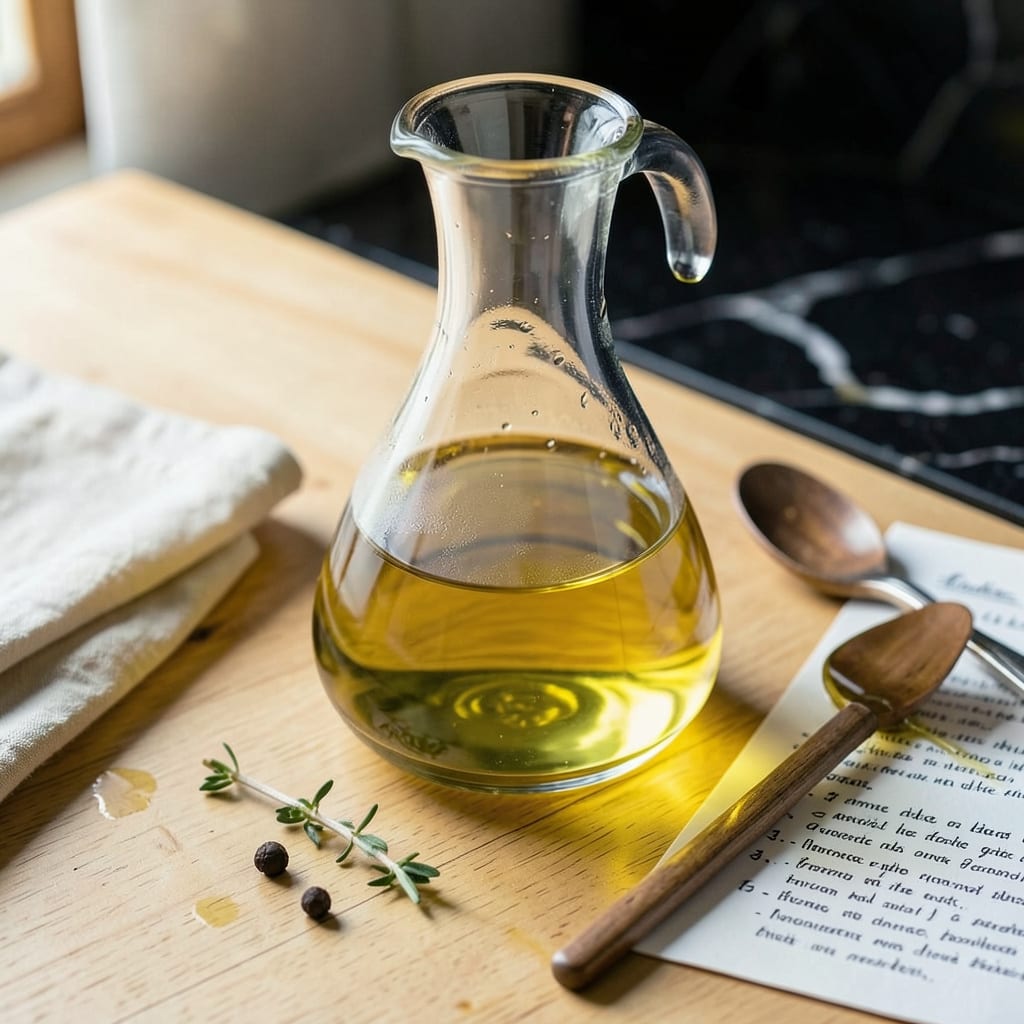
Oil and vinegar don’t naturally mix—they separate due to their different polarities. However, vigorous shaking or adding an emulsifier (like mustard or lecithin) can temporarily combine them into a uniform mixture like vinaigrette.
This separation happens because vinegar (a polar liquid) and oil (nonpolar) repel each other like magnets with opposite charges. 🔥 The science here is fascinating—water-based vinegar molecules cling together, while oil molecules do the same, creating distinct layers. That’s why your homemade dressing might look perfect at first but split after sitting for a while.
What changes the game is introducing an emulsifier—something that bridges the gap between these opposing forces. Mustard, for example, contains compounds that act like tiny connectors, holding the mixture together long enough for you to drizzle it over your salad. The right technique can make all the difference in stability. ✨
💡 In This Article
- The Science Behind Oil and Vinegar Separation
- How to Emulsify Oil and Vinegar for Perfect Dressings
The Science Behind Oil and Vinegar Separation
At the molecular level, vinegar and oil are fundamentally incompatible. Vinegar is primarily water and acetic acid—both polar molecules with positive and negative ends that attract each other. Oil, however, is nonpolar, meaning its molecules lack charged ends and instead bond through weaker van der Waals forces.
When combined, polar vinegar molecules cluster together while nonpolar oil molecules do the same, creating distinct layers. 🔥
The density difference compounds this separation. Vinegar (about 1.01 g/mL) is slightly denser than most cooking oils (0.92 g/mL), so it naturally sinks to the bottom. This is why you’ll always see vinegar form the lower layer in a separated dressing.
The repulsion between polar and nonpolar molecules is so strong that even vigorous shaking only creates a temporary suspension—within minutes, the molecules revert to their preferred groupings. ✨
What’s fascinating is how this plays out visually. If you observe a freshly shaken vinaigrette under a microscope, you’d see tiny oil droplets dispersed throughout the vinegar. But without an emulsifier, these droplets quickly coalesce into larger globules that rise to the top.
The surface tension of oil is about 35 dynes/cm, while water (vinegar’s base) is 72 dynes/cm—this mismatch makes stable mixing nearly impossible without help. 💫
Temperature affects this separation too. Heating the mixture increases molecular motion, temporarily improving dispersion, but cooling causes faster separation. That’s why refrigerator-stored dressings often split more dramatically than those kept at room temperature. The science here explains why commercial dressings contain stabilizers—without them, you’d need to shake the bottle before every use. ⚡
Even the type of oil matters. Olive oil, with its higher viscosity (84 cP at 20°C), separates more slowly than thinner oils like canola (48 cP). This is why extra virgin olive oil creates creamier emulsions—its natural waxes and fatty acids provide slight emulsifying properties.
Yet without a true emulsifier, all oils will eventually separate from vinegar. 🌟
The key takeaway? This separation isn’t a flaw—it’s fundamental chemistry. Polar and nonpolar molecules simply don’t interact favorably. That’s why every stable vinaigrette you’ve enjoyed has relied on either physical force (whisking) or chemical bridges (emulsifiers) to overcome these natural tendencies.
Understanding this helps you troubleshoot dressings that break too quickly or design recipes that stay mixed longer.

Trained in classic French technique but raised on slow-cooked ribs and spicy rubs, she blends culinary skill with smoke and soul.
- Recipe for Boneless Pork Chops in Cast Iron Skillet: Sear and Baste to Juicy Perfection - October 3, 2026
- Recipe for Boneless Cross Rib Roast: Slow-Roasted Beef with Herb Crust - October 3, 2026
- Hamburgers in Sauce Recipe Crock Pot: Slow-Cooked Savory Delight - October 3, 2026