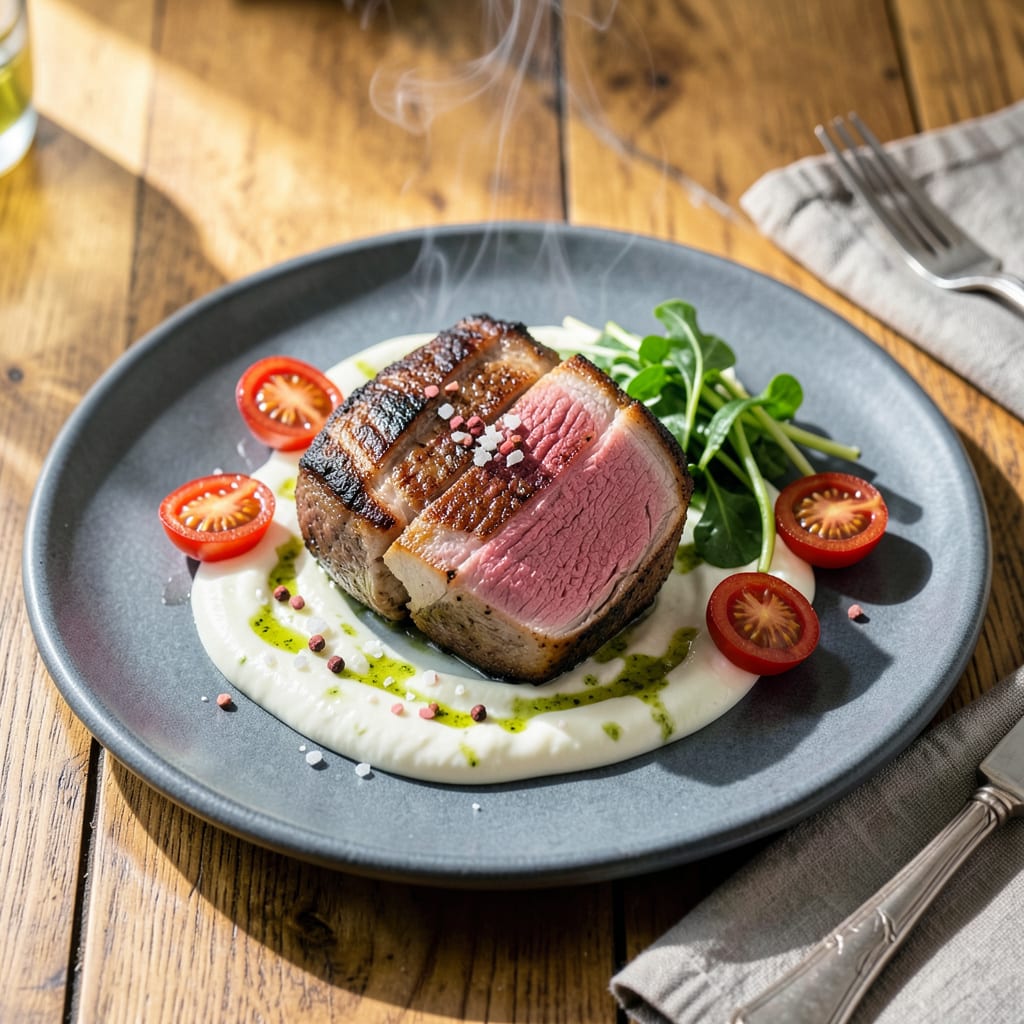
Lamb can be cooked like steak for certain cuts (ribs, loin chops), but requires lower heat and shorter cooking times due to its delicate fat and connective tissue. Rare to medium-rare is ideal to prevent toughness.
I’ve found that treating lamb like beef steak is all about understanding its unique personality. The fat in lamb renders faster than beef’s, meaning those beautiful marbled rib chops can go from perfect to dry in minutes. That’s why I always pull lamb off the heat at 130-135°F for medium-rare—about 10°F lower than I would for beef. 🔥
The connective tissue in lamb also behaves differently than beef’s, breaking down more quickly under heat. This makes timing absolutely critical, especially with thinner cuts. I recommend using a meat thermometer and checking frequently—those last few degrees happen faster than you’d expect with lamb’s delicate structure.
💡 In This Article
- Why Lamb and Steak Require Different Cooking Approaches
- Best Lamb Cuts for Steak-Like Cooking and Techniques
Why Lamb and Steak Require Different Cooking Approaches
Lamb fat has a significantly lower melting point than beef—about 105°F compared to beef’s 130-140°F. This means lamb’s marbling begins rendering almost immediately when it hits the pan, creating that rich flavor faster but also making it more vulnerable to drying out.
The fat composition is different too: lamb contains more unsaturated fats, which oxidize quicker under heat. That’s why you’ll notice lamb develops a deeper color and aroma much sooner than beef during cooking. ✨
The connective tissue in lamb is also more delicate than beef’s. Lamb’s collagen fibers are thinner and break down at lower temperatures—around 160°F versus beef’s 180°F. This structural difference explains why lamb becomes tender more quickly but also why it can turn tough if cooked beyond medium-rare.
The muscle fibers in lamb are shorter too, which is why overcooked lamb feels mealy rather than fibrous like overcooked beef. 🔥
Here’s what’s actually happening at the cellular level: lamb’s myoglobin (the protein that gives meat its color) denatures at lower temperatures than beef’s. This is why lamb changes from red to pink to gray much faster during cooking.
The pH difference also plays a role—lamb is naturally more alkaline (pH 5.7-6.2) than beef (pH 5.4-5.6), which affects how proteins coagulate under heat. This alkaline nature makes lamb more sensitive to temperature spikes. ⚡
Practical implications for your cooking: you’ll want to use 25-50°F lower heat for lamb than you would for steak. A ribeye might sear beautifully at 400°F, but lamb chops will develop a bitter crust at that temperature. I recommend 325-350°F for pan-searing lamb to achieve that perfect golden crust without burning the fat.
The cooking window is tighter too—lamb typically needs only 2-4 minutes per side for medium-rare versus beef’s 4-6 minutes. 💫
Consider the breed differences too. Younger lamb (under 1 year) has even more delicate fat and connective tissue than older lamb or mutton. A spring lamb chop might cook perfectly in 2 minutes per side, while a mutton chop could handle 3-4 minutes before reaching the same doneness.
This variability is why I always recommend using a meat thermometer rather than relying on timing alone. The ideal pull temperature for lamb is 125-130°F for rare and 130-135°F for medium-rare. 🌟
What most people don’t realize is that lamb’s fat also contains more volatile aromatic compounds than beef. These compounds vaporize at lower temperatures, which is why lamb develops its distinctive aroma so quickly during cooking. However, this also means the flavor can become overwhelming if cooked too long.
The key is balancing that beautiful lamb flavor with proper doneness—something that requires precise temperature control and attentive cooking. 💛
The resting process works differently too. While beef benefits from a 5-10 minute rest, lamb only needs about 3-5 minutes because its fibers relax more quickly. This shorter resting time helps prevent the meat from continuing to cook and becoming overdone.
I’ve found that tenting lamb loosely with foil during resting preserves just the right amount of heat while allowing the juices to redistribute perfectly throughout the meat. ✨

Trained in classic French technique but raised on slow-cooked ribs and spicy rubs, she blends culinary skill with smoke and soul.
- Recipe for Boneless Pork Chops in Cast Iron Skillet: Sear and Baste to Juicy Perfection - October 3, 2026
- Recipe for Boneless Cross Rib Roast: Slow-Roasted Beef with Herb Crust - October 3, 2026
- Hamburgers in Sauce Recipe Crock Pot: Slow-Cooked Savory Delight - October 3, 2026