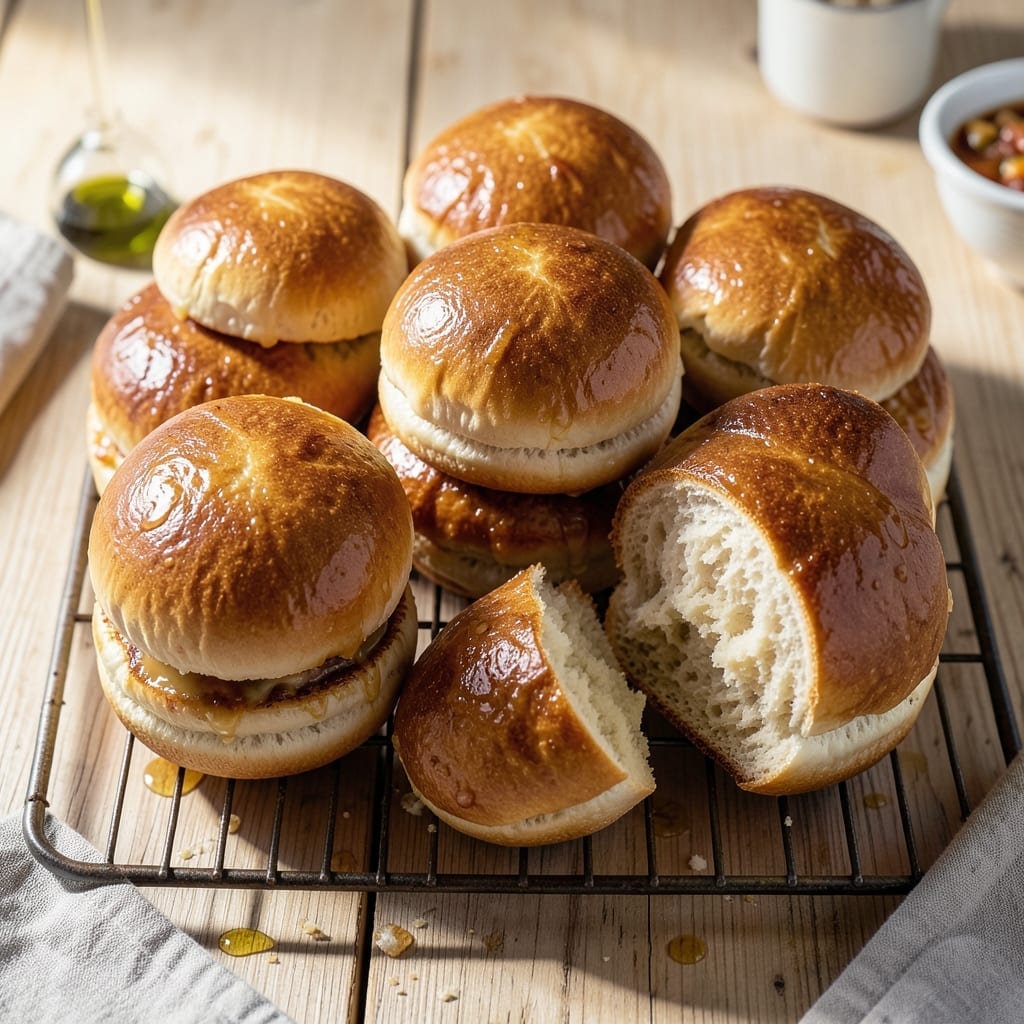
This bread machine method delivers soft, pillowy hamburger buns with minimal effort.
Perfect for beginners, the machine handles kneading and rising automatically. The result is golden buns with a tender crumb, ideal for any burger.
Ingredients for Hamburger Bun Recipe Bread Machine
Soft, pillowy buns start with just a dozen pantry staples and your bread machine.
| Ingredient | Amount | Notes |
|---|---|---|
| Bread Flour 🌾 | 4 cups | Plus 2 tbsp for dusting |
| Whole Milk 🥛 | 1 cup | Warmed to 110°F |
| Large Eggs 🥚 | 2 whole | Room temperature, beaten |
| Unsalted Butter 🧈 | ¼ cup | Melted and cooled |
| Granulated Sugar 🍚 | 3 tbsp | Fine grain for even distribution |
| Active Dry Yeast 🍞 | 2 ¼ tsp | One packet, proofed in warm milk |
| Sea Salt 🧂 | 1 ½ tsp | Fine grain for consistency |
| Egg Yolk 🥚 | 1 whole | For egg wash finish |
| Sesame Seeds 🌰 | 2 tbsp | Optional topping, toasted |
| Honey 🍯 | 1 tbsp | For subtle sweetness |
| Vital Wheat Gluten 🌾 | 2 tbsp | Enhances soft texture |
| Dry Milk Powder 🥛 | ¼ cup | Improves crumb structure |
[recipe_ingredient_scaler]
Bread flour is non-negotiable here—King Arthur or Gold Medal deliver consistent protein content for the perfect crumb. The milk needs to be 110°F (warm but not hot) to activate the yeast without killing it. Whole milk adds richness that skim can’t match. Vital wheat gluten might seem niche, but most Whole Foods or baking supply stores carry it. It’s the secret to that bakery-style softness.
No bread flour? All-purpose flour plus 2 tbsp vital wheat gluten per cup works in a pinch. Out of whole milk? Half-and-half or oat milk (unsweetened) maintains the richness. The honey can be swapped for maple syrup or agave—just keep the quantity identical. Egg wash is traditional, but milk or cream brushed on top gives a similar golden finish.
Dough rises best in a warm, draft-free spot—your oven with the light on works perfectly. Baked buns keep at room temperature for 2 days, or freeze for 1 month in a sealed bag. Reheat frozen buns wrapped in foil at 350°F for 10 minutes to restore that fresh-baked feel.
Why You’ll Love This Recipe
- Set and Forget: Let the bread machine do the kneading and rising while you prep the rest of dinner.
- Buttery Richness: The whole milk and unsalted butter give these buns that melt-in-your-mouth softness.
- Meal Prep Hero: Bake a batch on Sunday and you’ve got buns ready for burgers, sliders, or sandwiches all week.
- Pantry Friendly: Bread flour and sugar are staples, so I can whip these up without a special grocery trip.
Step-by-Step Instructions for Hamburger Bun Bread Machine
This method ensures perfectly soft, pillowy buns with your bread machine handling the heavy lifting.
Step 1: Activate the Yeast in Warm Liquid
Begin by warming the 1 cup Whole Milk to 110°F—it should feel warm but not hot to the touch. In the bread machine pan, combine the warm milk with the 2.25 tsp Active Dry Yeast and 1 tbsp Honey. Let this mixture sit for 5-7 minutes until it becomes frothy.
This proofing step is critical. You should observe a distinct foam layer forming on the surface, confirming the yeast is active. Without this frothing action, your buns won’t rise properly, resulting in dense texture.
Step 2: Combine All Dry and Wet Ingredients
Add the 4 cups Bread Flour, 0.25 cup Dry Milk Powder, 2 tbsp Vital Wheat Gluten, 3 tbsp Granulated Sugar, and 1.5 tsp Sea Salt to the bread machine pan. These dry ingredients create the structure and subtle sweetness characteristic of quality burger buns.
Next, add the 0.25 cup Unsalted Butter (melted and cooled), 2 whole Large Eggs (beaten), and the yeast mixture from Step 1. Ensure all ingredients are at room temperature to prevent shocking the yeast and to promote even mixing.
Step 3: Select and Run the Dough Cycle
Secure the bread machine pan and select the dough cycle. This cycle typically runs for 1 hour 30 minutes to 2 hours, during which the machine will knead and perform the first rise. The dough should form a smooth, elastic ball that pulls away from the sides of the pan.
About 10 minutes into the cycle, check the dough consistency. It should be slightly tacky but not sticky. If it appears too dry, add 1 tablespoon of water. If too wet, add 1 tablespoon of bread flour. This adjustment ensures optimal hydration for soft, pillowy buns.
Step 4: Shape and Second Rise
Once the dough cycle completes, turn the dough out onto a lightly floured surface. Divide it into 12 equal portions (about 3 ounces each) and shape each into a smooth ball. Place the balls on a parchment-lined baking sheet, spacing them 2 inches apart.
Cover with a damp towel and let rise in a warm place for 45-60 minutes, or until nearly doubled in size. The buns should spring back slowly when lightly pressed. This second rise develops the airy texture essential for perfect burger buns.
Step 5: Bake to Golden Perfection
Preheat your oven to 375°F. Gently brush the risen buns with the 1 whole Egg Yolk beaten with 1 tablespoon of water. This egg wash creates a beautiful, glossy finish. Sprinkle with 2 tbsp Sesame Seeds if desired for added crunch and visual appeal.
Bake for 15-18 minutes until the buns are golden brown and the internal temperature reaches 190°F. Rotate the baking sheet halfway through for even browning. Transfer to a wire rack to cool completely before slicing—the residual heat completes the cooking process and prevents gummy centers.
Pro Tips For Making Hamburger Bun Recipe Bread Machine
- Warm the Milk: I learned this the hard way—using cold whole milk straight from the fridge slows yeast activation. Heat it to about 110°F, the temperature of a warm bath, to kickstart the rise.
- Use Room-Temp Eggs: Sounds weird, but it works: cold eggs can shock the dough and make it dense. Pull them out 30 minutes before mixing for a smoother, more even texture.
- Don’t Overfill the Machine: After burning three batches, I finally figured out that bread machines need space to work. Stick to the 1-1.5 lb setting for this recipe—any more and the buns won’t bake through.
- Brush with Butter: My grandmother swore by this, and she was right: once the buns come out, brush the tops with melted unsalted butter. It’s the thing that matters most for that soft, golden finish.
Essential Equipment for hamburger bun recipe bread machine
Bread Machine Selection
Not all bread machines are created equal for this recipe. I recommend a 1.5-2 pound capacity machine with a dough cycle—Zojirushi Home Bakery Virtuoso is my top pick for consistent results. Larger machines may overwork the dough, while smaller ones can’t handle the quantity. 🔥
Essential Accessories
A good digital kitchen scale (I use OXO Good Grips) ensures precise ingredient measurements. A dough scraper helps divide the sticky dough into even portions. Don’t skip the parchment paper—it prevents sticking and makes cleanup a breeze.
Mixing and Proofing
Use your machine’s dough cycle (typically 90-120 minutes). About 10 minutes in, check the dough ball—it should pull away from pan sides. If too wet, add 1 tbsp flour; if too dry, add 1 tbsp water. This adjustment is crucial for perfect texture.
Shaping Tools
A kitchen scale ensures equal 3-ounce portions. Roll each piece into a smooth ball using cupped hands. For uniform buns, invest in a dough divider—Norpro’s 12-piece set works perfectly. Place shaped buns on a half-sheet pan with 2 inches between each.
Baking Setup
A wire cooling rack is non-negotiable for even air circulation. Use a pastry brush for the egg wash—silicone bristles work best. An oven thermometer (like Taylor Precision) verifies your oven’s 375°F accuracy. 💡
Nutrition Facts
Frequently Asked Questions
Can I use all-purpose flour instead of bread flour?
Yes, but add 2 tbsp vital wheat gluten per cup to match bread flour’s protein content. This ensures your buns stay soft and hold their shape. Without it, the texture may be less pillowy.
Why does my dough not rise in the bread machine?
Check your yeast first—it may be expired. Also ensure the milk is 110°F (not hotter) to activate yeast without killing it. A drafty kitchen can also slow rising.
How do I store leftover buns?
Cool completely, then store in an airtight container for up to 2 days. For longer storage, freeze for 1 month and reheat at 350°F for 10 minutes.
Can I skip the egg wash?
You can, but the buns won’t have that golden sheen. For a vegan alternative, brush with melted butter or milk before baking. The finish won’t be as glossy.

Trained in classic French technique but raised on slow-cooked ribs and spicy rubs, she blends culinary skill with smoke and soul.
- Recipe for Boneless Pork Chops in Cast Iron Skillet: Sear and Baste to Juicy Perfection - October 3, 2026
- Recipe for Boneless Cross Rib Roast: Slow-Roasted Beef with Herb Crust - October 3, 2026
- Hamburgers in Sauce Recipe Crock Pot: Slow-Cooked Savory Delight - October 3, 2026