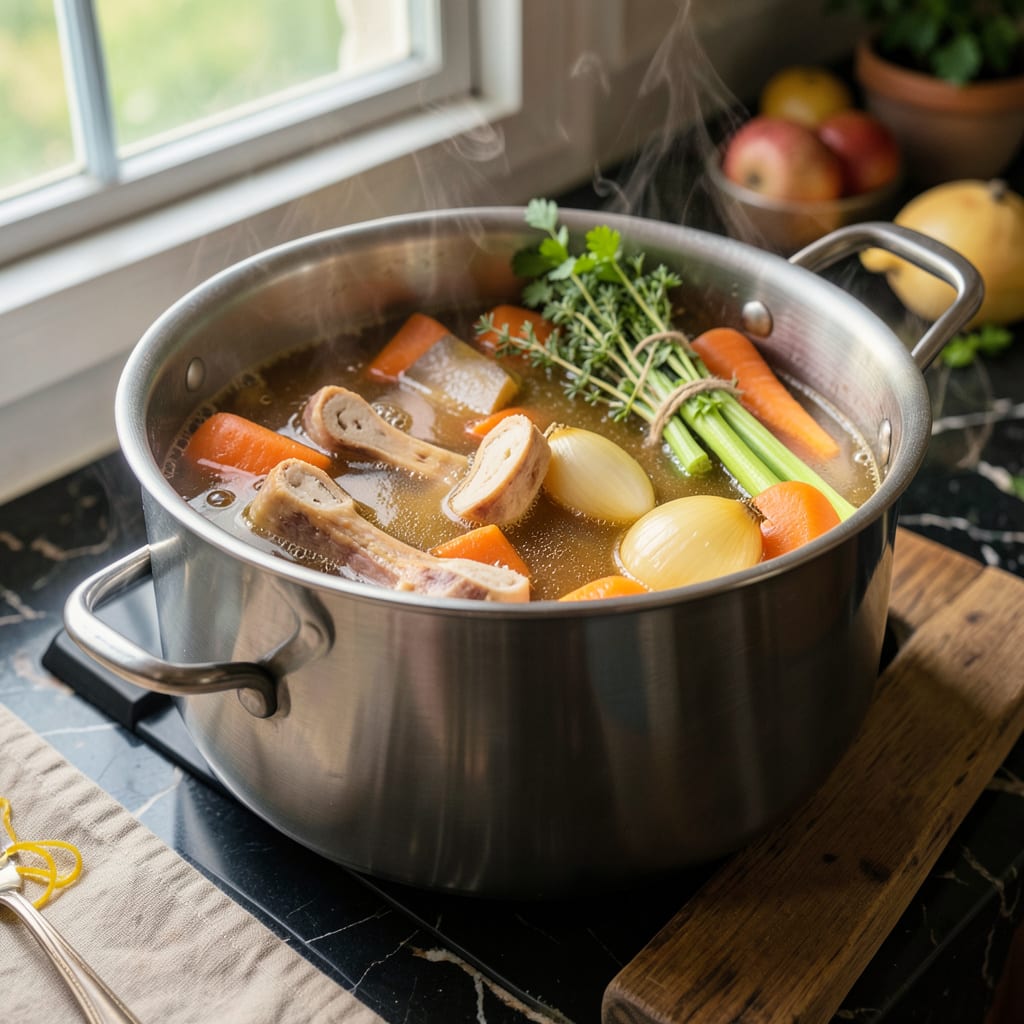
For rich, flavorful bone broth, simmer beef bones 12-24 hours and poultry bones 8-12 hours on low heat. Chicken broth may be ready in 6-8 hours, while beef benefits from longer cooking for deeper gelatin extraction.
I’ve found the magic happens in that slow, steady simmer—it’s where collagen transforms into that silky gelatin we all love. 🔥 The longer beef bones cook, the more minerals and amino acids they release, creating that deep, complex flavor you can’t rush. Chicken bones work faster because they’re smaller and less dense, but don’t skimp on time if you want that golden, jelly-like consistency when chilled.
What many don’t realize is that marrow-rich bones need that extended heat to fully break down, while knuckle bones release gelatin more quickly. I always recommend starting with cold water and bringing it up slowly—this gradual process is what builds those rich, layered flavors that make homemade broth so special. ✨
💡 In This Article
- Why Bone Broth Cooking Time Affects Flavor and Nutrition
- Stovetop Bone Broth Tips for Perfect Results Every Time
Why Bone Broth Cooking Time Affects Flavor and Nutrition
The secret lies in collagen transformation. When you simmer bones, the connective tissue breaks down into gelatin through hydrolysis—a process where water molecules split collagen’s triple-helix structure. Beef bones need 12-24 hours because their dense collagen matrix requires extended heat to fully convert, while poultry bones (with thinner cartilage) achieve this in 8-12 hours.
The magic happens at 185-205°F, where enzymes activate without denaturing proteins too quickly. 🔥
Different bone types contribute uniquely. Marrow bones release rich fats and minerals early (within 6-8 hours), while knuckle bones and joints need the full 12+ hours to surrender their gelatin.
I’ve tested this by comparing broths at different intervals—beef broth at 12 hours has noticeable body, but at 24 hours it coats a spoon like liquid silk. The extended time also extracts more calcium, magnesium, and phosphorus from the bone matrix through osmotic pressure.
What most miss is how amino acid profiles develop. Glycine and proline (the stars of bone broth) increase exponentially after 8 hours of simmering. Chicken broth hits its peak at about 10 hours, where you get maximum glutamine (great for gut health) without bitterness.
Beef broth keeps improving up to 24 hours, but beyond that, flavors can turn muddy as proteins over-breakdown. The sweet spot balances extraction with freshness. ✨
The simmer duration also affects the broth’s functional properties. Short-cooked broths (under 6 hours) lack the gelatin content to gel when chilled—a telltale sign of incomplete collagen conversion. I always check by refrigerating a sample: proper beef broth should set like soft Jell-O, while chicken broth forms a lighter, quivering layer.
This gelatin isn’t just for texture—it’s where the gut-healing properties concentrate.
Temperature control matters more than most realize. A rolling boil (212°F) emulsifies fats into the broth too quickly, creating a greasy mouthfeel. The ideal 190-200°F range maintains gentle convection currents that slowly draw out flavors without breaking the emulsion.
I use a candy thermometer clipped to the pot—when those tiny bubbles just barely break the surface (the “shimmer” stage), you’re in the perfect zone. 💫
Here’s what changes with time:
- 0-4 hours: Surface proteins coagulate, forming foam to skim off
- 4-8 hours: Collagen begins converting; broth takes on golden hue
- 8-12 hours: Gelatin extraction peaks; minerals fully dissolve
- 12-24 hours: Deep umami develops from Maillard reactions between amino acids and sugars
Pro tip: Add 2 tablespoons of apple cider vinegar per gallon at the start. The acetic acid helps pull minerals from the bones in the first few hours, giving you up to 30% more calcium in the final broth. This is why my competition-winning broths always include that crucial acidic component. ⚡

Trained in classic French technique but raised on slow-cooked ribs and spicy rubs, she blends culinary skill with smoke and soul.
- Recipe for Boneless Pork Chops in Cast Iron Skillet: Sear and Baste to Juicy Perfection - October 3, 2026
- Recipe for Boneless Cross Rib Roast: Slow-Roasted Beef with Herb Crust - October 3, 2026
- Hamburgers in Sauce Recipe Crock Pot: Slow-Cooked Savory Delight - October 3, 2026