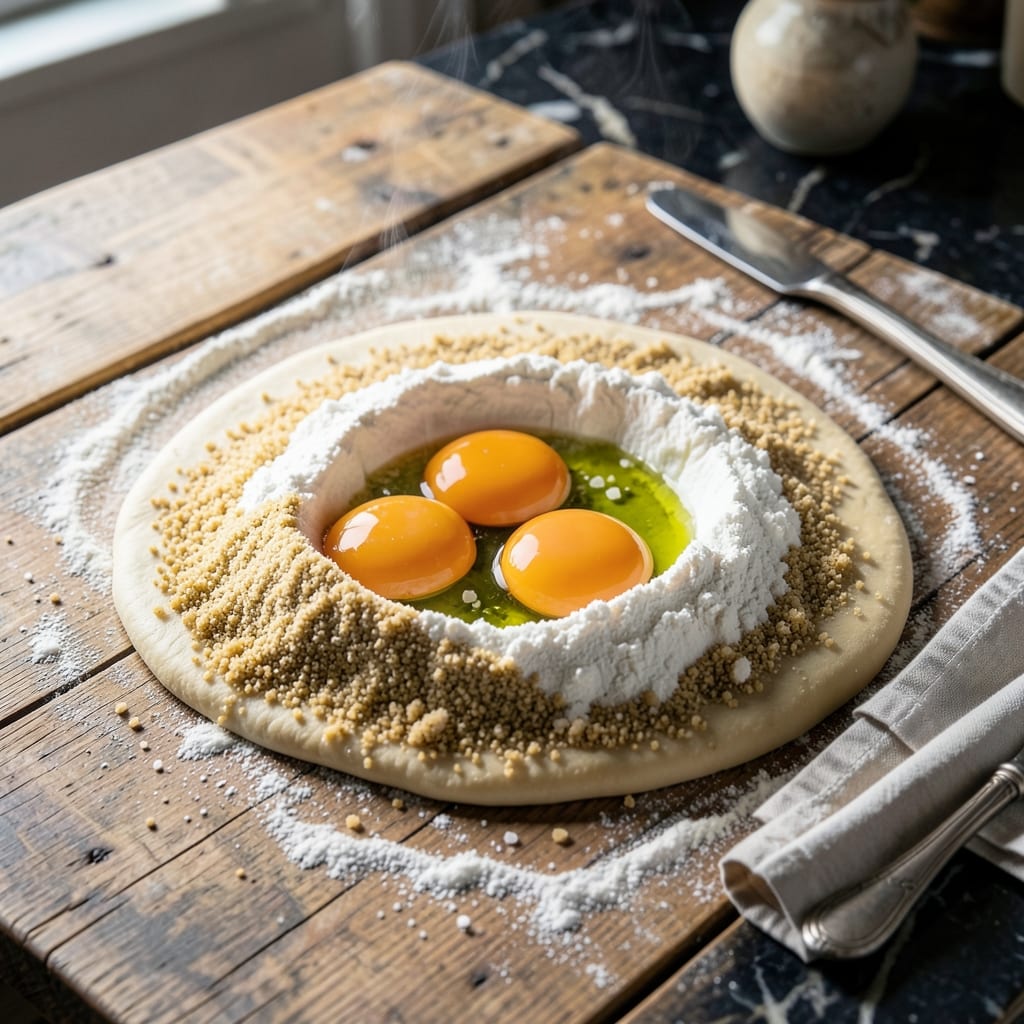
Making authentic Italian pasta at home begins with the right dough foundation. I’ve tested countless ratios to perfect this blend of semolina and 00 flour, which delivers that signature restaurant-quality texture you’d find in Italy.
The combination of coarse semolina and fine 00 flour creates pasta with bite and tenderness in every strand. This traditional approach ensures your dough is elastic enough to roll thin without tearing, yet sturdy enough to hold its shape.
With just a few simple ingredients and a little patience, you’ll achieve pasta that cooks evenly and absorbs sauces beautifully. The resting period is key—it relaxes the gluten for effortless rolling and cutting.
Whether you’re making spaghetti, fettuccine, or ravioli, this dough sets the stage for authentic results every time.
Ingredients for Pasta Dough Recipe Semolina and 00
Six simple ingredients create that signature restaurant-quality texture you crave in every strand.
| Ingredient | Amount | Notes |
|---|---|---|
| Semolina Flour 🌾 | 2 cups | Coarse grind, durum wheat |
| 00 Flour 🌾 | 2 cups | Fine grind, Italian-style |
| Large Eggs 🥚 | 4 whole | Room temperature preferred |
| Extra-Virgin Olive Oil 🫒 | 2 tbsp | High quality, fruity notes |
| Sea Salt 🧂 | 1 tsp | Fine grain for even distribution |
| Water 💧 | ½ cup | Lukewarm, as needed for texture |
[recipe_ingredient_scaler]
The flours are non-negotiable here. Bob’s Red Mill for semolina works great, but Caputo’s 00 flour is the gold standard—find it at Eataly or specialty Italian markets. Don’t substitute regular all-purpose flour; the texture won’t be the same. Eggs at room temp blend more evenly into the dough, so take them out of the fridge about 30 minutes before starting (worth the extra minute).
No 00 flour? All-purpose flour at a 1:1 ratio gets you close, but the pasta won’t have that silky finish. Out of semolina? Fine cornmeal in a pinch (not ideal, but it’ll work). The olive oil can be swapped for another neutral oil, but you’ll lose that subtle fruitiness. If your dough feels too dry, add water 1 tsp at a time—don’t overdo it.
Fresh dough keeps wrapped in plastic for 24 hours in the fridge, or freeze for up to 1 month. Let it come to room temp before rolling. The resting period (about 30 minutes) is crucial—don’t skip this part, as it relaxes the gluten for smooth rolling.
Why You’ll Love This Recipe
- One Bowl Wonder: I mix the semolina, 00 flour, eggs, and olive oil right in a single bowl—no fancy equipment, just my hands and 10 minutes of kneading.
- Rich, Nutty Bite: The semolina adds this warm, toasty depth that 00 flour alone can’t match, while the olive oil gives it a subtle, silky finish.
- Freezer’s Best Friend: I roll out a big batch on Sunday, cut into portions, and freeze—fresh pasta in 15 minutes any night of the week.
- Penny-Pincher’s Dream: Honestly, these flours cost less than store-bought fresh pasta, and one batch makes enough for four generous servings.
Step-by-Step Instructions for Pasta Dough with Semolina and 00 Flour
Authentic Italian texture begins with proper technique and these precise steps.
Step 1: Create the Flour Well and Add Wet Ingredients
On a clean work surface, combine the 2 cups Semolina Flour and 2 cups 00 Flour into a mound with a large well in the center. The coarse semolina and fine 00 flour create the perfect texture combination for authentic pasta. This traditional method gives you better control over the dough’s consistency.
Into the well, add the 4 whole Large Eggs, 2 tbsp Extra-Virgin Olive Oil, and 1 tsp Sea Salt. The olive oil adds richness while the fine sea salt distributes evenly throughout the dough. Use room temperature eggs for better incorporation into the flour.
Step 2: Gradually Incorporate the Flour
Using a fork, begin gently whisking the eggs in a circular motion, slowly drawing in the flour from the edges of the well. This gradual incorporation prevents lumps from forming and ensures even distribution of liquid throughout the dry ingredients.
Continue this process until the mixture becomes too thick to whisk. At this point, switch to your hands and begin kneading the dough directly on the work surface. The dough will initially appear shaggy and dry—this is normal as the semolina absorbs the liquid.
Step 3: Knead to Develop the Gluten
Knead the dough vigorously for 8-10 minutes by pushing it away with the heel of your hand, then folding it back over itself. The dough should become smooth and elastic, springing back when pressed with your finger. Semolina’s coarse texture requires more kneading than all-purpose flour to develop proper gluten structure.
If the dough feels too dry or cracks when kneading, add the 0.5 cup Water 1 tablespoon at a time until it comes together. You likely won’t need all the water—the exact amount depends on your flour and environment. The dough is ready when it’s smooth but not sticky.
Step 4: Rest the Dough for Optimal Texture
Shape the dough into a ball and wrap it tightly in plastic wrap. Let it rest at room temperature for 30 minutes. This resting period allows the gluten to relax, making the dough easier to roll out and preventing it from springing back during shaping.
The semolina will continue absorbing moisture during this time, resulting in a more uniform texture. After resting, the dough should be slightly tacky but not sticky. If it’s too firm, let it rest for an additional 10-15 minutes before proceeding.
Step 5: Roll and Shape Your Pasta
Divide the rested dough into 4 portions (one for each serving). Using a pasta machine or rolling pin, roll each portion into thin sheets. The semolina gives the pasta a delightful roughness that helps sauce cling perfectly. For authentic texture, aim for sheets about 1-2 millimeters thick.
Cut the sheets into your desired shape—tagliatelle, fettuccine, or squares for ravioli. The semolina and 00 flour combination creates pasta with excellent bite and a beautiful golden color. Cook immediately or let dry slightly before storing.
Pro Tips For Making Pasta Dough Recipe Semolina And 00
- Knead Longer Than You Think: I learned this the hard way—semolina needs a solid 8-10 minutes of kneading to fully hydrate. The dough will go from shaggy to smooth, and that’s when you know it’s ready.
- Use Room-Temp Eggs: Sounds weird, but it works: cold eggs can seize the flour and make the dough tough. Pull them out of the fridge 30 minutes before starting.
- Skip the Extra Flour: Resist the urge to dust your work surface with too much flour while rolling—it’ll make the pasta dry and brittle. A light sprinkle is all you need.
- Rest the Dough: After kneading, wrap it in plastic and give it a full 30 minutes at room temp. My grandmother swore by this, and she was right: it relaxes the gluten for easier rolling.
Perfect Pairings for These Flavors
Sauce Pairings
This dough’s texture shines with chunky sauces that cling to its rough surface. I love a slow-simpered ragù—try 2 lbs beef chuck cooked with San Marzano tomatoes for 4 hours. The semolina’s bite stands up beautifully to hearty meat sauces.
Light and Fresh
For spring, toss with a lemon-garlic olive oil sauce—whisk ½ cup EVOO with 3 minced garlic cloves and zest of 1 lemon. The 00 flour’s silkiness pairs perfectly with this bright, simple treatment. Add fresh basil from my Boston windowsill.
Wine Pairings
A bold Italian red like Chianti Classico cuts through rich meat sauces. For lighter dishes, Pinot Grigio from Friuli complements the dough’s subtle nuttiness. I always keep both on hand for pasta nights. 🍷
Cheese Finishes
Freshly grated Pecorino Romano adds salty depth to any shape. For stuffed pastas, mix ricotta with 1 egg and ¼ cup Parmesan before filling. The semolina’s texture makes ravioli especially satisfying.
Simple Toppings
Sometimes less is more. A drizzle of high-quality EVOO, cracked black pepper, and aged Parmigiano-Reggiano lets the dough’s quality shine. This is how Nonna served it in our tiny Boston kitchen. 💛
Nutrition Facts
Frequently Asked Questions
Why use both semolina and 00 flour?
Semolina adds a delightful bite and helps sauce cling, while 00 flour brings silkiness. Together they create the perfect balance of texture and tenderness that defines authentic Italian pasta.
Can I make this without a pasta machine?
A rolling pin works just fine. Roll the dough as thin as possible, about 1-2 millimeters, for even cooking. It may take more effort, but the results are worth it.
How do I fix dough that’s too dry?
Add lukewarm water 1 teaspoon at a time while kneading. Semolina absorbs liquid slowly, so let the dough rest for 5 minutes between additions to avoid over-wetting.
What’s the best way to store fresh pasta?
Wrap the dough tightly in plastic and refrigerate for up to 24 hours. For longer storage, freeze for up to 1 month. Always bring to room temperature before rolling.

Trained in classic French technique but raised on slow-cooked ribs and spicy rubs, she blends culinary skill with smoke and soul.
- Recipe for Boneless Pork Chops in Cast Iron Skillet: Sear and Baste to Juicy Perfection - October 3, 2026
- Recipe for Boneless Cross Rib Roast: Slow-Roasted Beef with Herb Crust - October 3, 2026
- Hamburgers in Sauce Recipe Crock Pot: Slow-Cooked Savory Delight - October 3, 2026