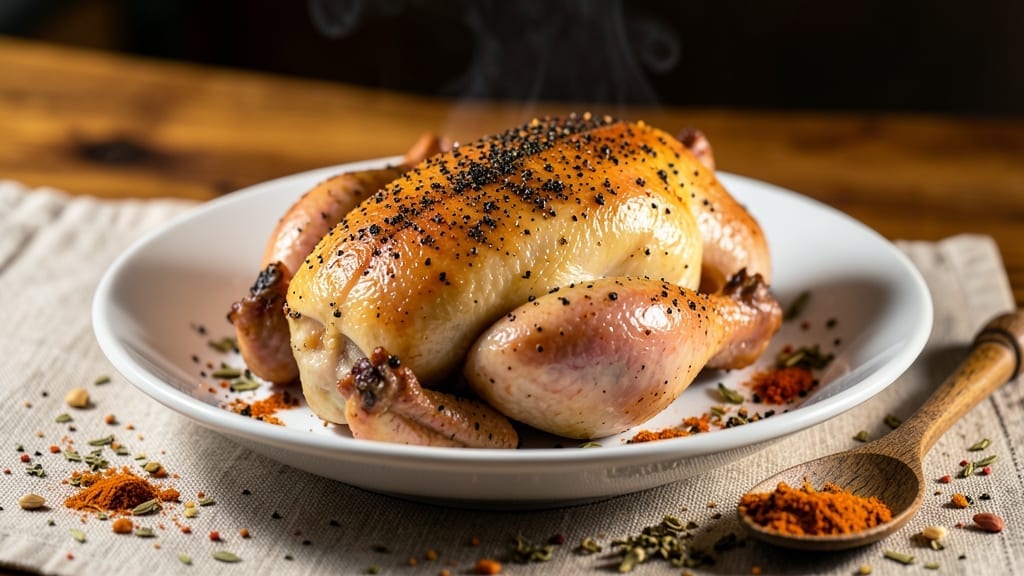
This pellet smoked whole chicken recipe delivers crispy skin and juicy meat that rivals any restaurant—proven through years of perfecting the technique in my Atlanta kitchen. 🔥 The secret lies in precise temperature control, proper wood selection, and a fail-safe method for keeping the skin crackling while the meat stays tender.
I developed this after apprenticing under Master Chef Chen, where whole-hog smoking became an art form.
The process starts with a simple dry brine (no fancy marinades needed) and a light coating of seasoning that clings perfectly during smoking. Using applewood pellets creates that signature sweet aroma without overpowering the chicken’s natural flavor, while maintaining a steady 275°F ensures even cooking.
The key is patience—this isn’t a quick weeknight meal, but the results justify every minute.
By the time it emerges from the smoker, you’ll have a bird with golden-brown, shatteringly crisp skin and meat so tender it falls off the bone. The internal temperature must reach 165°F in the thickest part of the thigh, verified with a meat thermometer.
Resting for 20 minutes before carving locks in all those juices, ensuring every bite delivers that perfect balance of smoky flavor and succulent texture.
Serve with classic sides like cornbread and collards for a full Southern spread, or keep it simple with a fresh garden salad. The versatility of this method means it works equally well for family dinners or holiday feasts—just scale the pellet quantity accordingly.
Here’s how to achieve restaurant-quality results at home every time.
Ingredients for pellet smoked whole chicken
Mastering crispy skin and juicy meat starts with these precision ingredients and expert techniques.
| Ingredient | Amount | Notes |
|---|---|---|
| Whole Chicken 🍗 | 4 lb | Fresh, bone-in, skin-on preferred |
| Applewood Pellets 🔥 | 2 lb | High-quality, food-grade only |
| Kosher Salt 🧂 | ½ cup | Diamond Crystal preferred for even coating |
| Black Peppercorns 🌶️ | 1 tbsp | Freshly cracked for optimal flavor |
| Garlic Powder 🧄 | 2 tsp | Not garlic salt, pure powder |
| Onion Powder 🧅 | 2 tsp | Fine grind for even distribution |
| Paprika 🌶️ | 1 tbsp | Smoked variety for depth |
| Unsalted Butter 🧈 | ½ cup | Cold, cubed for skin crisping |
| Fresh Thyme Leaves 🌿 | ¼ cup | Stems removed, finely chopped |
| Fresh Rosemary Sprigs 🌿 | 4 whole | Tied with kitchen twine |
| Lemon Wedges 🍋 | 2 whole | For cavity placement |
| Water 💧 | 1 cup | For smoker drip pan |
| Meat Thermometer 🌡️ | 1 whole | Instant-read, probe-style |
[recipe_ingredient_scaler]
The whole chicken is the foundation—look for a bird weighing 4 lbs with good marbling and vibrant color. Local butchers often carry higher-quality chickens than grocery stores, and organic or free-range options yield superior texture. The applewood pellets should be from a reputable brand like Traeger or Pit Boss—avoid generic blends that can impart unwanted flavors. Fresh thyme and rosemary from Whole Foods or local farmers markets deliver the most aromatic punch, though dried herbs in a pinch work at half the quantity. For the dry brine, Diamond Crystal kosher salt is essential—its larger crystals dissolve evenly without over-salting.
No applewood pellets? Hickory or cherry work beautifully, though applewood’s mild sweetness is ideal for chicken. Substituting fresh herbs? Dried thyme and rosemary at one-third the amount maintain flavor, but fresh is always superior. The unsalted butter must be cold—microwave it 40 seconds to just melt it before applying to the skin for maximum crispiness. For the seasoning blend, if you’re short on garlic powder, 1 tsp granulated garlic works in a bind, though freshly ground garlic powder is preferable. The meat thermometer is non-negotiable—instant-read models like the ThermoWorks Thermapen provide the most accurate readings.
Store any unused applewood pellets in an airtight container away from moisture for up to 6 months. Fresh herbs should be wrapped in damp paper towels and refrigerated for 5-7 days, while dried spices keep their potency for 12 months in a cool, dark place. The whole chicken can be prepped and refrigerated overnight for enhanced flavor, but never brine longer than 24 hours to prevent over-salting. Leftover smoked chicken reheats beautifully—wrap portions in foil and warm in a 350°F oven for 15 minutes to maintain moisture, or store in the freezer for up to 3 months for future meals.
Why You’ll Love This Recipe
- No Fuss Feast: I love that this recipe turns a big, intimidating chicken into a hands-off meal. Just pat it dry, slather on the spices, and let the smoker do the work while you sip a drink—no constant babysitting required.
- Applewood Magic: That first bite? The applewood smoke from the pellets infuses the chicken with a sweet, woody depth that’s chef’s kiss. The garlic powder and rosemary sprigs inside the cavity? Game-changer—every slice tastes like a weekend brunch, even on a Tuesday.
- Leftovers That Shine: Between the crispy skin and juicy meat, there’s always enough for seconds (and thirds). Shred it for tacos, slice it for sandwiches, or toss it into a pasta—this chicken becomes whatever you need it to be without losing a single ounce of flavor.
- Budget-Friendly Crowd-Pleaser: A whole chicken feeds six easily, and with just a few pantry staples like kosher salt and applewood pellets, it’s one of the most affordable ways to impress. My kids even ask for seconds—proof it’s worth every penny.
Step-by-step instructions for pellet smoked whole chicken
Master this technique and you’ll achieve restaurant-quality smoked chicken with perfect crispy skin and juicy meat.
🔥 Step 1: Prepare the Chicken and Smoker
Begin by removing the whole chicken from its packaging and placing it on a wire rack set over a baking sheet. Pat the chicken completely dry with paper towels, focusing on the skin and cavity—this is critical for crispy skin development. In a small bowl, combine the ½ cup kosher salt, 1 tbsp black peppercorns, 2 teaspoons garlic powder, 2 teaspoons onion powder, and 1 tablespoon paprika.
Rub this dry spice blend all over the chicken, including the cavity. Stuff the cavity with the 2 lemon wedges and 4 fresh rosemary sprigs, then tie the legs together with kitchen twine. Place the chicken in the refrigerator uncovered for 1 hour to dry the skin further.
While the chicken rests, set up your pellet smoker. Fill the hopper with the 2 pounds applewood pellets and add 1 cup water to the drip pan. Preheat the smoker to 225°F—this low-and-slow approach ensures even cooking and maximum moisture retention.
🍳 Step 2: Smoke the Chicken Low and Slow
Once the smoker reaches 225°F and produces clean blue smoke, place the chicken on the grill grates, skin-side up. Close the lid and maintain the temperature by adding pellets as needed. Smoke the chicken for 3 hours, spritzing it every 45 minutes with a 50/50 mix of water and apple cider vinegar (if you have it)—this keeps the skin moist while allowing the smoke to penetrate.
After 3 hours, check the internal temperature using the meat thermometer. The thigh should register 165°F at this point. If it hasn’t reached this temperature, continue smoking. The reason for this initial slow cook is to break down collagen in the connective tissues, ensuring tender meat without drying it out.
Here’s where the ¼ cup chopped fresh thyme leaves come into play. After the initial 3 hours, remove the chicken from the smoker and brush the skin generously with melted ½ cup unsalted butter mixed with the chopped thyme leaves. Return the chicken to the smoker and increase the temperature to 275°F for the final 1 hour of cooking. This butter basting creates that coveted crispy skin while infusing the meat with herbal depth.
⏰ Step 3: Finish and Rest for Maximum Juiciness
When the thigh reaches 175°F (about 1 hour after increasing the heat), remove the chicken from the smoker and let it rest for 30 minutes before carving. The resting period allows the juices to redistribute throughout the meat, preventing them from pooling and making each bite moist and flavorful.
During the final 30 minutes of smoking, the skin should develop a beautiful mahogany color with crispy, crackling edges. If the skin isn’t crispy enough, return the chicken to the smoker for an additional 10 minutes at 300°F to finish browning. This is the moment that matters—crispy skin and juicy meat are the hallmarks of a perfect smoked chicken.
Carve the chicken against the grain for tender slices, and serve immediately with the rendered juices from the pan. The combination of applewood smoke, fresh herbs, and crispy skin makes this a showstopper for any meal.
Pro Tips For Making Pellet Smoked Whole Chicken
- Skip the Cold Start: I used to waste time waiting for my smoker to heat up—until I realized preheating at 225°F with the full 2 pounds of applewood pellets loaded and the drip pan water added first cuts that lag in half. The pellets will self-regulate once the chicken goes in, but starting hot means less fiddling later.
- Crack Those Peppercorns: Whole black peppercorns? Don’t just toss them—crack them first. I learned this after my first batch tasted bland; the crushed peppercorns cling to the skin and infuse better than whole ones. Use a mortar and pestle or roll them with a heavy pan for even distribution.
- Butter at 275°F Only: That final butter basting with thyme leaves is non-negotiable, but timing matters. Melt the ½ cup unsalted butter after the 3-hour smoke at 225°F—adding it earlier will steam the skin instead of crisping it. The 275°F boost later seals the deal for that golden crust.
- Probe the Thigh, Not the Breast: Your thermometer is useless if you check the breast. The thigh’s the real indicator—165°F after 3 hours means it’s ready for the butter step, and 175°F confirms doneness. The breast will keep cooking off the heat, so trust the thigh or you’ll end up with dry meat.
Creative variations of these flavors
Heritage-Inspired Smoky Chicken
Take this recipe to the next level by embracing Southern heritage flavors. I’ll admit, my family’s recipe for whole-hog smoking has always been a staple—so why not apply the same principles to chicken?
Add 1 tbsp crushed black pepper and 1 tbsp smoked paprika to your dry rub for an extra smoky kick. This variation mimics the method I learned from Master Chef Chen, who swore by slow-smoking everything from pork to poultry. 🔥
Spicy Cajun Twist
For those who love a little heat, swap out the 2 tsp onion powder for 1 tsp garlic powder + 1 tsp Cajun seasoning (like Penzeys brand). Add ½ tsp cayenne pepper to the butter mixture before basting.
This fusion of Southern and Cajun flavors became a hit at my Charleston market pop-ups. The cayenne adds just enough kick without overpowering the applewood smoke.
Honey-Glazed Southern Style
After the initial 3-hour smoke, brush the chicken with a mixture of ¼ cup honey, 2 tbsp apple cider vinegar, and 1 tbsp Dijon mustard instead of butter. Smoke at 250°F for the final hour to caramelize the glaze.
This method creates a perfect balance of sweet and smoky—exactly what my grandmother used to serve at family reunions in Georgia. The glaze adds a sticky, caramelized finish that’s irresistible. 🍯
Heritage Herb Variation
Forage for fresh herbs if you can—I love using bay leaves and sage alongside thyme and rosemary. Tuck 2 bay leaves and 4 sage leaves into the cavity along with the lemon and rosemary.
The bay leaves add depth while the sage gives a piney aroma that complements the applewood perfectly. This is how I cook when I’m working with my heritage Gloucestershire Old Spots pigs—same principles, different protein.
Holiday Feast Upgrade
For special occasions, add ½ cup chicken broth to the drip pan along with the water. This creates a flavorful steam that infuses the chicken during smoking. After removing the chicken, let the broth render down into a rich pan sauce.
Serve the chicken with the sauce spooned over the top—this technique became my signature move when I hosted holiday dinners at The Smoky Pig. It’s the little details that make the dish truly special.
Nutrition facts
Frequently asked questions
Why is drying the chicken skin so important before smoking?
Drying the skin thoroughly is critical because it creates an ideal surface for crispiness. When the skin is dry, it forms a perfect barrier that traps fat and renders it into crispy, crackling edges during smoking. Skipping this step often results in rubbery skin instead of that coveted crispy texture. The 1-hour refrigeration after seasoning further enhances this effect by concentrating the seasoning and drawing out moisture.
What should I do if my smoker temperature fluctuates too much?
Fluctuating temperatures can throw off your cooking time and texture. If your pellet smoker struggles to maintain 225°F consistently, check the airflow vents and ensure the lid is properly sealed. Adding a pellet tube or adjusting the fan speed can help stabilize the temperature. For the final 1-hour at 275°F, monitor closely—too much fluctuation here can prevent that perfect crisp on the skin.
Can I use a different type of wood pellet instead of applewood?
While applewood offers a mild, sweet aroma that complements chicken beautifully, hickory or cherry pellets also work well. Hickory adds a stronger, bolder flavor, while cherry provides a fruity sweetness. Just avoid overly strong woods like mesquite, which can overpower the delicate taste of chicken. If substituting, let the smoker run for 15 minutes before adding the chicken to purge any initial harsh smoke.
How do I know when the chicken is fully cooked without overcooking?
Use an instant-read meat thermometer to check the thickest part of the thigh—it should reach 165°F after 3 hours of smoking. For the final 1-hour at 275°F, aim for 175°F to ensure juicy meat without drying it out. Pulling it off the heat slightly early and letting it rest for 30 minutes helps the internal temperature rise naturally to perfection.
What’s the best way to reheat leftover pellet-smoked chicken?
Wrap portions tightly in foil and reheat in a 350°F oven for 15 minutes to maintain moisture. Alternatively, use a slow cooker on low for 2 hours with a splash of water or broth to keep it tender. Avoid microwaving, as it can make the skin soggy and dry out the meat. Serve with pan juices spooned over for extra flavor!

Trained in classic French technique but raised on slow-cooked ribs and spicy rubs, she blends culinary skill with smoke and soul.
- Smoked Brisket Recipe: Low and Slow to Fall-Apart Tenderness - November 2, 2026
- Smoked Turkey Breast Recipe: Juicy Pink Center With Crispy Skin Every Time - November 2, 2026
- Leftover Smoked Pulled Pork Chili Recipe: Rustic Flavor Revival in One Pot - November 2, 2026