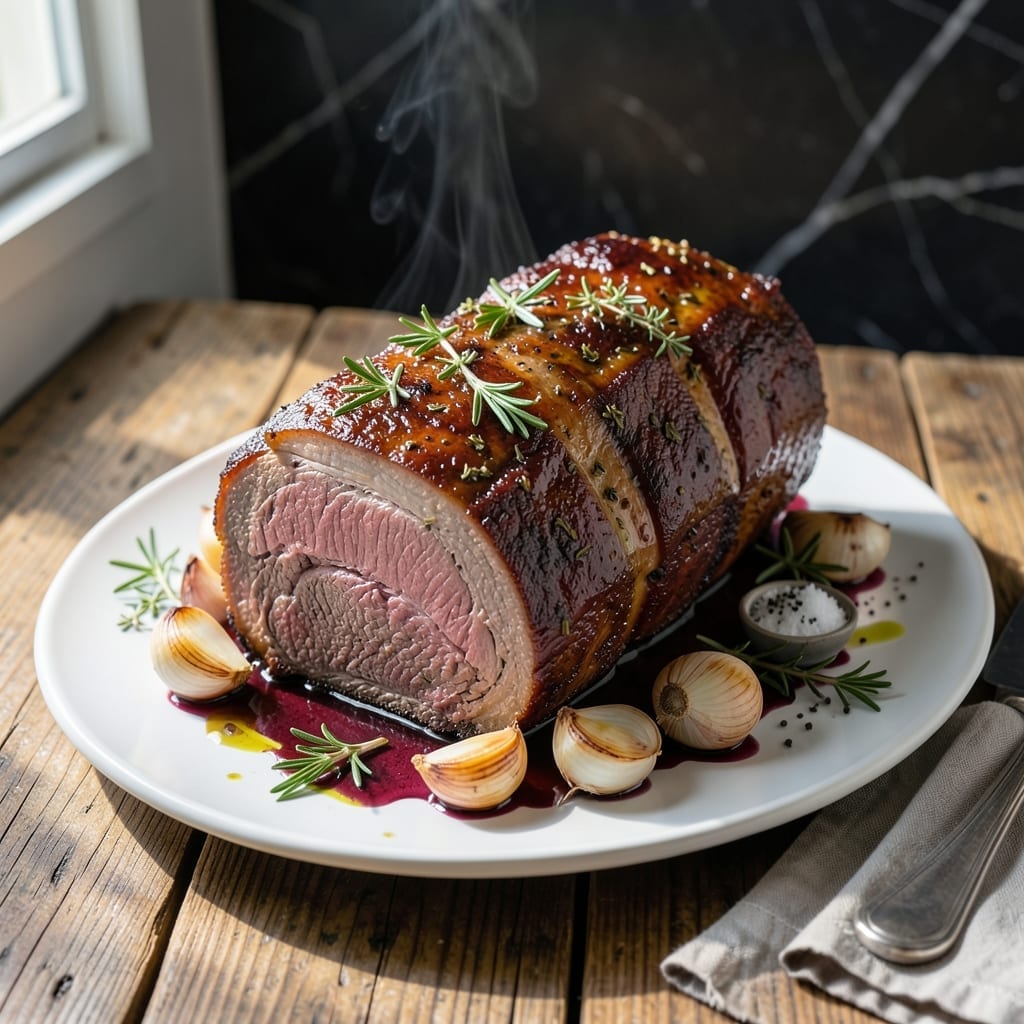
This bone-in prime rib delivers the succulent results your holiday table deserves. A simple herb crust enhances the beef’s natural richness without overpowering it.
With precise temperature control and proper resting time, you’ll achieve perfectly pink slices every time. This centerpiece requires minimal effort for maximum impression.
Ingredients for Prime Rib Roast Recipe Bone In
Quality beef and fresh herbs create this impressive holiday centerpiece with minimal effort.
| Ingredient | Amount | Notes |
|---|---|---|
| Bone-In Prime Rib Roast 🥩 | 6 lb | First 3 ribs, well-marbled |
| Kosher Salt 🧂 | 2 tbsp | Diamond Crystal preferred |
| Freshly Ground Black Pepper 🌶️ | 1 ½ tbsp | Coarse grind ideal |
| Fresh Rosemary 🌿 | 3 tbsp | Finely chopped, stems discarded |
| Fresh Thyme 🍃 | 2 tbsp | Leaves stripped from stems |
| Garlic Cloves 🧄 | 6 cloves | Minced to fine paste |
| Dijon Mustard 🟡 | 2 tbsp | Smooth, not whole grain |
| Extra-Virgin Olive Oil 🫒 | 3 tbsp | High quality, fruity notes |
| Unsalted Butter 🧈 | 4 tbsp | Softened to room temperature |
| Red Wine 🍷 | 1 cup | Dry variety like Cabernet |
| Beef Stock 🥣 | 2 cups | Low-sodium preferred |
| Yellow Onion 🧅 | 1 whole | Large, roughly chopped |
| Carrots 🥕 | 3 whole | Peeled, cut into chunks |
| Celery Stalks 🌿 | 3 pieces | Cut into large pieces |
[recipe_ingredient_scaler]
The prime rib is the star—look for USDA Prime or Choice with abundant marbling. Costco and Whole Foods have excellent options, but any good butcher will special-order if you ask ahead. Bone-in adds flavor and helps with even cooking. For the herbs, fresh is non-negotiable (dried won’t give that vibrant crust). Grab a bunch of each—they keep well wrapped in damp paper towels.
No red wine? Substitute beef broth with 1 tbsp balsamic vinegar. Fresh out of thyme? Use one-third the amount of dried. The Dijon can be swapped for whole-grain mustard if that’s what you have. For the stock, homemade is ideal, but Better Than Bouillon makes a solid store-bought version. Skip the pre-minced garlic—it lacks punch.
Rest the roast before carving (this keeps it juicy). Leftovers? Wrap tightly and refrigerate for up to 4 days, or freeze for 3 months. The herb paste can be made a day ahead—just bring it to room temperature before using.
Why You’ll Love This Recipe
- Set and Forget: I rub the roast with salt, pepper, rosemary, and thyme, pop it in the oven, and let the bone-in cut do all the work while I relax.
- Crusty Perfection: That deep brown crust from the rosemary and thyme? It gives way to the most tender, juicy beef I’ve ever carved.
- Holiday Hero: This is my showstopper for Christmas dinner—impressive enough for guests but unfussy enough for a quiet family meal.
- Leftovers for Days: Honestly, the sandwiches I make with the leftovers might be even better than the original meal.
Step-by-Step Instructions for Herb-Crusted Prime Rib Roast
This holiday-worthy method guarantees a perfectly cooked roast with a fragrant herb crust.
Step 1: Prepare the Herb Paste and Season the Roast
Remove the bone-in prime rib roast from the refrigerator 1 hour before cooking to bring it to room temperature. This ensures even cooking throughout. Pat it completely dry with paper towels—moisture prevents proper browning.
In a small bowl, combine the 2 tbsp Dijon mustard, 3 tbsp extra-virgin olive oil, 3 tbsp fresh rosemary, 2 tbsp fresh thyme, 6 cloves garlic cloves (minced to a paste), 2 tbsp kosher salt, and 1.5 tbsp freshly ground black pepper. Mix into a thick paste. Rub this mixture all over the roast, pressing firmly to adhere. The herbs should form a visible crust on the surface.
Step 2: Sear for a Flavorful Crust
Position a rack in the lower third of your oven and preheat to 450°F. Place the roast bone-side down on a rack in a roasting pan. This high-heat start creates a deeply browned, flavorful crust.
Roast at 450°F for 30 minutes. You’ll see the herb paste transform into a deep golden-brown crust. The surface should develop a rich, aromatic scent as the herbs toast and the mustard caramelizes.
Step 3: Slow-Roast to Perfection
Reduce the oven temperature to 325°F. Add the 1 whole yellow onion, 3 whole carrots, and 3 pieces celery stalks to the pan around the roast. These vegetables will flavor the pan drippings for a rich au jus.
Continue roasting for approximately 1.5 to 2 hours (for a 6 lb roast), or until an instant-read thermometer inserted into the thickest part of the meat (avoiding bone) reaches 125-130°F for medium-rare. The internal temperature will rise 5-10°F while resting.
Step 4: Rest and Prepare the Au Jus
Transfer the roast to a cutting board and tent loosely with foil. Let it rest for 20 to 30 minutes—this allows the juices to redistribute, ensuring every slice is moist and tender.
Place the roasting pan with vegetables on the stovetop over medium heat. Add the 1 cup red wine and deglaze, scraping up all browned bits with a wooden spoon. Simmer for 2 minutes, then add the 2 cups beef stock and 4 tbsp unsalted butter. Simmer for another 5 minutes until slightly thickened. Strain and serve alongside the sliced roast.
Step 5: Carve and Serve
To carve, slice between the ribs to separate them, then cut the meat into ½-inch thick slices. Serve immediately with the au jus. The roast should have a deeply browned herb crust outside and a rosy pink center inside.
The meat will be tender and juicy, with the herb aromatics complementing the rich beef flavor. This centerpiece is sure to impress at any holiday gathering.
Pro Tips For Making Prime Rib Roast Recipe Bone In
- Salt Overnight: Rub the roast with kosher salt at least 12 hours before cooking—this guarantees a deep seasoning and better crust. I learned this the hard way after serving bland prime rib to my in-laws.
- Room Temp Start: Pull the roast out of the fridge 2-3 hours before cooking so it cooks evenly. Sounds tedious, but it actually changes the outcome.
- Skip the Overcrowding: Use a roasting pan just big enough for the bone-in roast so the heat circulates properly. After burning three batches, I finally figured out my pan was the problem.
- Herb Under the Bone: Tuck sprigs of rosemary and thyme under the bone before roasting—it infuses flavor directly into the meat. My grandmother swore by this, and she was right.
Storing and Reheating This prime rib roast recipe bone in
Refrigerator Storage
Let your prime rib cool completely before storing. Wrap slices tightly in plastic wrap or place in airtight containers with some au jus to retain moisture. It will keep in the fridge at 40°F or below for up to 4 days. 🥩
Freezer Storage
For longer storage, wrap individual portions in heavy-duty foil then place in freezer bags. Squeeze out excess air to prevent freezer burn. This creation freezes beautifully for up to 3 months without losing quality.
Oven Reheating
Preheat oven to 300°F. Place slices in a baking dish, add ¼ cup beef stock, cover with foil, and heat for 15-20 minutes. This gentle method preserves the juicy texture you worked hard to achieve. ❄️
Au Jus Revival
If the au jus has thickened in storage, simply reheat it in a small saucepan over medium-low heat with a splash of water or wine. Simmer for 3-5 minutes until it reaches your desired consistency.
Microwave Option
For quick meals, place individual portions on a microwave-safe plate with a damp paper towel. Heat on 50% power for 1-2 minutes, checking frequently. This prevents the meat from becoming tough.
Nutrition Facts
Frequently Asked Questions
How do I know when it’s done cooking?
Use a meat thermometer inserted into the thickest part, avoiding the bone. It’s ready at 125-130°F for medium-rare. The temperature will rise 5-10°F while resting.
Should I cover it while roasting?
No, leave it uncovered to develop that flavorful herb crust. The high initial heat at 450°F creates the perfect sear before reducing to 325°F for slow roasting.
Can I use dried herbs instead of fresh?
Fresh herbs are ideal, but in a pinch use 1/3 the amount of dried. The flavor won’t be as vibrant, but it’ll still taste delicious.
Why does the roast need to rest?
Resting for 20-30 minutes lets juices redistribute. Slicing too soon causes all those precious juices to spill out, leaving the meat dry.

Trained in classic French technique but raised on slow-cooked ribs and spicy rubs, she blends culinary skill with smoke and soul.
- Recipe for Boneless Pork Chops in Cast Iron Skillet: Sear and Baste to Juicy Perfection - October 3, 2026
- Recipe for Boneless Cross Rib Roast: Slow-Roasted Beef with Herb Crust - October 3, 2026
- Hamburgers in Sauce Recipe Crock Pot: Slow-Cooked Savory Delight - October 3, 2026