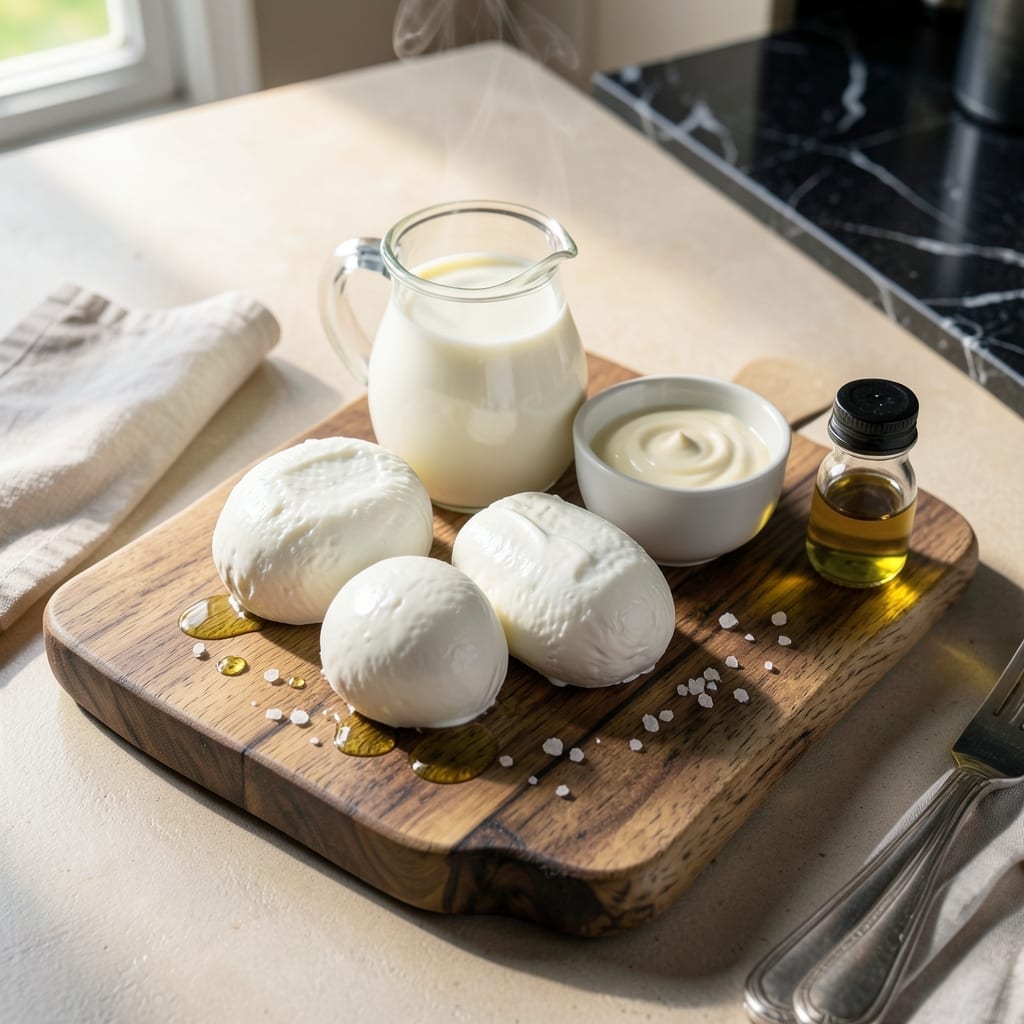
Making fresh mozzarella at home is simpler than you think, and the results are far superior to store-bought. This method delivers creamy, stretchy cheese with just a few ingredients and 30 minutes of active time.
The process involves heating milk with citric acid and rennet to create curds, which are then stretched in warm whey to achieve that signature elastic texture. The key is maintaining precise temperatures throughout each stage.
What emerges is homemade mozzarella with a delicate, milky flavor and the perfect balance of softness and stretch. It’s ideal for caprese salads, pizza, or enjoying fresh with tomatoes and basil.
No special equipment is required beyond a thermometer and a microwave-safe bowl. The freshness makes all the difference.
Ingredients for Recipe for Fresh Mozzarella
Eight ingredients transform into rich, stretchy cheese with minimal effort and maximum reward.
| Ingredient | Amount | Notes |
|---|---|---|
| Whole Milk 🥛 | 1 cup | Not ultra-pasteurized, full-fat required |
| Heavy Cream 🥛 | ½ cup | Full-fat for richness |
| Citric Acid 🧪 | 1 ½ tsp | Dissolved in water |
| Liquid Rennet 🧪 | ¼ tsp | Vegetarian rennet preferred |
| Distilled Water 💧 | ¼ cup | For dissolving citric acid |
| Kosher Salt 🧂 | 1 tsp | Non-iodized, for brining |
| Ice Cubes ❄️ | 2 cups | For cooling curds |
| Cheesecloth 🧻 | 1 sheet | For draining whey |
[recipe_ingredient_scaler]
The milk is critical here. Whole, non-ultra-pasteurized milk from Organic Valley or local dairies yields the best curds—avoid anything labeled ultra-pasteurized as it won’t set properly. Heavy cream boosts fat content for creamier texture. Citric acid and rennet are non-negotiable; New England Cheesemaking Supply offers high-quality vegetarian rennet. Precision matters, so use a kitchen thermometer for accurate temperature control throughout the process.
No rennet? Vegetable-based rennet tablets work at one-fourth the liquid amount. Out of whole milk? Half-and-half plus heavy cream (3:1 ratio) can substitute, though results may be slightly less stretchy. For a tangier flavor, add 1 tablespoon of buttermilk to the milk. The citric acid cannot be skipped—it’s essential for acidifying the milk to create proper curds.
Fresh mozzarella is best used immediately but can be stored in lightly salted whey in the fridge for up to 5 days. Do not freeze, as it will lose its signature texture. For the creamiest results, serve at room temperature—ideal for caprese salads or melting over warm pasta.
Why You’ll Love This Recipe
- Surprisingly Simple: I was shocked how just milk, cream, and a little citric acid can turn into mozzarella with barely any hands-on time.
- Melt-in-Your-Mouth Creamy: The freshness hits different—so soft and mild, it makes store-bought taste like plastic.
- Endless Meal Potential: Toss it on salads, melt it on pizza, or snack straight from the bowl. Honestly, it disappears fast.
- Budget-Friendly Luxury: A gallon of whole milk yields a pound of cheese for a fraction of the grocery store price.
Step-by-Step Instructions for Fresh Mozzarella
Master the technique of transforming whole milk and heavy cream into silky, stretchy cheese at home.
Step 1: Acidify the Milk Mixture
Combine the 1 cup Whole Milk and 0.5 cup Heavy Cream in a stainless steel pot. Stir in the 1.5 tsp Citric Acid dissolved in the 0.25 cup Distilled Water. Heat over medium heat while stirring gently until the mixture reaches 90°F.
You’ll notice the milk beginning to separate slightly—that’s the acid working. Maintain the 90°F temperature for 1-2 minutes to ensure proper acidification. This step creates the ideal environment for the rennet to work its magic in the next phase.
Step 2: Add Rennet and Form Curds
Remove the pot from heat and let it cool to 80°F. Add the 0.25 tsp Liquid Rennet and stir gently with an up-and-down motion for 30 seconds. Cover and let sit undisturbed for 5-8 minutes.
The mixture will transform into a firm, custard-like consistency. When you insert a clean knife and it comes out clean with a defined break, the curds are ready. This is the moment the milk solids separate from the whey—a critical transformation in cheese making.
Step 3: Cut and Cook the Curds
Using a long knife, cut the curds into ½-inch cubes. Return the pot to medium-low heat and warm the curds to 105°F, stirring gently to prevent sticking. Maintain this temperature for 5-10 minutes while continuing to stir.
You’ll see the curds begin to shrink and firm up as they release more whey. The texture should become springy and slightly rubbery when pressed between your fingers. This cooking process develops the proper moisture content for perfect stretching later.
Step 4: Drain and Stretch the Curds
Drain the curds through the 1 sheet Cheesecloth into a colander, reserving the whey. Transfer the drained curds to a microwave-safe bowl and microwave for 30-45 seconds. The curds should now be hot enough to stretch but not scalding.
Add the 1 tsp Kosher Salt and begin stretching the curds with your hands or a wooden spoon. If they resist, microwave for another 15-20 seconds. The curds will become glossy and elastic as you work them. Use the 2 cups Ice Cubes nearby to cool your hands if needed.
Step 5: Shape and Cool the Mozzarella
Once the curds are smooth and stretchy, shape them into a ball. If the cheese becomes too cool to work with, briefly microwave for 10-15 seconds to restore its stretchiness. The final texture should be silky and slightly tacky.
Submerge the shaped mozzarella in a bowl of ice water for 10-15 minutes to set its form. The finished cheese will be firm yet yielding, with a delicate milky flavor and the signature stretch that defines fresh mozzarella. Store in the reserved whey in the refrigerator for up to 1 week.
Pro Tips For Making Recipe For Fresh Mozzarella
- Use Ultra-Pasteurized Milk: Skip raw or regular pasteurized milk—ultra-pasteurized gives the cleanest, most reliable curd formation, and I learned this the hard way after three failed batches with organic milk.
- Keep Rennet Cold: Always dilute liquid rennet in cold distilled water (about 1/4 cup) before adding it to warm milk—adding it straight can shock the milk and ruin the set.
- Maintain 90°F: After adding rennet, hold the milk at exactly 90°F for 5-10 minutes; even a few degrees off can prevent a clean break, and yes, I’ve ruined curds by rushing this.
- Stretch at 135°F: When heating the curds for stretching, use a thermometer to hit 135°F—any hotter and the mozzarella turns tough, any cooler and it won’t stretch. Sounds fussy, but it works.
Troubleshooting Great recipe for fresh mozzarella
Curds Not Forming
If your milk isn’t setting into curds, the temperature might be off. Ensure it hits exactly 90°F during acidification and 80°F when adding rennet. Also, check your milk isn’t ultra-pasteurized—this is the most common culprit. I learned this the hard way with my first batch! 💡
Weak Stretch
If your curds won’t stretch, they might be too cool. Microwave them for 15-20 seconds longer until they reach 135°F internally. The whey should be hot enough to work with but not boiling. Using ice cubes to cool your hands helps maintain control while stretching.
Grainy Texture
Graininess often means the curds were overcooked during the stretching phase. Keep the temperature between 130-135°F while working. If it happens, try working the curds more gently next time. The texture should be smooth and elastic, not gritty.
Too Salty
If your cheese is overly salty, you may have added too much Kosher Salt during stretching. Start with ½ tsp and adjust to taste. Remember, the cheese will absorb more salt if stored in the whey. I prefer to salt lightly and add more when serving. 🧂
Milk Not Coagulating
If the milk isn’t thickening after adding rennet, your rennet might be old or the milk might be too cold. Always use fresh Liquid Rennet and ensure the milk is exactly 80°F. Stirring too vigorously after adding rennet can also prevent proper coagulation.
Storage Issues
If your mozzarella becomes rubbery in the fridge, it’s likely drying out. Store it submerged in the reserved whey in an airtight container. This keeps it fresh and maintains the perfect texture for up to 5 days. Change the whey daily for best results.
Nutrition Facts
Frequently Asked Questions
What kind of milk works best?
Use whole, non-ultra-pasteurized milk for best results. Ultra-pasteurized won’t set properly. Brands like Organic Valley work well. Avoid skim or low-fat options.
Can I make this without rennet?
Vegetable-based rennet tablets work as a substitute. Use ¼ tablet dissolved in water for each ¼ tsp liquid rennet in the recipe. Results may vary slightly.
Why isn’t my cheese stretching?
Curds need to be 130-135°F to stretch properly. If too cool, microwave for 15-20 seconds longer. Overheating or underworking can also cause issues.
How long does homemade mozzarella last?
Store in lightly salted whey in the fridge for up to 5 days. For best texture, use within 2-3 days. Do not freeze.

Trained in classic French technique but raised on slow-cooked ribs and spicy rubs, she blends culinary skill with smoke and soul.
- Best Smoked Oxtail Recipe: Deep-Rich Flavor After Low-and-Slow Cooking - October 14, 2026
- Pit Boss Smoked Prime Rib Roast Recipe: Bark-to-Bone Crispness in 4 Hours - October 14, 2026
- Smoked Tuna Steak Recipe: Seared Crust Meets Silky Centers - October 14, 2026