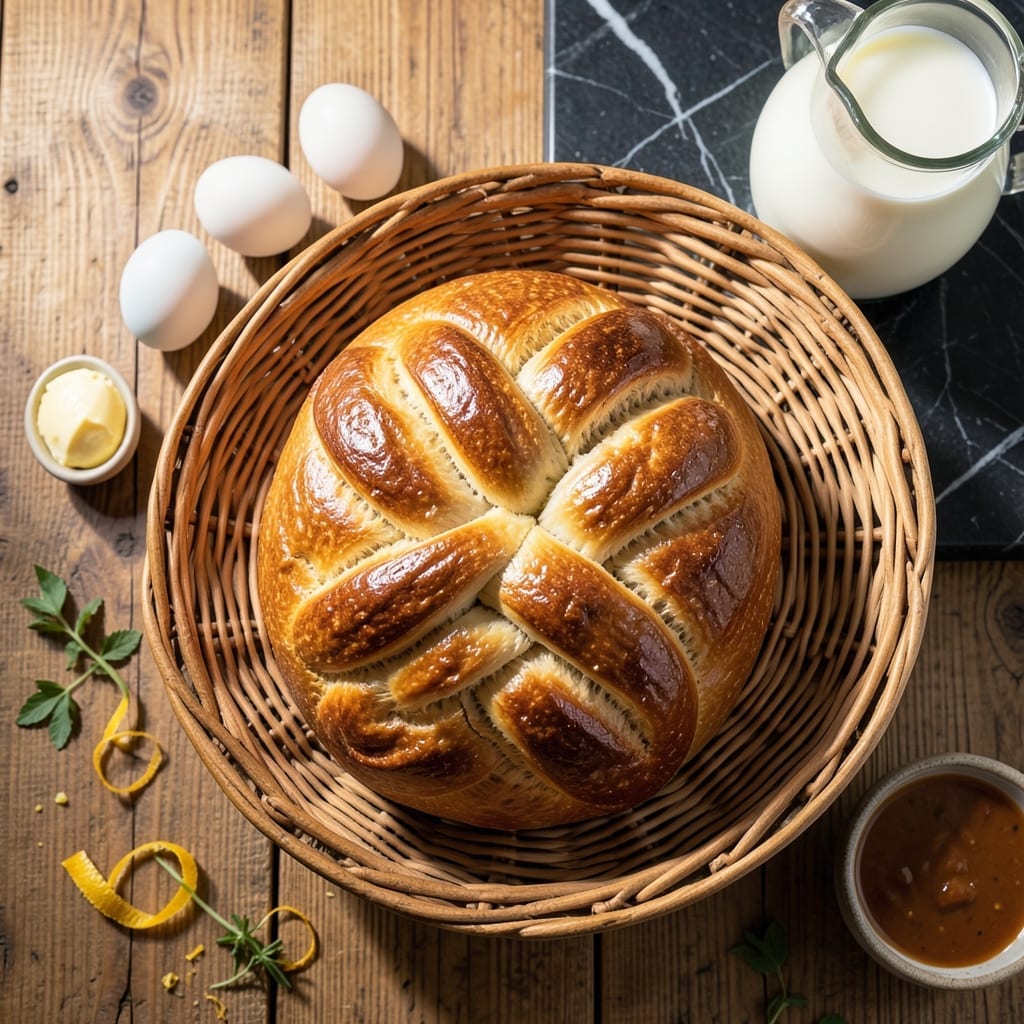
This traditional Greek Easter bread brings sweet, aromatic flavors to your holiday table. The braided dough, enriched with eggs and butter, creates a tender crumb that’s lightly spiced with cardamom or mahlep.
Perfect for sharing with family, this recipe delivers a golden, sweet loaf that’s as beautiful as it is delicious. The braiding technique ensures even baking and an impressive presentation.
Ingredients for Recipe for Tsoureki Bread
Incredibly soft and aromatic, this traditional bread requires quality ingredients for its signature richness and spice.
| Ingredient | Amount | Notes |
|---|---|---|
| All-Purpose Flour 🌾 | 4 cups | Plus extra for dusting work surface |
| Granulated Sugar 🍚 | ¾ cup | Divided for dough and topping |
| Unsalted Butter 🧈 | ½ cup | Melted and cooled slightly |
| Whole Milk 🥛 | ¾ cup | Warmed to 110°F |
| Large Eggs 🥚 | 3 whole | Room temperature, divided |
| Active Dry Yeast 🍞 | 2 ¼ tsp | One packet, proofed in milk |
| Ground Cardamom 🌿 | 1 tsp | Freshly ground preferred |
| Mahlep 🌿 | ½ tsp | Optional, traditional Greek spice |
| Vanilla Extract 💧 | 1 tsp | Pure extract recommended |
| Orange Zest 🍊 | 1 tbsp | Finely grated from fresh orange |
| Salt 🧂 | 1 tsp | Fine sea salt |
| Sesame Seeds 🌰 | 2 tbsp | For topping, optional |
| Hard Red Easter Eggs 🥚 | 3 whole | Dyed red, traditional decoration |
[recipe_ingredient_scaler]
The flour and butter are foundational. King Arthur all-purpose flour yields consistent texture, while European-style butter (like Plugrá) adds superior richness to the dough. The cardamom and mahlep—sourced from Penzeys or Middle Eastern markets—deliver authentic Greek flavor. Ensure your yeast is fresh; expired packets won’t activate properly in the warmed milk.
No mahlep? One-quarter teaspoon ground nutmeg offers a similar warmth. Substitute whole wheat pastry flour for up to half the all-purpose if desired, but texture will be denser. For a richer dough, heavy cream can replace the milk. The orange zest is flexible—lemon zest works equally well for a brighter citrus note.
The braided loaf keeps well wrapped at room temperature for 3 days, or freeze for 1 month. Revive day-old bread by warming briefly in a 300°F oven. Dyed eggs are decorative only and should be discarded after display.
Why You’ll Love This Recipe
- One Bowl Wonder: The dough comes together in a single bowl—no fancy equipment, just a wooden spoon and those simple pantry staples like flour, eggs, and butter.
- Rich, Sweet Comfort: Honestly, the buttery richness from the milk and sugar gives it that slightly sweet, tender crumb that’s impossible to resist.
- Holiday or Tuesday: I’ve made this for Easter morning and also just because—it’s as fitting for a celebration as it is for a lazy weekend breakfast.
- Stays Fresh for Days: Baked with eggs and milk, this loaf stays soft and delicious for nearly a week, so I can slice as needed without waste.
Step-by-Step Instructions for Tsoureki Bread
Master the technique for this traditional Greek Easter bread with perfect texture and flavor.
Step 1: Activate the Yeast and Prepare Wet Ingredients
Warm the 0.75 cup whole milk to exactly 110°F—this is the optimal temperature to activate yeast without killing it. I use an instant-read thermometer for precision. Stir in the 2.25 tsp active dry yeast and let it sit for 5-7 minutes until frothy.
Meanwhile, whisk together 3 whole large eggs (reserving one for egg wash), the 0.75 cup granulated sugar, 0.5 cup unsalted butter (melted and cooled), 1 tsp vanilla extract, 1 tbsp orange zest, 1 tsp ground cardamom, and 0.5 tsp mahlep. The mixture should be smooth and fragrant, with the citrus notes from the orange zest coming through.
Step 2: Combine Wet and Dry Ingredients into a Dough
In a large mixing bowl, combine the 4 cups all-purpose flour and 1 tsp salt. Make a well in the center and pour in the yeast mixture and the egg-sugar mixture. Using a wooden spoon or dough whisk, combine until a shaggy dough forms.
Turn the dough out onto a lightly floured surface and knead for 8-10 minutes by hand, or 6-8 minutes in a stand mixer with the dough hook attachment. The dough should become smooth, elastic, and slightly tacky but not sticky. If it’s too wet, add 1 tablespoon all-purpose flour at a time; if too dry, add 1 teaspoon whole milk.
Step 3: First Rise Until Doubled in Size
Place the kneaded dough in a lightly greased bowl, turning once to coat. Cover with a clean kitchen towel and let it rise in a warm, draft-free place for 1.5-2 hours, or until doubled in volume. I like to place mine near (but not on) a preheating oven for consistent warmth.
The dough is ready when it springs back slowly when pressed lightly with a finger, leaving a slight indentation. This indicates the yeast has properly fermented the sugars, creating the airy texture essential for tsoureki.
Step 4: Shape, Braid, and Second Rise
Punch down the risen dough to release the air, then divide it into 3 equal portions. Roll each portion into a 20-inch long rope, tapering the ends slightly. Place the ropes side by side on a parchment-lined baking sheet and braid them loosely, pinching the ends to seal.
Tuck the 3 whole hard red Easter eggs (dyed red) gently into the braids at even intervals—they should be partially visible but well-supported by the dough. Cover loosely with plastic wrap and let rise for another 1-1.5 hours until puffy and nearly doubled. The eggs will rise with the dough, creating the traditional presentation.
Step 5: Bake to Golden Perfection
Preheat the oven to 350°F. Brush the risen loaf with the reserved egg (mixed with 1 tablespoon whole milk for a thinner wash), then sprinkle evenly with 2 tbsp sesame seeds. Bake for 25-30 minutes, or until the top is deep golden brown and the internal temperature reaches 190°F.
If the top browns too quickly, tent with foil. The loaf should sound hollow when tapped on the bottom. Transfer to a wire rack and let cool completely before slicing—this prevents the bread from becoming gummy. The finished tsoureki will have a slightly sweet, aromatic flavor with a tender, fluffy crumb.
Pro Tips For Making Recipe For Tsoureki Bread
- Warm Your Milk: Heat the whole milk to about 110°F before mixing with yeast—too hot kills the yeast, too cold slows activation. I learned this the hard way after a few dense loaves.
- Soften Butter Right: Use unsalted butter that’s soft but not melted—press your finger into it and it should leave a slight indent. Sounds weird, but it works for even mixing.
- Skip Cold Eggs: Take your large eggs out of the fridge 30 minutes before starting, or soak in warm water for 10 minutes. Cold eggs can cause the butter to clump.
- Knead Long Enough: Don’t rush the kneading—give it at least 10-12 minutes until the dough is smooth and elastic. My first few attempts were under-kneaded and turned out tough.
Dietary Considerations for This Recipe
Vegetarian-Friendly
This recipe is naturally vegetarian, with no meat or animal byproducts in the dough. The richness comes from eggs, butter, and milk, which are all vegetarian staples. It’s perfect for meat-free celebrations. 💛
Dairy-Free Adaptations
For a dairy-free version, replace whole milk with unsweetened almond milk and use vegan butter like Miyoko’s. The texture may be slightly denser, but the flavors remain authentic.
Egg-Free Option
To make this egg-free, substitute 3 flax eggs (mix 3 tbsp ground flaxseed with 9 tbsp water). Skip the egg wash and use olive oil for brushing before baking.
Gluten-Free Version
Use a 1:1 gluten-free flour blend like Bob’s Red Mill. Add 1 tsp xanthan gum if not already included. The dough will be stickier, so knead carefully. 🌾
Nut Allergy Note
This recipe is nut-free as written. However, if adapting with nut-based alternatives (like almond milk), ensure all ingredients are processed in nut-free facilities to avoid cross-contamination.
Sugar Considerations
For lower sugar, reduce the granulated sugar to ½ cup. The bread will be less sweet but still aromatic. I’ve tested this with success for those watching their sugar intake.
Nutrition Facts
Frequently Asked Questions
What makes the bread so fragrant?
The unique aroma comes from cardamom and mahlep, traditional Greek spices. The orange zest adds a bright citrus note that complements the warmth of the spices perfectly.
How long should I knead the dough?
Knead for 8-10 minutes by hand or 6-8 minutes in a stand mixer. The dough is ready when it’s smooth, elastic, and slightly tacky but not sticky.
Can I make this without red eggs?
The red eggs are traditional for Easter but optional. Simply braid the dough without them for a beautiful loaf that still tastes authentic.
How do I know when it’s done baking?
The loaf should be deep golden brown with an internal temperature of 190°F. It should sound hollow when tapped on the bottom.

Trained in classic French technique but raised on slow-cooked ribs and spicy rubs, she blends culinary skill with smoke and soul.
- Recipe for Fried Pork Chops With Flour: Crispy Crust and Juicy Centers - October 3, 2026
- Octopus Recipe Pan Fried: Crispy Edges With Tender Bites - October 3, 2026
- Recipe For Fried Pork Chops In An Iron Skillet: Crispy Crust With Juicy Centers - October 3, 2026