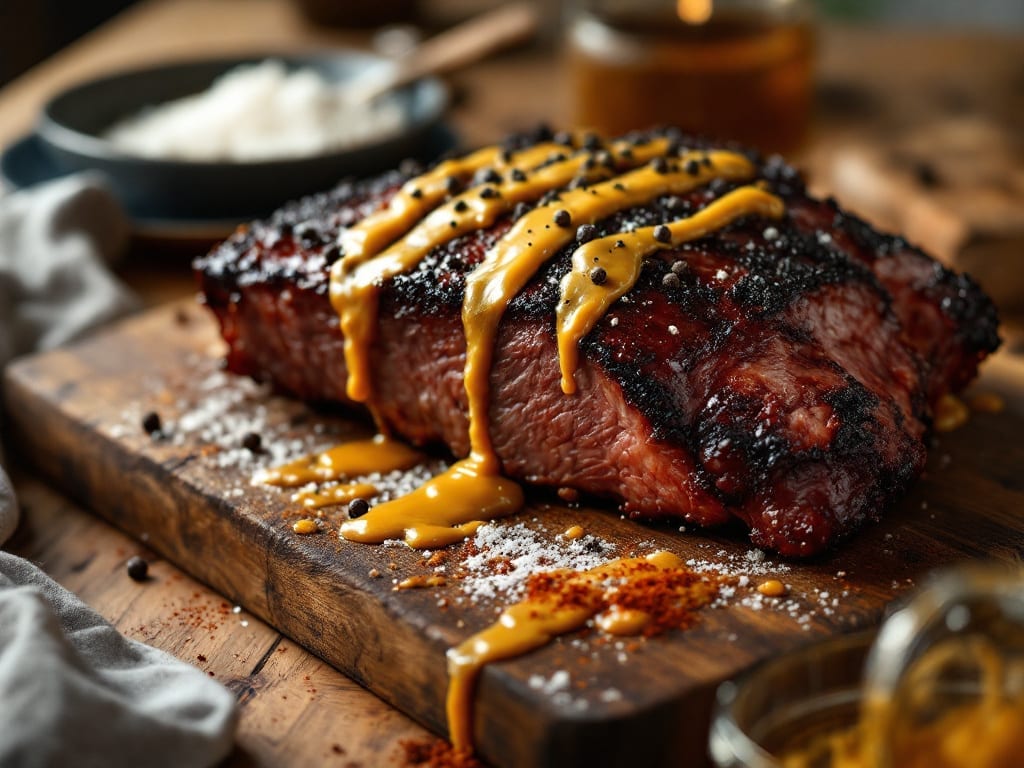
Mastering slow smoked beef brisket transforms tough cuts into melt-in-your-mouth perfection with a crackling bark that defies expectations. This recipe delivers restaurant-quality tenderness using time-tested techniques that balance patience with precision—no shortcuts, just proven results that impress even seasoned pitmasters.
The secret lies in temperature control, wood selection, and letting the meat work its magic over hours, not minutes.
We start with a well-trimmed brisket, generously coated in a dry rub that develops deep, smoky flavors while creating that coveted crust.
The smoking process itself is where the magic happens: maintaining 225°F for 12-16 hours ensures even cooking without drying out the meat, while hickory or oak wood chips infuse rich, traditional aromatics. Internal temperature checks at 195°F-203°F guarantee fork-tender results every time.
What you’ll end up with is a brisket so tender it practically falls apart at the touch, with a bark so crisp it shatters under pressure. The meat stays juicy and flavorful from edge to edge, and the aroma alone will have your kitchen smelling like a Texas BBQ joint.
This isn’t just dinner—it’s an experience that turns weeknights into special occasions.
Serve with classic sides like smoked potatoes, coleslaw, and cornbread for the full Southern BBQ spread. The leftovers? Even better the next day, making this the ultimate meal for crowds or meal prep. Let’s get started on creating your showstopper brisket.
Ingredients for slow smoked beef brisket
Sixteen ingredients, twelve hours, one unforgettable brisket that delivers restaurant-quality bark and melt-in-your-mouth tenderness.
| Ingredient | Amount | Notes |
|---|---|---|
| Beef Brisket 🥩 | 8 lb | Whole packer cut, fat cap intact |
| Yellow Mustard 🍯 | ½ cup | For bark adhesion layer |
| Coarse Kosher Salt 🧂 | ½ cup | Diamond Crystal preferred |
| Black Peppercorns 🌶️ | ¼ cup | Freshly cracked coarse |
| Smoked Paprika 🌶️ | ¼ cup | High-quality for deep color |
| Garlic Powder 🧄 | 2 tbsp | Freshly ground preferred |
| Onion Powder 🧅 | 2 tbsp | No added MSG |
| Ground Cumin 🌿 | 1 tbsp | Toasted for depth |
| Brown Sugar 🍯 | ¼ cup | Light or dark preferred |
| Chopped Hickory Wood Chips 🌳 | 4 lb | 100% pure, no fillers |
| Apple Juice 🍎 | ½ cup | For spritzing during cook |
| Beef Stock 🍲 | 1 cup | Homemade or high-quality |
| Yellow Onion 🧅 | 1 whole | Quartered for wood chip soak |
| Fresh Rosemary 🌿 | ¼ cup | Chopped, sprig form works |
[recipe_ingredient_scaler]
The brisket is non-negotiable here. Whole packer cuts from Costco or local butchers give you the best marbling and fat cap for flavor and moisture. Look for bright red, not grayish meat—USDA Choice or Prime is ideal, but Select works in a pinch. Trim excess fat to 1/4-inch thickness but leave that fat cap intact for flavor. The wood chips? 100% pure hickory from Traeger or Pit Barrel Cookers ensures authentic smoke flavor without bitter aftertaste. Soak them in water with the onion and rosemary for 30 minutes minimum before using.
No hickory wood chips? Oak works beautifully—just double the amount. Running out of apple juice for spritzing? White grape juice or even water keeps the bark from drying out. The beef stock isn’t just for flavor—it helps maintain moisture during the long cook. Homemade is best, but Annie’s or Pacific Foods brands are solid grocery store options. The spices? Penzeys or bulk bins for the freshest grind—pre-ground spices lose potency fast. And that brown sugar? Light or dark works, but avoid powdered sugar unless you’re desperate.
Brisket stays at its peak for 5 days in the fridge, wrapped tightly in butcher paper. For longer storage, vacuum-seal portions and freeze for up to 6 months. The bark gets even better after resting 2 hours—don’t skip this. I always make double batches because the leftovers? Even more tender the next day. Store the wood chips in a sealed container in the fridge once opened—they’ll stay good for up to 6 months. And that dry rub? Make extra—it keeps for 3 months in an airtight container.
Why You’ll Love This Recipe
- Set-It-Forgot-It Magic: I rub the brisket with coarse salt, cracked peppercorns, and smoked paprika—then let the smoker do all the work. No hovering, no stress, just that deep, smoky aroma filling the house while I sip my coffee and pretend I’m not cooking.
- Mustard-Crusted Perfection: The yellow mustard isn’t just a binder—it caramelizes into a sticky, tangy crust that cracks open like bark. That’s the moment you know you’ve hit the jackpot: tender meat with a flavor bomb of smoky-sweet heat in every bite.
- Leftovers That Save Me: This brisket practically begs to be made in bulk. Shred it for tacos, sandwiches, or even breakfast hash the next day. Honestly, I’ve eaten it cold in a wrap three days later, and it’s still the star of the meal.
- Budget-Friendly Crowd-Pleaser: A whole packer of brisket feeds my family for days, and the spices cost pennies. Smoked paprika and salt? That’s it for the fancy stuff. It’s the kind of meal where everyone’s happy, and my wallet isn’t crying. Win-win.
Step-by-step instructions for slow smoked beef brisket
Here’s the method that delivers melt-in-your-mouth tenderness with that coveted crackling bark.
Prepare the Brisket and Rub
Begin by trimming the fat cap of the 8 lb beef brisket to about ¼-inch thickness using a sharp boning knife. Leave the fat on the edges to protect the meat during smoking. Pat the entire surface completely dry with paper towels—this is crucial for bark formation.
In a large bowl, combine the 0.5 cup coarse kosher salt, 0.25 cup freshly cracked black peppercorns, 0.25 cup smoked paprika, 2 tbsp garlic powder, 2 tbsp onion powder, 1 tbsp ground cumin, and 0.25 cup brown sugar. Mix thoroughly to create an even blend. Spread the 0.5 cup yellow mustard on the brisket, then press the spice rub firmly into every surface, including the fat cap. The mustard acts as a binder for maximum adhesion.
Place the brisket on a wire rack set over a baking sheet and refrigerate uncovered for 12-24 hours. This dry-brining process ensures deep flavor penetration and prevents the rub from falling off during smoking. The brisket will develop a slightly tacky surface—this is normal and indicates proper preparation.
Set Up the Smoker
Soak the 4 lb chopped hickory wood chips in water for at least 30 minutes, then drain. Quarter the 1 whole yellow onion and add it to the soaking water for additional flavor. Fill the smoker’s wood chip tray with the soaked mixture and preheat to 225°F using indirect heat.
Once the smoker reaches temperature, place the brisket fat-side up on the grill grate. Position it away from direct heat to maintain consistent, low-and-slow cooking. You’ll want to see clean, blue smoke without thick white vapor—this indicates proper combustion and optimal flavor development.
Resist the urge to open the smoker during the first 2 hours. Each time you peek, you lose valuable heat and moisture. Instead, use a remote thermometer to monitor the internal temperature without disturbing the cook.
Smoke to the Stall
Smoke the brisket undisturbed for 6-8 hours until the internal temperature reaches 165-170°F. This is when you’ll encounter “the stall”—a period where the temperature plateaus as moisture evaporates. Don’t panic; this is normal physics in action.
Prepare a large piece of pink butcher paper and a spray bottle with equal parts of the 0.5 cup apple juice and 1 cup beef stock. When the brisket hits the stall, remove it from the smoker, wrap it tightly in the butcher paper, and spritz it generously with the apple juice-beef stock mixture. This “Texas crutch” technique helps power through the stall while preserving that coveted bark.
Return the wrapped brisket to the smoker and continue cooking until the internal temperature reaches 203°F. The probe should slide in like butter with no resistance—this indicates perfect tenderness. Total cooking time typically ranges from 12-16 hours, depending on your smoker’s efficiency.
Rest and Slice
Remove the brisket from the smoker and transfer it to a cutting board. Tent loosely with foil and let it rest for at least 1 hour. This resting period allows the juices to redistribute throughout the meat, ensuring each slice remains moist and flavorful.
Locate the grain direction by examining the meat’s natural muscle fibers. Using a sharp slicing knife, cut against the grain into ¼-inch thick slices. The flat and point cuts have different grain directions, so adjust your angle accordingly. Serve immediately while still warm, garnished with additional chopped fresh rosemary.
Each slice should reveal a deep mahogany bark on the outside, a pink smoke ring just beneath, and meat that’s so tender it practically melts in your mouth. The bark should crackle audibly when you press it between your fingers—a true sign of success.
Pro Tips For Making Slow Smoked Beef Brisket
- Trim the Fat Cap: That thick layer of fat on the brisket isn’t just for show—it’s your moisture shield. Trim it down to about ¼-inch thick before smoking; any thicker and you’ll end up with grease fires instead of tender meat. (Yes, I’ve learned this the hard way with a smoker full of smoke and a sad brisket.)
- Mustard First, Salt Last: Slather that yellow mustard on before you hit the smoker—it acts as a sticky barrier that keeps the rub from falling off. But wait to add the coarse kosher salt until after the initial smoke phase; sprinkling it early makes the rub clump like wet sand. (I used to do it wrong and spent 20 minutes re-rubbing.)
- Wrap at 165°F: The moment the internal temp hits 165°F, wrap that brisket in butcher paper or foil—no peeking, no second-guessing. This is when the collagen starts breaking down, and rushing it or waiting too long ruins the texture. (My first attempt at 180°F gave me a chewy brick. Never again.)
- Peppercorns, Not Powder: Crush those black peppercorns fresh into the rub—whole peppercorns stay potent longer and add a satisfying bite. Skip the pre-ground stuff; it loses flavor faster and tastes like it’s been sitting in a spice rack since 2018. (I was skeptical until I tried it, and now I won’t go back.)
Perfect pairings for this recipe
Classic BBQ Sides
Serve your brisket with smoked baby potatoes—toss 2 lbs baby potatoes with 2 tbsp olive oil, 1 tbsp smoked paprika, and ½ tsp garlic powder, then smoke alongside the brisket for 2 hours at 250°F.
Their crispy skins and fluffy insides balance the rich brisket perfectly. 🥔
For a tangy contrast, make creamy coleslaw with 1 small head green cabbage shredded, ½ cup mayonnaise, 2 tbsp apple cider vinegar, 1 tbsp Dijon mustard, and 1 tbsp sugar.
Toss with ½ cup chopped celery and 1 tbsp fresh dill. The cool crunch cuts through the smoky richness.
Bread and Dips
Warm homemade cornbread—mix 1 cup cornmeal, 1 cup flour, 2 tbsp sugar, 1 tbsp baking powder, 1 egg, 1 cup buttermilk, and ¼ cup melted butter. Bake at 375°F for 20-25 minutes until golden. The buttery crumb soaks up brisket juices beautifully.
For dipping, whip up white BBQ sauce with ½ cup mayonnaise, 2 tbsp apple cider vinegar, 1 tbsp honey, ½ tsp garlic powder, and ¼ tsp cayenne. It’s sweet, tangy, and light enough to complement the brisket without overpowering it.
Drink Pairings
A Texas-style sweet tea is non-negotiable—brew 4 tea bags in 4 cups hot water, stir in 1 cup sugar, and chill for 2 hours. The Southern sweetness enhances the smoky flavors. 🍹
For beer lovers, a hazy IPA like New Belgium Fat Tire or a crisp lager such as Miller Lite cleanses the palate between bites. Avoid heavy stouts—they’ll clash with the brisket’s delicate bark.
Unexpected Twists
Add pickled jalapeños—slice 3 jalapeños into rings, pack into a jar with ½ cup vinegar, 1 tbsp sugar, and 1 tsp salt. Let sit for 24 hours for a spicy, tangy kick that brightens each bite.
For a modern touch, serve with avocado slices drizzled with lime juice and sprinkled with sea salt**. The creamy texture contrasts the brisket’s smokiness while adding freshness.
Nutrition facts
Frequently asked questions
What’s the best wood for smoking beef brisket?
Hickory is the classic choice for its bold, smoky flavor that pairs perfectly with beef. Oak offers a milder profile, while pecan adds a slightly sweet note. Avoid fruit woods like cherry or apple—they can overpower the beef’s natural taste. For a balanced approach, try a 50/50 mix of hickory and oak.
How do I know when the brisket is done?
Use a meat thermometer to check the internal temperature—203°F is your target for perfect tenderness. The probe should slide in like butter with no resistance. If you don’t have a thermometer, look for a deep mahogany bark and check if the meat pulls apart easily when poked with a fork.
Can I smoke brisket without a dedicated smoker?
A charcoal grill with a water pan works well. Use a chimney starter to light coals, spread them evenly, and place the brisket on the cooler side. Add wood chips to the hot coals for smoke. For an oven method, wrap the brisket in foil with wood chips and cook at 275°F for 4-5 hours.
Why did my brisket turn out dry?
Overcooking or opening the smoker too often are common culprits. Maintain 225°F and avoid peeking for the first 2 hours. The stall (around 165°F) is critical—wrap the brisket in butcher paper with apple juice or beef stock to push through it. Never smoke brisket above 250°F.
How should I store leftover brisket?
Wrap tightly in butcher paper and refrigerate for up to 5 days. For longer storage, portion and vacuum-seal for 6 months in the freezer. Reheat slices in a skillet with a splash of beef broth or water to restore moisture—never microwave directly from frozen.

Trained in classic French technique but raised on slow-cooked ribs and spicy rubs, she blends culinary skill with smoke and soul.
- Roasted Corned Beef Brisket Recipe: Slow-Braised Crust and Fork-Tender Meat - October 14, 2026
- Slow Smoked Beef Brisket Recipe: Wood-Fired Tenderness With Bark That Cracks Under Pressure - October 14, 2026
- Smoked Boston Butt Roast Recipe: Low-and-Slow Smoky Crust With Molasses-Infused Depth - October 14, 2026