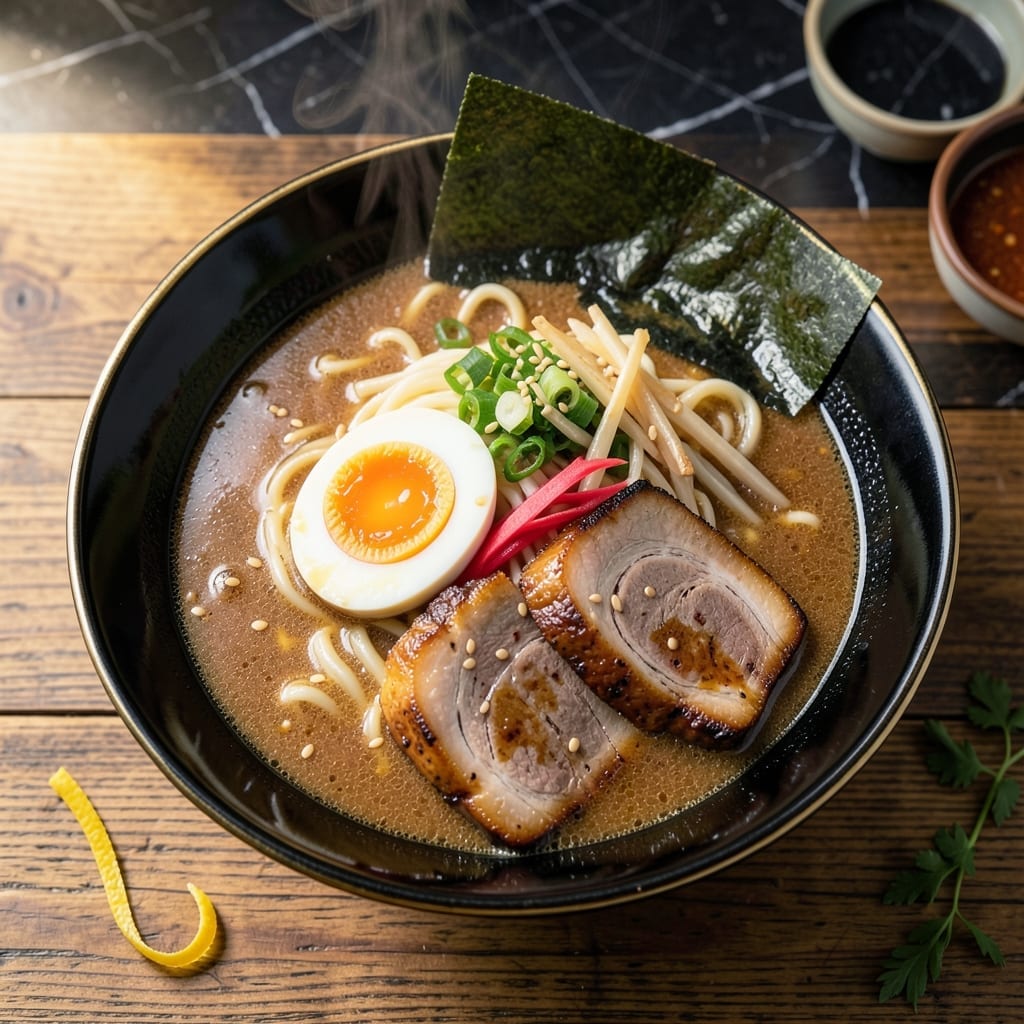
Crafting authentic ramen from scratch is a labor of love that yields deeply rewarding results. This traditional approach honors the dish’s cultural roots while delivering restaurant-quality flavor at home.
The process begins with a rich, slow-simmered broth that develops complex umami depth over 12 hours. Hand-pulled noodles, tender chashu pork, and marinated soft-boiled eggs complete the bowl with authentic texture and taste.
Each component builds upon the last, creating a harmonious balance of flavors and textures. The broth’s collagen-rich body coats the noodles, while the toppings add contrast and visual appeal.
This method requires patience and precision, but the final bowl—steaming, aromatic, and layered with tradition—makes every minute worthwhile.
Ingredients for Traditional Japanese Ramen Recipe from Scratch
Traditional ingredients build authentic ramen depth from broth to toppings with precision and care.
| Ingredient | Amount | Notes |
|---|---|---|
| Pork Belly 🥩 | 2 lb | For chashu, skin-on preferred |
| Chicken Feet 🍗 | 1 lb | For collagen-rich broth depth |
| Pork Femur Bones 🦴 | 2 lb | Split for marrow access |
| Dried Shitake Mushrooms 🍄 | 1 oz | For umami intensity in broth |
| Kombu Seaweed 🌊 | 2 pieces | 6-inch squares, wiped clean |
| Dried Bonito Flakes 🐟 | 1 oz | For secondary dashi layer |
| Bread Flour 🌾 | 4 cups | High protein for chewy noodles |
| Kansui Alkaline Water 💧 | 1 ½ tbsp | Or baked baking soda substitute |
| Soy Sauce 🥢 | ½ cup | Japanese variety preferred |
| Mirin 🍶 | ¼ cup | Sweet rice wine for tare |
| Miso Paste 🍜 | ⅓ cup | Red or white, smooth consistency |
| Soft-Boiled Eggs 🥚 | 4 whole | Marinated 4-12 hours in soy sauce |
| Scallions 🧅 | 4 whole | Thinly sliced for garnish |
| Nori Seaweed Sheets 🌊 | 4 sheets | Cut into strips for topping |
| Sesame Seeds 🌰 | 2 tbsp | Toasted for aroma |
[recipe_ingredient_scaler]
The broth foundation requires pork femur bones and chicken feet—both essential for collagen extraction. Source these from Asian grocery stores or specialty butchers, as Western markets often lack proper cuts. Dried shiake and kombu must be high-quality; Mitoku or Eden Foods brands deliver superior umami. For kansui, Asian markets carry bottled versions, or create a substitute with baked baking soda.
No pork belly for chashu? Pork shoulder works but lacks the fat cap’s richness. Skip chicken feet? Additional pork bones can compensate, though texture suffers. For the noodles, 00 flour plus vital wheat gluten mimics bread flour’s protein. The tare can use white miso for milder flavor or red miso for robustness. Tamari replaces soy sauce in gluten-free versions.
Broth can be made 2 days ahead and reheated—flavor improves with time. Chashu keeps 5 days refrigerated or 1 month frozen. Noodles are best fresh but can be refrigerated 24 hours in water. Marinated eggs last 1 week in the fridge. Always store broth and toppings separately until assembly.
Why You’ll Love This Recipe
- One Pot Magic: I toss everything—Pork Femur Bones, Kombu, Shitake—into a single stockpot and let the stove do the heavy lifting for hours.
- Umami Bomb: The pork belly and chicken feet melt into the broth, while Kombu and dried Shitake layer in that deep, savory richness I crave in every slurp.
- Feeds the Freezer: Honestly, I always double the batch because this ramen base freezes like a dream for those lazy nights.
- Weekend Project: Between us, simmering the bones all afternoon turns a slow Sunday into something special—plus the house smells incredible.
Step-by-Step Instructions for Traditional Japanese Ramen with Hand-Pulled Noodles
Master this authentic process with precision—each component builds layers of traditional flavor and texture.
Step 1: Prepare the Collagen-Rich Broth Base
Begin by blanching the 2 lb Pork Femur Bones and 1 lb Chicken Feet in boiling water for 10 minutes to remove impurities. This step is non-negotiable for a clean, golden broth. Drain and rinse the bones thoroughly under cold water to stop the cooking process.
In a large stockpot, combine the blanched bones with 1 oz Dried Shitake Mushrooms and 2 pieces Kombu Seaweed. Cover with 4 quarts cold water and bring to a gentle simmer over medium-low heat. Skim any foam that rises to the surface during the first 30 minutes—this ensures clarity in your final broth.
Step 2: Build Depth with Dashi and Aromatics
After 2 hours of simmering, add the 1 oz Dried Bonito Flakes directly to the pot. Do not stir; the flakes should steep like tea. Remove from heat and let sit for 15 minutes before straining through a fine-mesh sieve. The bonito infuses a subtle smokiness that defines authentic ramen broth.
Return the strained broth to the pot and continue simmering on low heat for another 6-8 hours. The collagen from the chicken feet and pork bones will break down into gelatin, giving the broth its signature rich, velvety mouthfeel. Reduce by about one-third for concentrated flavor.
Step 3: Craft the Alkaline Noodle Dough
In a stand mixer fitted with the dough hook, combine the 4 cups Bread Flour with 1.5 tbsp Kansui Alkaline Water and ¾ cup cold water. Mix on low speed for 5 minutes until the dough comes together into a shaggy mass. The kansui is essential—it gives the noodles their characteristic chew and yellow hue.
Increase speed to medium and knead for another 8-10 minutes until the dough is smooth and elastic. It should bounce back slowly when pressed with a finger. Wrap tightly in plastic and rest at room temperature for 30 minutes to relax the gluten.
Step 4: Roll, Cut, and Cook the Noodles
Divide the rested dough into 4 portions. Working with one piece at a time (keep the rest covered), roll through a pasta machine at progressively thinner settings until you reach the thinnest setting. The sheet should be nearly translucent. Dust lightly with flour to prevent sticking.
Fold the sheet loosely and slice into ⅛-inch wide strands using a sharp knife. Toss the cut noodles with a bit of flour to prevent clumping. Cook in boiling water for 1-2 minutes until they float to the surface and are just tender. Drain immediately and rinse under cold water to stop cooking.
Step 5: Assemble with Traditional Garnishes
For each bowl, place a portion of cooked noodles in the bottom and ladle 2 cups hot broth over them. Add 1 Soft-Boiled Egg (marinated in 0.5 cup Soy Sauce and 0.25 cup Mirin for 4-12 hours), sliced in half to reveal the custardy yolk.
Garnish with 0.33 cup Miso Paste stirred into a small amount of broth for a rich, savory base. Top with thinly sliced Scallions, strips of Nori Seaweed Sheets, and a sprinkle of 2 tbsp Sesame Seeds toasted until fragrant. Serve immediately while the broth is piping hot.
Pro Tips For Making Traditional Japanese Ramen Recipe From Scratch
- Blanch the Bones: Parboil pork femur bones for 10-15 minutes first to remove impurities—I learned this the hard way after my first broth turned murky and bitter.
- Bloom the Shitake: Rehydrate dried shiitake in cold water for at least 4 hours (overnight is better) and reserve the liquid for the broth. Sounds tedious, but it works.
- Skim Constantly: Keep a fine-mesh skimmer handy during the first hour of simmering to remove foam and fat. After burning three batches, I finally figured out this keeps the broth clean and clear.
- Double-Strain the Broth: Use a cheesecloth-lined colander for the final strain—your future self will thank you when there’s no grit in the bowl. This isn’t the prettiest method, but it’s the tastiest.
Best Sauces and Condiments for This Dish
Rich Shoyu Tare
The foundation of your ramen flavor starts with a well-balanced tare. Combine ½ cup soy sauce, ¼ cup mirin, and ⅓ cup miso paste in a small saucepan. Simmer over low heat for 5-7 minutes until slightly thickened. 🔥
Spicy Miso Boost
For a bolder flavor, whisk 2 tbsp red miso paste with 1 tbsp chili oil and 1 tsp sesame oil. This spicy miso paste adds heat and depth. Stir 1-2 tbsp into each bowl of broth before adding noodles.
Garlic Chili Oil
Heat ½ cup neutral oil with 6 minced garlic cloves and 2 tbsp crushed red pepper flakes over medium-low heat for 10 minutes. Strain and drizzle 1-2 tsp over finished bowls for aromatic heat.
Sesame Seed Garnish
Toast 2 tbsp sesame seeds in a dry pan over medium heat until golden and fragrant, about 3-4 minutes. Sprinkle over the top for nutty crunch. I always add extra seeds for texture contrast. ✨
Citrus Ponzu Drizzle
Mix ¼ cup soy sauce, 2 tbsp yuzu juice, and 1 tbsp rice vinegar for a bright, tangy ponzu. Drizzle 1 tsp over each bowl just before serving to cut through the richness.
Chashu Glaze
Reduce ½ cup soy sauce, ¼ cup mirin, and 2 tbsp sugar in a pan until syrupy, about 8-10 minutes. Brush this glaze on sliced chashu pork for extra flavor and shine.
Nutrition Facts
Frequently Asked Questions
Can I make the broth in a slow cooker?
Yes, but use the low setting for 12-14 hours. Skim foam every few hours for clarity. The flavor develops well, though stovetop gives better control.
What can I substitute for kansui water?
Bake 1 tsp baking soda at 250°F for 1 hour to mimic kansui’s alkalinity. Use 1.5 tbsp of this in your dough.
How do I keep noodles from sticking?
Dust noodles with flour after cutting and cook in plenty of boiling water. Stir gently during the first 30 seconds of cooking.
Can I prep components ahead of time?
Broth and chashu can be made 2 days ahead. Noodles are best fresh but can be refrigerated 24 hours in water.

Trained in classic French technique but raised on slow-cooked ribs and spicy rubs, she blends culinary skill with smoke and soul.
- Recipe for Boneless Pork Chops in Cast Iron Skillet: Sear and Baste to Juicy Perfection - October 3, 2026
- Recipe for Boneless Cross Rib Roast: Slow-Roasted Beef with Herb Crust - October 3, 2026
- Hamburgers in Sauce Recipe Crock Pot: Slow-Cooked Savory Delight - October 3, 2026