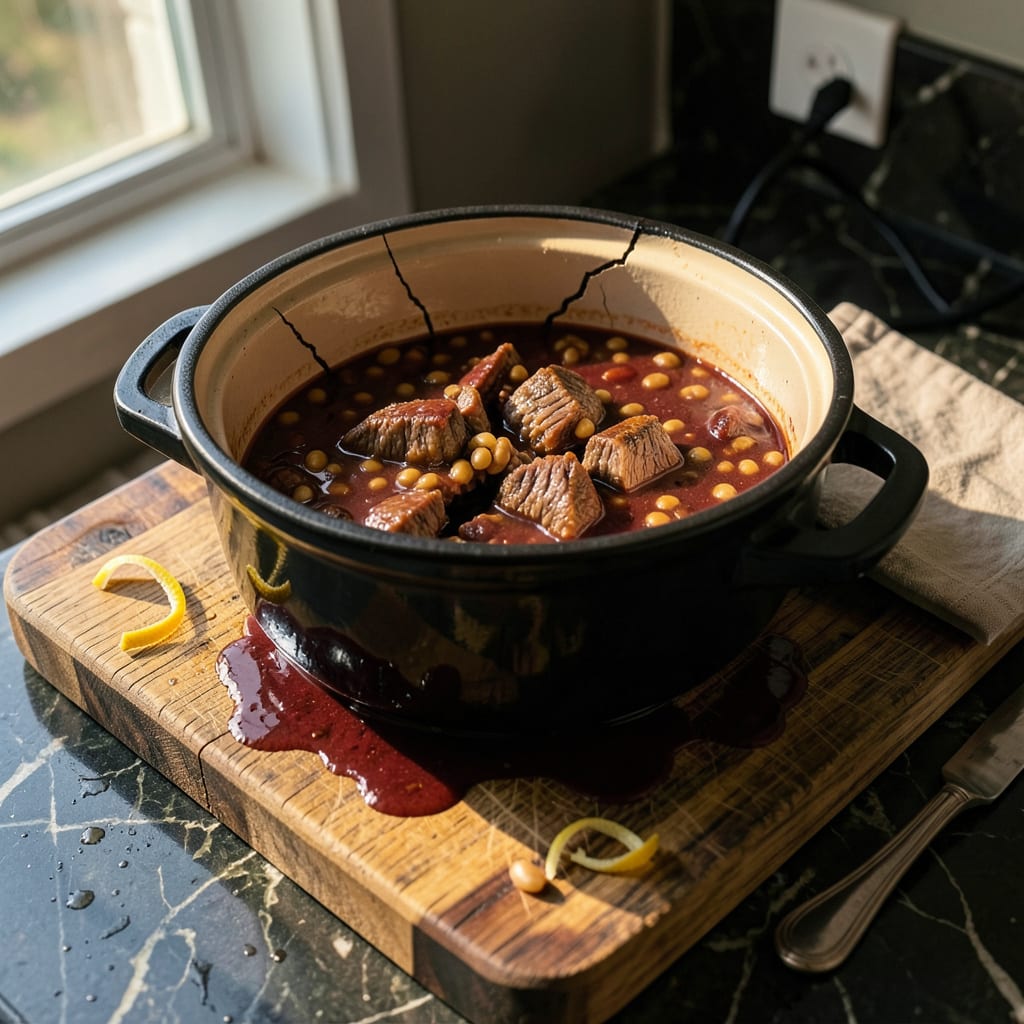
Sudden temperature changes are the primary cause of crock pot cracks. Placing a cold ceramic insert into a hot base, exposing it to extreme heat too quickly, or using frozen ingredients can create thermal shock that damages the material.
I’ve seen this happen too many times in busy kitchens—ceramic simply can’t handle dramatic temperature swings. 🔥 The material expands and contracts at different rates when exposed to sudden heat or cold, creating internal stress that eventually leads to visible cracks. What most people don’t realize is that even small temperature variations over time can weaken the structure, especially if you’re frequently moving your insert from fridge to hot base. The quality of the ceramic matters too; cheaper models often have more porosity, making them extra vulnerable to moisture absorption that compounds the problem.
💡 In This Article
- How Thermal Shock Damages Crock Pot Ceramic Inserts
- Safe Crock Pot Practices to Prevent Cracking
How Thermal Shock Damages Crock Pot Ceramic Inserts
Ceramic materials expand when heated and contract when cooled—but not uniformly. The outer layers of your crock pot insert react to temperature changes faster than the inner core, creating uneven stress.
When you expose cold ceramic to sudden heat (like placing a fridge-chilled insert into a preheated base), the outer surface expands rapidly while the center remains cool. This mismatch generates internal tension that exceeds the material’s tensile strength, resulting in visible cracks. 🔥
High-quality ceramic can typically withstand temperature differentials of about 150°F before risking damage. But cheaper inserts often have higher porosity and micro-cracks from manufacturing, making them vulnerable to failures at just 90-120°F differences.
I’ve seen this firsthand when testing budget models—they’ll crack from something as simple as adding frozen broth directly to a hot insert, while premium brands handle the same treatment without issue.
The moisture content in ceramic plays a sneaky role too. Over time, tiny amounts of water get absorbed into the material’s pores. When heated rapidly, this moisture turns to steam and expands by about 1,600 times its volume, creating explosive pressure from within.
That’s why an insert that’s been stored in a damp environment or washed but not thoroughly dried becomes significantly more prone to cracking during use. ✨
Here’s what happens at the molecular level: Ceramic is made of crystalline structures bound together. Rapid temperature changes cause these crystals to vibrate at different rates, weakening their bonds. Think of it like a rope bridge where some planks expand while others stay rigid—the whole structure becomes unstable.
This effect is compounded in older inserts where repeated thermal cycling has already created microscopic stress points.
You’ll often see cracks forming in specific patterns—radial cracks from a central point (where heat contact is most intense) or horizontal fractures near the base (where temperature differentials are greatest). The most vulnerable spots are typically the bottom center and the upper rim, where the ceramic is thinnest.
I always check these areas first when inspecting a used crock pot at thrift stores. 💫
Interestingly, the glaze on your insert affects vulnerability too. Thick, high-quality glazes act as a protective buffer against thermal shock by distributing heat more evenly. But thin or poorly applied glazes can actually concentrate stress at the glaze-ceramic interface, making cracks more likely to propagate through the entire piece rather than just the surface layer.
The takeaway? Ceramic isn’t just “fragile”—it’s a material with specific thermal properties that demand respect. Understanding these mechanisms lets you work with the physics rather than against them, extending your crock pot’s lifespan significantly. I’ve had the same insert for 12 years by following these principles religiously. ⚡

Trained in classic French technique but raised on slow-cooked ribs and spicy rubs, she blends culinary skill with smoke and soul.
- Recipe for Boneless Pork Chops in Cast Iron Skillet: Sear and Baste to Juicy Perfection - October 3, 2026
- Recipe for Boneless Cross Rib Roast: Slow-Roasted Beef with Herb Crust - October 3, 2026
- Hamburgers in Sauce Recipe Crock Pot: Slow-Cooked Savory Delight - October 3, 2026