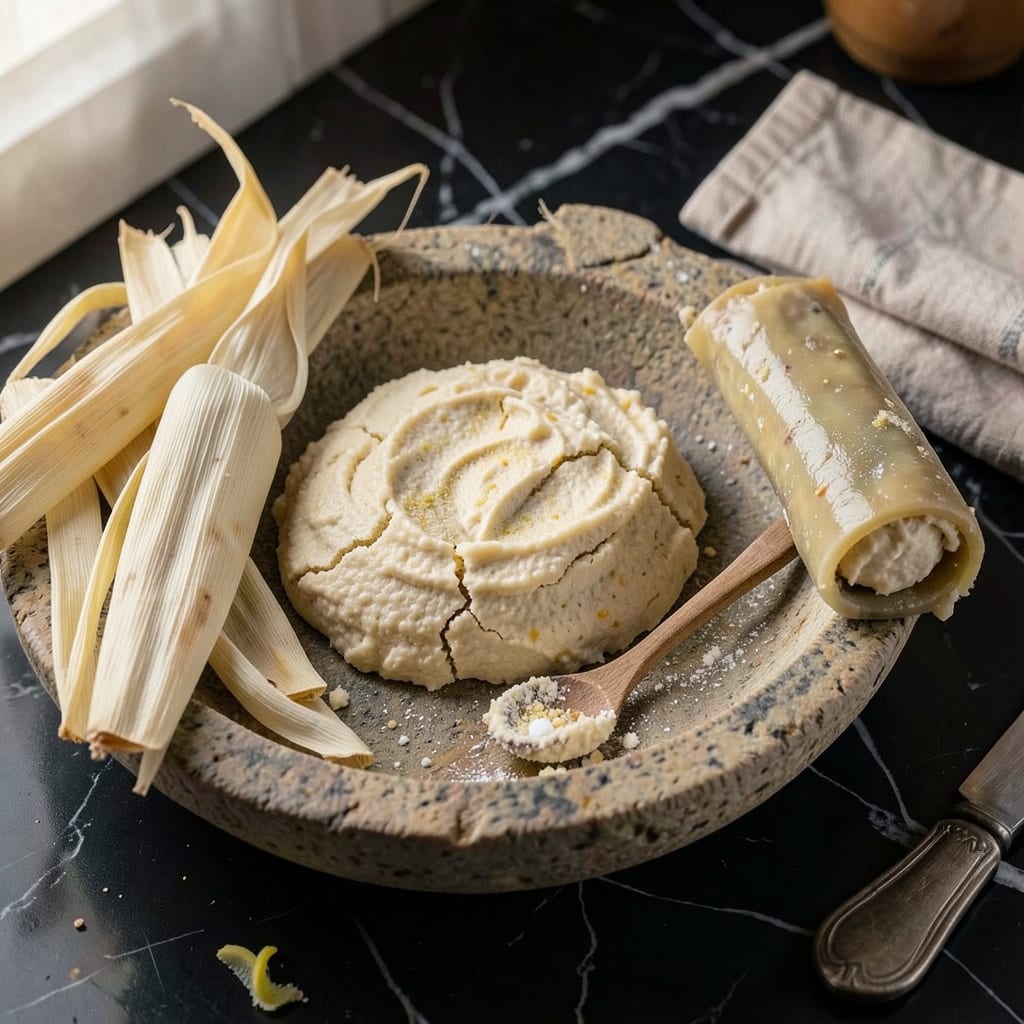
Masa often fails to stick to corn husks when it’s too dry, lacks enough fat, or hasn’t been soaked properly. The dough needs the right moisture-fat balance to adhere during steaming.
I’ve found that the secret lies in how the masa interacts with the husk’s surface. When the dough lacks sufficient lard or shortening, it loses its natural “glue” that binds it to the husk. 🔥 The soaking process is equally important—husk fibers need to soften enough to grip the masa, but not so much that they become slippery. Even the mixing technique plays a role; overworking the dough can break down its structure, making it too loose to cling properly.
What many don’t realize is that humidity and room temperature also affect adhesion. In dry climates, you might need to adjust your liquid ratios slightly, while colder kitchens may require the masa to rest longer before assembly. ✨
💡 In This Article
- Common Causes of Masa Not Adhering to Husks
- Step-by-Step Fixes for Masa That Won’t Stick
Common Causes of Masa Not Adhering to Husks
The science behind masa adhesion starts with fat distribution. Traditional tamale dough relies on lard or shortening (typically 1/2 to 3/4 cup per pound of masa) to create a sticky emulsion that binds to the husk’s fibrous surface. When the fat ratio drops below 20% of total masa weight, the dough loses its tacky quality.
🔥 The fat molecules essentially coat the masa particles, allowing them to grip the husk’s microscopic ridges.
Husk preparation plays an equally critical role. Dry husks repel masa like wax paper repels water. Soaking them in warm water (120-140°F) for 30-60 minutes softens their cellulose structure, creating tiny pores that interlock with the masa.
I’ve found that husks soaked too briefly (under 20 minutes) develop a slick surface, while over-soaked ones become mushy and can’t hold the dough’s weight.
Masa consistency determines everything. The ideal texture should feel like thick cake batter—able to hold its shape when pressed but still spreadable. When the dough contains too much liquid (over 1.5 cups broth per pound of masa), it becomes runny and slides off.
Conversely, under-hydrated masa (less than 1 cup liquid) forms dry clumps that can’t adhere. The protein strands in masa need proper hydration to stretch and bond during steaming.
Mixing technique affects adhesion more than most realize. Over-beating the dough after adding fat breaks down the gluten-like structures in masa harina, creating a gummy texture that resists sticking. I recommend mixing just until the ingredients combine—about 2-3 minutes at medium speed.
The dough should pull away slightly from the bowl but still feel slightly tacky to the touch.
Environmental factors create unexpected challenges. In dry climates (below 40% humidity), masa loses surface moisture quickly, requiring an extra 1-2 tablespoons of broth per batch. Cold kitchens (below 65°F) cause fats to solidify prematurely, preventing proper binding.
Letting the prepared masa rest for 15-20 minutes at room temperature allows the fats to redistribute evenly throughout the dough. ✨
Even the type of masa harina matters. Freshly ground nixtamalized corn creates more surface area for binding compared to pre-packaged mixes. I’ve noticed that instant masa harina often requires 10-15% more fat to achieve the same adhesion as traditional stone-ground versions.
The particle size and starch content vary significantly between brands, affecting how well the dough clings to husks.
The steaming process itself can cause separation if not controlled. Rapid temperature changes make the masa contract and pull away from the husk. Maintaining steady medium-low heat (with water at a gentle simmer, not a rolling boil) prevents this shock.
The ideal steam temperature hovers around 212°F—hot enough to cook through without creating moisture pockets that could loosen the masa’s grip. 💫

Trained in classic French technique but raised on slow-cooked ribs and spicy rubs, she blends culinary skill with smoke and soul.
- Recipe for Boneless Pork Chops in Cast Iron Skillet: Sear and Baste to Juicy Perfection - October 3, 2026
- Recipe for Boneless Cross Rib Roast: Slow-Roasted Beef with Herb Crust - October 3, 2026
- Hamburgers in Sauce Recipe Crock Pot: Slow-Cooked Savory Delight - October 3, 2026