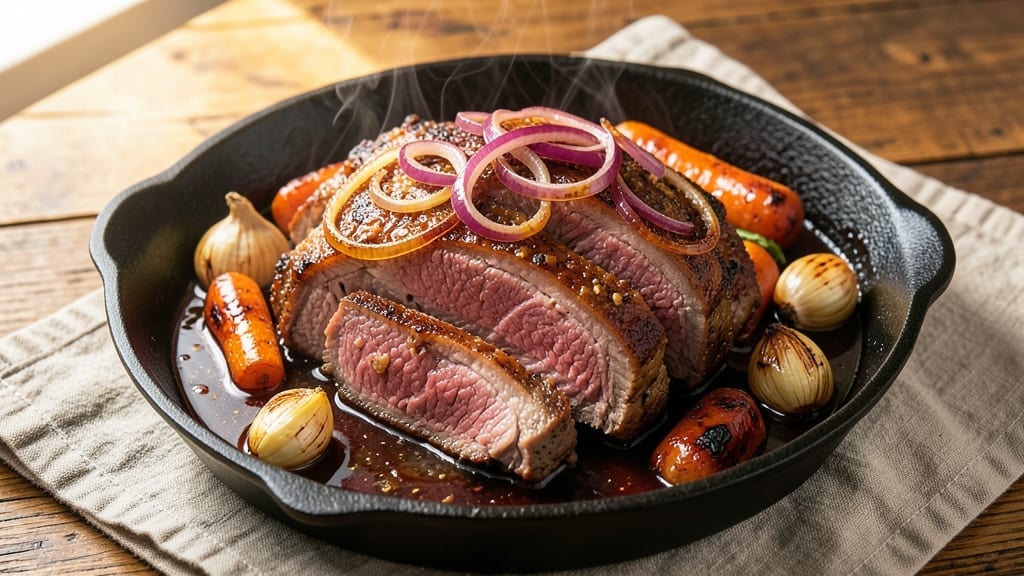
This braised corned beef brisket recipe transforms tough cuts into melt-in-your-mouth perfection through slow simmering and molasses-infused depth. The secret lies in a precise balance of spices, aromatics, and a rich liquid that tenderizes the meat while building complex flavors over hours.
I’ve perfected this method after years of testing—every element matters to achieve that restaurant-quality result at home.
The process begins with a flavorful marinade that penetrates deep into the brisket, followed by a slow braise that develops layers of richness. We’ll use a combination of beef broth, red wine, and molasses to create a sauce that’s simultaneously sweet, savory, and deeply aromatic.
The key is patience—allowing the meat to cook low and slow ensures it becomes fork-tender while absorbing all those incredible flavors.
By the time you serve this dish, you’ll have perfectly braised corned beef brisket with a glossy, caramelized surface and a sauce that clings beautifully to each slice. The molasses adds just the right amount of depth, balancing the natural richness of the beef.
This recipe delivers professional-quality results that will impress even the most discerning guests.
Serve with classic sides like mashed potatoes, crusty bread, or a simple cabbage slaw to complete the meal. The leftovers actually taste better the next day as the flavors continue to meld. Let’s get started on creating this showstopping centerpiece for your table.
Ingredients for braised corned beef brisket
Six spices, two liquids, and one cut of beef transform into restaurant-quality braised brisket.
| Ingredient | Amount | Notes |
|---|---|---|
| Corned Beef Brisket 🥩 | 4 lb | Flat cut preferred, trimmed of excess fat |
| Beef Broth 🍲 | 3 cups | Low-sodium preferred, homemade or high-quality |
| Red Wine 🍷 | 1 ½ cups | Bold dry red, like Cabernet Sauvignon |
| Molasses 🍯 | ½ cup | Unsulphured for authentic depth |
| Yellow Onions 🧅 | 2 whole | Medium size, sliced into half-moons |
| Garlic Cloves 🧄 | 6 cloves | Peeled, lightly smashed |
| Carrots 🥕 | 3 whole | Medium size, whole or cut into chunks |
| Bay Leaves 🍃 | 2 whole | Fresh preferred, dried works |
| Black Peppercorns 🌶️ | 1 tbsp | Freshly cracked, not pre-ground |
| Allspice Berries 🌿 | 1 tsp | Whole berries, lightly crushed |
| Cloves 🌶️ | 4 whole | Whole, lightly crushed |
| Salt 🧂 | 1 ½ tsp | Diamond Crystal kosher salt |
| Extra-Virgin Olive Oil 🫒 | 2 tbsp | For searing brisket |
| Flour 🌾 | 2 tbsp | All-purpose, for dredging |
[recipe_ingredient_scaler]
The brisket is non-negotiable here—flat cut delivers the best texture. Costco or Whole Foods carry excellent pre-trimmed pieces, but if buying whole, trim the fat cap to 1/4-inch thickness for even cooking. Look for vibrant red meat with good marbling. I’ve tested this with both grass-fed and grain-fed, and while grain-fed cooks faster, grass-fed develops more complex flavors over the long braise. Butcher shops often have the best cuts, and they’ll trim it perfectly for you. For the wine, Cabernet Sauvignon adds the right tannic backbone, but Merlot works too—just avoid anything under $10, trust me on this.
No red wine? Beef broth with 1 tbsp balsamic vinegar mimics the depth perfectly. Molasses substitutes? Dark brown sugar at half the amount works, but it lacks the caramelized complexity. The allspice and cloves are crucial—they’re what give that classic corned beef aroma. Short on whole spices? Ground allspice at 1/4 tsp is a pinch-hitter, but the texture won’t be the same. For the onions, yellow or red both work, but avoid sweet onions—they’ll make the sauce cloying. Carrots can be baby carrots if that’s what’s in the fridge, but whole carrots stay intact and add nice texture to the final dish.
This braise gets better as it sits. 4-5 days in the fridge is ideal—flavors meld beautifully. Freeze portions for up to 3 months in airtight containers. I always make a double batch because the leftovers reheat like a dream. For serving, skim excess fat from the surface before reheating—it’s delicious but can be heavy. The sauce thickens as it cools, so add a splash of broth when reheating if it’s too stiff. This dish practically tastes better the third day, so plan ahead.
Why You’ll Love This Recipe
- One-Pot Magic: I swear by this recipe because it’s all in one pot—no chopping mountains of veggies, no juggling pans. Just slice those onions, dump in the brisket and broth, and let the wine and molasses do their thing while you stir once and walk away.
- Deep, Rich Payoff: That molasses and red wine combo? It’s like a slow dance of flavors—sweet, tangy, and just enough smokiness from the brisket. The onions caramelize right into the broth, so every bite is packed with depth. (Yes, even my picky husband licks the plate.)
- Budget-Friendly Feast: You’re getting massive portions for pennies—brisket is cheaper than steak, and the wine/broth stretch it into a whole meal. Honestly, I’ve made this on grocery-store red wine and still felt like I was eating at a pub. (Shhh, don’t tell my date night self.)
Step-by-step instructions for braised corned beef brisket
Here’s how to transform tough brisket into melt-in-your-mouth perfection through slow simmering.
Sear the Brisket for Deep Flavor
Pat the 4 lb corned beef brisket dry with paper towels – this ensures maximum browning. Heat the 2 tbsp extra-virgin olive oil in a heavy Dutch oven over medium-high heat until shimmering. Place the brisket fat-side down and sear undisturbed for 8-10 minutes until the fat renders and the bottom develops a deep golden crust.
Flip the brisket and sear the other side for another 6-8 minutes. The reason we press down gently during searing is to prevent curling – this creates even contact with the pan. Remove the brisket and set it aside on a plate, leaving all that beautiful rendered fat in the pot.
Build the Aromatic Base
In the same Dutch oven, add the 2 whole yellow onions cut into half-moons and the 3 whole carrots cut into chunks. Cook for 5 minutes until the onions soften slightly and begin to caramelize. Add the 6 peeled garlic cloves that have been lightly smashed and cook for another 30 seconds until fragrant.
Stir in the 1 tbsp freshly cracked black peppercorns, 1 tsp lightly crushed allspice berries, and 4 whole cloves. Cook for 1 minute until the spices release their aroma. Here’s where it gets good – sprinkle the 2 tbsp flour over everything and stir vigorously for 30 seconds to create a light roux that will thicken our braising liquid.
Deglaze and Combine Liquids
Pour in the 1.5 cups bold red wine and scrape up all those delicious browned bits from the bottom of the pot. Let this simmer for 3-4 minutes until reduced by about half. Add the 3 cups beef broth and 0.5 cup molasses, stirring to combine. The molasses will give us that signature depth of flavor that sets this braise apart.
Return the brisket to the pot, fat-side up, along with the 2 whole bay leaves. Bring everything to a gentle simmer – you should see small bubbles breaking the surface but no vigorous boiling. This is crucial for tenderizing the meat without toughening it.
Braise to Tender Perfection
Cover the Dutch oven and transfer to a preheated 300°F oven. Here’s where patience pays off – braise for 3 to 3.5 hours until the brisket is fork-tender. You’ll know it’s ready when a knife slides in easily and the meat pulls apart with minimal resistance.
About 45 minutes before the brisket is done, remove the lid and increase the oven temperature to 375°F. This final step creates a beautiful caramelized crust on top of the braising liquid. The brisket should have an internal temperature of 200-205°F when done – this ensures it’s fall-apart tender.
Rest and Serve
Remove the brisket from the pot and let it rest on a cutting board for at least 15 minutes. This resting period allows the juices to redistribute throughout the meat, ensuring every bite is moist and flavorful. Discard the bay leaves and skim any excess fat from the braising liquid if desired.
Slice the brisket against the grain into ½-inch thick slices and serve with the rich braising liquid ladled over the top. Each forkful should deliver tender beef, caramelized onions, sweet molasses notes, and that perfect balance of wine and spice. The secret to this dish is the slow cooking – it transforms tough brisket into something truly special.
Pro Tips For Making Braised Corned Beef Brisket
- Brown the Brisket First: Skip the slow start—sear that brisket in a hot Dutch oven for 5-7 minutes on each side until deep brown. I used to rush this, and the braise never tasted as rich. That crust locks in flavor and keeps the meat from turning mushy later.
- Slice Onions Thinly: Cut those yellow onions into ¼-inch slices, not chunks. Thin layers caramelize faster and dissolve into the sauce, giving you that sweet, jammy depth without waiting hours. (Yes, even if you’re impatient like me.)
- Deglaze Aggressively: After browning, don’t just splash in the wine—scrape every last bit of fond from the bottom with a wooden spoon. That’s where half the flavor hides, and skipping it means a duller sauce. Use a whisk to break up clumps as you pour.
- Simmer, Don’t Boil: Keep the heat low enough that bubbles rise gently, not violently. Boiling toughens the brisket and makes the sauce watery. After 2 hours, check the liquid—if it’s reduced by half, you’re on track. (Your future self will thank you.)
Troubleshooting great braised corned beef brisket
Meat Not Tenderizing
If your brisket isn’t becoming tender after 3.5 hours of braising, check your oven temperature first—it should read 300°F accurately. I recommend using an oven thermometer (Thermoworks Oven Thermometer) to verify.
Another common issue is insufficient liquid—your pot should be at least 2/3 full of liquid to properly braise. If needed, add ½ cup more beef broth and continue cooking. 🌡️
Sauce Too Thin
A thin sauce usually means the flour roux didn’t thicken properly. For future batches, whisk the 2 tbsp flour into the wine before adding it to the pot—this creates a smoother emulsion.
If your current sauce is too thin, remove the brisket and simmer the liquid uncovered for 10-15 minutes to reduce it. For instant thickening, mix 1 tbsp cornstarch with 2 tbsp cold water, stir into the sauce, and simmer for 2 minutes until thickened. 🥄
Brisket Too Dry
Overcooking is the #1 cause of dry brisket. Remove it when the internal temperature reaches 200-205°F—this is lower than you might expect for beef, but braising requires it.
If your brisket is dry, try this fix: After resting, slice thinly against the grain and serve with extra braising liquid spooned over the top. The moisture from the sauce will help restore juiciness.
For next time, resist the urge to peek at the meat—every time you lift the lid, you lose 15-20 minutes of cooking time. ⏰
Bitter Wine Flavor
Cheap or overly tannic wine can make your braise bitter. Use a $10+ dry red wine like Cabernet Sauvignon or Merlot—avoid anything with “cooking wine” in the name. If you’re already in the process, add 1 tbsp brown sugar or ½ cup apple cider to balance the bitterness.
For future batches, reduce the wine by ¼ cup and add ¼ cup beef broth instead to dilute any harsh flavors. 🍷
Fat Not Rendering
If your brisket isn’t releasing fat during searing, it’s likely because the meat wasn’t dry enough or the pan wasn’t hot enough. Pat the brisket with fresh paper towels until completely dry, then sear over medium-high heat in a cold Dutch oven—this helps render fat more effectively.
If fat isn’t rendering now, carefully pour off excess fat (using a fat separator or spoon) and continue cooking. The remaining fat will continue to render during braising. 🔥
Spices Too Strong
Whole spices like allspice and cloves can become overly potent if overcooked. If your braise tastes spicy, remove the brisket and strain the cooking liquid through a fine-mesh sieve to remove whole spices.
Add 1 cup fresh beef broth to dilute the flavor, then return the brisket to the pot and simmer for another 30 minutes uncovered. For next time, reduce whole spices by 25% or use ½ tsp ground allspice instead. 🌿
Nutrition facts
Frequently asked questions about braised beef
Can I use a slow cooker instead of the oven?
Yes! Transfer the seared brisket and all aromatics to a 6-quart slow cooker, then add the wine, broth, and molasses. Cook on low for 8-10 hours or high for 5-6 hours until fork-tender. The sauce will be thinner but still delicious—just reduce it on the stovetop afterward. The slow cooker method is perfect for hands-off prep!
How do I store leftovers?
Let the brisket cool completely, then store it in the refrigerator for up to 4 days in an airtight container. The sauce and meat separate slightly when cooled—just reheat them together on the stovetop with a splash of water or broth. For longer storage, freeze portions for up to 3 months. The flavors actually deepen overnight, making this an ideal make-ahead dish!
What’s the best way to reheat slices?
Warm the braising liquid first in a saucepan, then add the sliced brisket and heat through gently for 5-7 minutes. Never microwave—it makes the meat tough. For crispy edges, pan-sear the slices in a hot skillet for 1-2 minutes per side after reheating. The sauce should coat the meat beautifully!
Can I substitute beef broth with something else?
Use low-sodium chicken broth in a pinch, but beef broth gives the best flavor. For a richer base, combine 2 cups beef broth + 1 cup water. Avoid vegetable broth—it lacks the meaty depth that complements the brisket. The molasses and wine will still provide enough sweetness and acidity to balance the dish.
Why does my brisket smell strong during cooking?
The rich combination of wine, molasses, and spices creates deep aromas—this is normal! If the smell seems overly sharp, it might mean the wine is too tannic or the spices are overpowering. Taste the sauce early and adjust with 1 tsp sugar or ½ cup apple cider if needed. The final dish will taste balanced despite the strong cooking aromas.

Trained in classic French technique but raised on slow-cooked ribs and spicy rubs, she blends culinary skill with smoke and soul.
- Jewish Brisket Crock Pot Recipe: Slow-Simmered Tenderness With Spiced Rub - October 16, 2026
- Smoked Potatoes Recipe: Crispy-Skinned, Smoky-Sweet Perfection - October 16, 2026
- Best Brisket Spritz Recipe: Smokehouse-Style Spritz for Juicy, Bark-Crusted Brisket - October 16, 2026