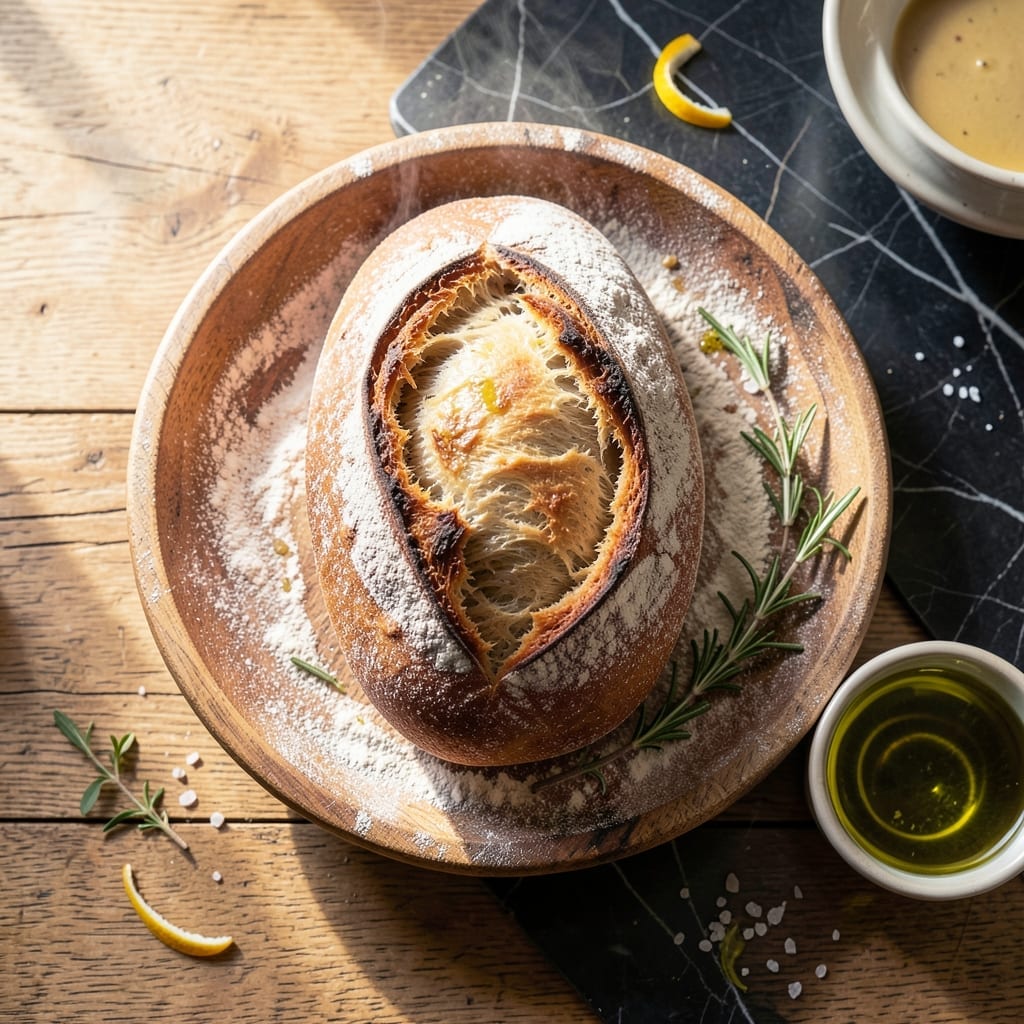
There’s nothing like the satisfying crunch of a properly baked ciabatta, with its signature open crumb and chewy texture. This Italian classic requires patience and precision, but the results are worth every minute of effort.
The secret lies in high hydration dough and a slow fermentation process that develops complex flavors. I’ve adapted traditional techniques to make this accessible for home bakers without sacrificing authenticity.
You’ll end up with a rustic loaf that’s crispy on the outside, airy on the inside, and perfect for sandwiches or dipping in olive oil. The long proofing time is what creates those coveted large holes throughout the bread.
Serve warm for the best experience, or use as the foundation for incredible panini. Here’s how to achieve bakery-quality results at home.
Ingredients for Ciabatta Bread Recipe Jamie Oliver
High hydration dough and patience create this Italian masterpiece with signature airy crumb.
| Ingredient | Amount | Notes |
|---|---|---|
| Bread Flour 🌾 | 3 ½ cups | High-protein for structure |
| Active Dry Yeast 🍞 | ¼ tsp | Instant yeast works too |
| Sea Salt 🧂 | 2 tsp | Fine grain preferred |
| Lukewarm Water 💧 | 1 ¾ cups | About 110°F for activation |
| Extra-Virgin Olive Oil 🫒 | ¼ cup | For dough and bowl coating |
| Sugar 🍚 | 1 tsp | Helps yeast activation |
| Semolina Flour 🌾 | ½ cup | For dusting work surface |
| All-Purpose Flour 🌾 | ½ cup | Blended with bread flour |
| Cornmeal 🌽 | 2 tbsp | For baking sheet dusting |
| Ice Cubes ❄️ | 4 pieces | For steam in oven |
[recipe_ingredient_scaler]
The flour blend is key here. King Arthur Bread Flour gives you that perfect chew—don’t sub all-purpose entirely (the 12-14% protein content is non-negotiable). I grab mine from Whole Foods bulk bins when I’m making a big batch. The yeast needs to be fresh—if it’s been in your pantry since the last solar eclipse, test it in warm water first.
Out of bread flour? Add 1 tbsp vital wheat gluten per cup of all-purpose to boost protein. No semolina? Fine cornmeal works for dusting. Skip the sugar? Honey at half the amount feeds the yeast just as well. The olive oil matters here—California Olive Ranch or Filippo Berio are solid grocery store picks.
The dough keeps in the fridge for 24-48 hours (flavor deepens with time). Baked loaves stay fresh for 3 days in a paper bag. Freeze slices for 1 month—revive by spritzing with water and baking at 375°F for 5 minutes.
Why You’ll Love This Recipe
- Minimal Effort: I just mix flour, yeast, salt, and water—no kneading, no fuss. The olive oil does all the work for that signature chewy texture.
- Crusty Perfection: That crisp golden crust with the airy, hole-filled center? Honestly, it’s the best part of waking up to fresh bread.
- Endless Uses: From dipping in olive oil to making killer sandwiches, this loaf handles breakfast, lunch, or dinner like a champ.
- Budget Friendly: Bread flour and yeast cost pennies, and one batch gives me enough for days. I’ll be real: it beats store-bought every time.
Step-by-Step Instructions for Rustic Italian Ciabatta Bread
This method delivers that signature open crumb and crisp crust with minimal effort.
Step 1: Activate the Yeast and Start the Dough
In a large bowl, whisk together the 1.75 cups lukewarm water, 0.25 tsp active dry yeast, 1 tsp sugar, and 0.25 cup extra-virgin olive oil. The water should feel just warm to the touch—about 110°F. Let this sit for 5-10 minutes until the mixture becomes frothy and slightly bubbly, confirming the yeast is active.
Add the 3.5 cups bread flour and 0.5 cup all-purpose flour to the yeast mixture. Stir with a wooden spoon until a shaggy, sticky dough forms. The high-protein bread flour gives this loaf its structure, while the all-purpose adds a touch of tenderness. Don’t worry if the dough looks rough at this stage—it will smooth out as it hydrates.
Step 2: Incorporate Salt and Begin Bulk Fermentation
Once the dough starts to come together, sprinkle in the 2 tsp sea salt. I like to add it after the initial mixing to avoid inhibiting the yeast activation. Use your hands or a dough whisk to fully incorporate it. The dough will be extremely sticky—this high hydration is what creates ciabatta’s characteristic airy texture.
Cover the bowl with a damp kitchen towel and let it rise at room temperature for 1 hour. You’ll notice the dough begin to bubble and expand. This first rise, called autolyse, allows the flour to fully absorb the liquid. The surface should look glossy and slightly domed when it’s ready for the next step.
Step 3: Perform Stretch-and-Folds for Structure
After the initial rest, perform a series of stretch-and-folds to build gluten strength. Wet your hands (to prevent sticking) and grab one side of the dough, stretching it upward and folding it over itself. Rotate the bowl and repeat this process 4-5 times around the bowl.
Repeat these stretch-and-folds every 30 minutes for the next 2 hours. With each set, you’ll feel the dough becoming more elastic and less sticky. This technique replaces traditional kneading and develops the gluten network needed for that open, holey crumb. The dough should nearly double in size and look puffy with large air bubbles by the end.
Step 4: Shape and Final Proof
Lightly dust a work surface with 0.5 cup semolina flour. This coarse flour prevents sticking while adding a nice texture to the crust. Turn the dough onto the floured surface. Using wet hands, gently shape it into a rectangle about 1 inch thick, being careful not to deflate the air bubbles you’ve worked so hard to create.
Line a baking sheet with parchment paper and dust it with 2 tbsp cornmeal. Transfer the shaped dough to the baking sheet. Cover with the damp towel and let it proof for 1-2 hours at room temperature, or until the dough has risen by about 50% and jiggles slightly when shaken.
Step 5: Bake with Steam for Crisp Crust
Preheat your oven to 450°F with a baking stone or inverted baking sheet on the middle rack. Just before baking, dimple the surface of the dough with wet fingers to create ciabatta’s signature rustic look. Slide the parchment with the dough onto the preheated stone.
Immediately place the 4 pieces ice cubes in a heatproof pan on the lower oven rack. The steam they create will give your loaf that professional bakery crust. Bake for 25-30 minutes until the bread is deep golden brown and sounds hollow when tapped on the bottom. Let it cool completely on a wire rack before slicing—this prevents a gummy crumb.
Pro Tips For Making Ciabatta Bread Recipe Jamie Oliver
- Use Very Wet Dough: I learned this the hard way—ciabatta dough should be sticky and slack, almost like thick batter. Resist adding extra flour; the high hydration is what gives it those signature air pockets.
- Proof Overnight: After mixing, let the dough rise in the fridge for 12-16 hours. This slow fermentation develops deeper flavor and makes the dough easier to handle the next day.
- Skip the Kneading: sounds weird, but it works: Jamie’s method relies on stretch-and-fold technique instead of traditional kneading to build structure without toughening the gluten.
- Bake on Hot Stone: Preheat a baking stone or inverted tray in the oven for 30 minutes before baking. The intense heat mimics a professional deck oven, giving you that perfect chewy crust.
Wine and Beer Pairings for This ciabatta bread recipe jamie oliver
Italian Wine Pairings
Ciabatta’s rustic simplicity calls for Italian whites. I love Vermentino from Sardinia—its crisp acidity and citrus notes complement the bread’s chewy texture. Pinot Grigio from Veneto offers a lighter, mineral-driven pairing. 🍷
Bold Red Options
For heartier sandwiches with ciabatta, try Chianti Classico from Tuscany. The sangiovese grape’s bright acidity cuts through rich fillings like prosciutto and cheese. I always recommend Ruffino for reliable quality.
Craft Beer Selections
An Italian pilsner like Peroni or Birra Moretti provides a crisp, clean finish. For craft lovers, a Belgian-style saison with peppery notes adds complexity without overwhelming the bread’s delicate flavor. 🍺
Regional Favorites
In Liguria, they pair ciabatta with Pigato, a local white with saline minerality. For a special treat, try Barolo with truffle-infused olive oil drizzled on warm bread. The contrast is divine.
Non-Alcoholic Choices
Sparkling San Pellegrino with lemon enhances the bread’s crust. For a sweet touch, try blood orange soda—its citrus notes mirror the olive oil used in the recipe.
Nutrition Facts
Frequently Asked Questions
Why is my dough so sticky?
That’s normal for ciabatta! The high hydration is what creates those signature holes. Use wet hands or a dough scraper to handle it, and resist adding extra flour.
Can I use all-purpose flour instead?
You can, but add 1 tbsp vital wheat gluten per cup to boost protein. Bread flour gives the best chewy texture. The extra protein helps support the high hydration.
How do I know when it’s done baking?
The loaf should be deep golden brown and sound hollow when tapped. An internal temperature of 205°F confirms it’s fully baked. Let it cool completely before slicing.
Can I make this ahead of time?
The dough can rest in the fridge for 24-48 hours, which actually improves the flavor. Baked loaves stay fresh for 3 days in a paper bag.

Trained in classic French technique but raised on slow-cooked ribs and spicy rubs, she blends culinary skill with smoke and soul.
- Recipe for Boneless Pork Chops in Cast Iron Skillet: Sear and Baste to Juicy Perfection - October 3, 2026
- Recipe for Boneless Cross Rib Roast: Slow-Roasted Beef with Herb Crust - October 3, 2026
- Hamburgers in Sauce Recipe Crock Pot: Slow-Cooked Savory Delight - October 3, 2026