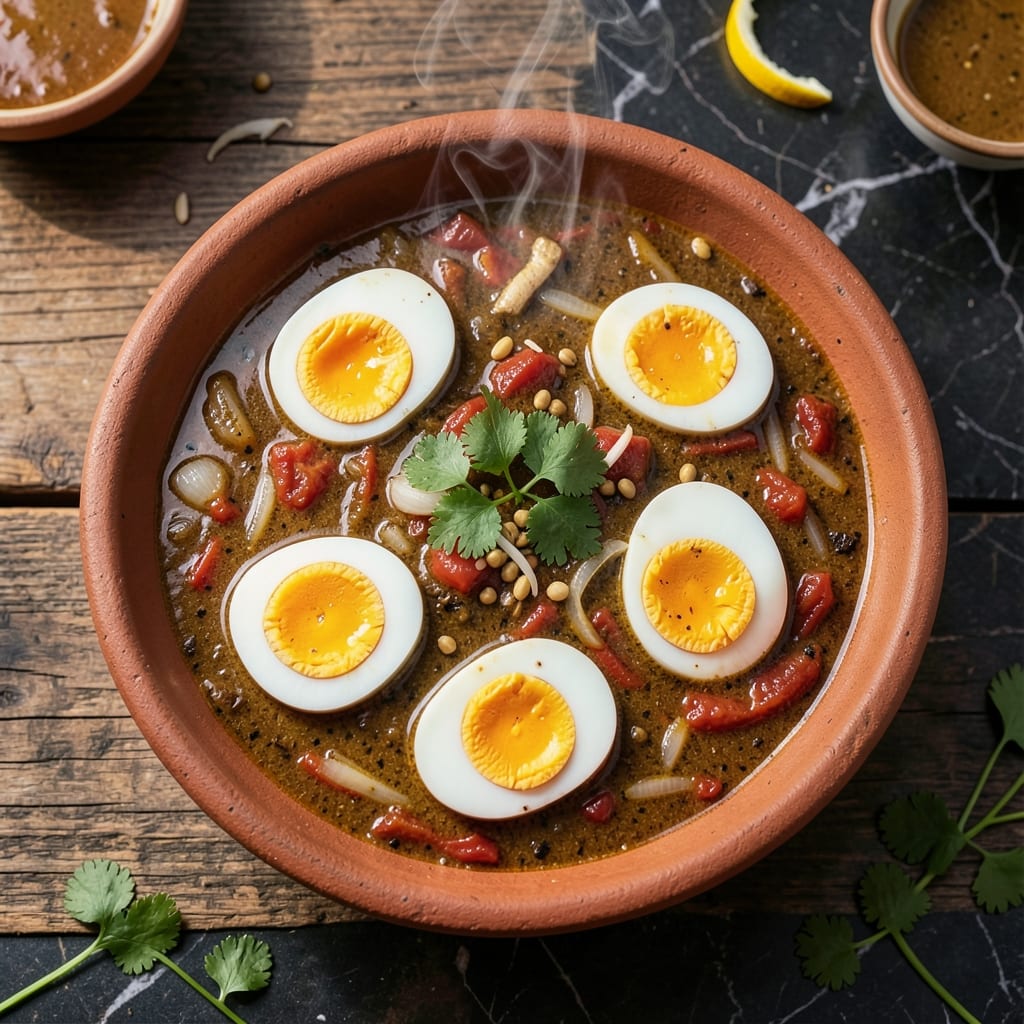
This traditional Maharashtrian dish brings authentic flavors to your home kitchen with a foolproof method I’ve perfected through years of testing.
What makes this creation special is its balance of warm spices and rich coconut milk, which creates a velvety sauce that coats every egg. The aroma alone will transport you to a Mumbai street food stall.
You’ll achieve tender eggs in a deeply flavorful curry that’s both comforting and complex. It’s the kind of dish that feels impressive but comes together with simple techniques.
Serve with steamed rice or fresh roti for the full experience. This is home cooking at its most satisfying.
Ingredients for Egg Curry Recipe in Marathi Language
Warm spices, creamy coconut, and tender eggs create this authentic Maharashtrian comfort dish at home.
| Ingredient | Amount | Notes |
|---|---|---|
| Hard-Boiled Eggs 🥚 | 8 whole | Peeled, halved lengthwise |
| Coconut Milk 🥥 | 1 ½ cups | Full-fat for creaminess |
| Onion 🧅 | 1 whole | Finely chopped, yellow preferred |
| Tomatoes 🍅 | 2 whole | Ripe, pureed or finely chopped |
| Fresh Ginger 🌿 | 1 tbsp | Minced or grated finely |
| Garlic Cloves 🧄 | 4 cloves | Minced for depth of flavor |
| Green Chili Peppers 🌶️ | 2 whole | Slit lengthwise, seeds removed |
| Ground Coriander 🌿 | 1 tbsp | Freshly ground preferred |
| Ground Cumin 🌿 | 1 tsp | Toasted lightly for aroma |
| Turmeric Powder 🧂 | ½ tsp | For color and earthiness |
| Red Chili Powder 🌶️ | 1 tsp | Adjust to heat preference |
| Garam Masala 🌿 | 1 tsp | Freshly ground for best flavor |
| Mustard Seeds 🌿 | ½ tsp | For tempering the curry |
| Curry Leaves 🍃 | 8 pieces | Fresh for authentic aroma |
| Vegetable Oil 🫒 | 3 tbsp | Neutral flavor, high smoke point |
| Fresh Cilantro 🌿 | ¼ cup | Chopped, for garnish |
[recipe_ingredient_scaler]
The coconut milk is non-negotiable here—full-fat cans from Thai Kitchen or Goya give that velvety texture. I grab mine from Whole Foods or any Asian grocery (they’ve got the best prices). Curry leaves can be tricky to find, but Indian grocery stores always stock fresh bunches. Mustard seeds? Patel Brothers or any spice aisle works. Don’t skip toasting the cumin—it wakes up the flavor.
No coconut milk? Heavy cream at half the amount changes the vibe but works. Out of fresh ginger? Ground ginger at one-third the amount saves the day (just add it with the spices). Green chilies too hot? Jalapeños or serranos work—adjust the seeds for heat. Garam masala missing? Mix cumin, coriander, cinnamon, and cardamom for a close substitute. Baby spinach wilts in nicely if you want extra greens.
Boiled eggs keep in the fridge for 1 week (peeled or unpeeled). The curry itself tastes even better the next day—store for up to 4 days in the fridge or freeze for 3 months. Freeze without the eggs, then add them when reheating (worth the extra minute).
Why You’ll Love This Recipe
- One-Pot Wonder: I just dump everything in a single pot—boiled eggs, coconut milk, and the ginger-onion-tomato masala—and let it simmer to perfection.
- Creamy Spice Hug: The coconut milk balances the heat so well, and the ginger gives that fresh zing I crave in every bite.
- Lunchbox Hero: Pack it for work or serve it at dinner—this curry tastes even better the next day, and the eggs hold up perfectly.
- Budget Keeper: Eggs and basic pantry staples stretch so far, and honestly, it feels like a restaurant meal for pennies.
Step-by-Step Instructions for Traditional Egg Curry
Here’s how to build layers of authentic Maharashtrian flavor in this comforting dish.
Step 1: Temper the Spices for Maximum Aroma
Heat the 3 tbsp vegetable oil in a heavy-bottomed pan over medium heat. When the oil shimmers, add the 0.5 tsp mustard seeds and let them pop for about 10-15 seconds until they dance in the pan.
Immediately add the 8 pieces curry leaves and the 2 whole green chili peppers slit lengthwise. Sauté for 30 seconds until the curry leaves release their citrusy aroma and the chilies blister slightly. This tempering step is non-negotiable—it blooms the spices and infuses the oil with complex flavors that define the curry.
Step 2: Build the Flavor Base with Aromatics
Add the 1 whole onion finely chopped to the pan. Cook for 5-6 minutes until it turns golden brown, stirring frequently to prevent burning. The onions should soften completely and develop a light caramelization around the edges.
Stir in the 1 tbsp fresh ginger and 4 cloves garlic cloves. Sauté for 1-2 minutes until the raw smell disappears and the mixture becomes fragrant. Then add the 2 whole tomatoes (pureed or finely chopped) and cook for 4-5 minutes until the oil starts to separate from the mixture. This visual cue signals that the base is properly developed.
Step 3: Toast the Spices and Create the Masala
Reduce the heat to medium-low and add the 1 tbsp ground coriander, 1 tsp ground cumin, 0.5 tsp turmeric powder, and 1 tsp red chili powder. Stir constantly for 1-2 minutes to toast the spices—this deepens their flavors and removes any raw taste.
You’ll notice the mixture darkening slightly and the spices releasing their aromatic oils. Pour in ¼ cup water to prevent the spices from burning, then add the 1.5 cups coconut milk. Stir well to combine and bring the mixture to a gentle simmer. Let it cook for 5 minutes until the sauce thickens slightly and the oil glistens on the surface.
Step 4: Add the Eggs and Finish with Garam Masala
Gently place the 8 whole hard-boiled eggs (peeled and halved lengthwise) into the simmering sauce. Spoon the sauce over the eggs to coat them evenly. Sprinkle the 1 tsp garam masala over the top and stir lightly to distribute the spices without breaking the eggs.
Cover the pan and let the curry simmer on low heat for 8-10 minutes. This allows the eggs to absorb the rich, spiced sauce while staying intact. The sauce should be thick enough to coat the back of a spoon but still pourable.
Step 5: Garnish and Rest for Optimal Flavor
Turn off the heat and let the curry rest for 5 minutes to allow the flavors to meld together. The eggs will soak up more of the sauce during this time, making every bite more flavorful.
Garnish with the 0.25 cup fresh cilantro chopped just before serving. The bright green cilantro adds a fresh contrast to the rich, warm spices. Serve hot with steamed rice or fresh roti to soak up every bit of the delicious sauce.
Pro Tips For Making Egg Curry Recipe In Marathi Language
- Peel Eggs Carefully: Boil eggs for exactly 9-10 minutes, then shock in ice water—I learned this the hard way after struggling to peel cracked eggs. The cold water makes the shells slip right off.
- Toast the Spices: Fry the cumin and mustard seeds in hot oil until they sizzle and pop, about 30 seconds. Sounds weird, but it works to wake up their flavors before adding onions.
- Simmer the Sauce: Once you add coconut milk, keep the heat at a gentle simmer, not a boil. After burning three batches, I finally figured out that high heat makes the sauce separate.
- Add Ginger Last: Grate the fresh ginger just before adding it to the curry—my grandmother swore by this, and she was right. It keeps the flavor sharp and bright, not bitter.
Essential Equipment for Perfect Results
Heavy-Bottomed Pan
A sturdy stainless steel or enameled cast iron pan is essential for even heat distribution. I use my 5-quart Le Creuset Dutch oven—it handles the tempering and simmering perfectly without hot spots burning the spices. 🔥
Wooden Spoon
Use a wooden spoon for stirring to avoid scratching your pan. It’s also gentle on the eggs when you add them to the sauce. I keep a 12-inch bamboo spoon dedicated to my Indian cooking—it’s become my lucky charm.
Sharp Chef’s Knife
A 8-inch chef’s knife makes quick work of chopping onions, tomatoes, and herbs. I swear by my Wüsthof Classic—it’s been my kitchen workhorse for years. Dull knives are dangerous, so keep yours honed.
Mortar and Pestle
For the freshest garam masala, lightly crush whole spices in a granite mortar and pestle. I picked mine up at a local Indian market for under $20. It releases oils that pre-ground spices just can’t match.
Fine-Mesh Strainer
A fine-mesh strainer is handy for rinsing fresh curry leaves or straining coconut milk if needed. I use a OXO Good Grips strainer—it fits over my sink perfectly and doesn’t rust.
Instant-Read Thermometer
To ensure perfect hard-boiled eggs every time, use an instant-read thermometer. I check that my eggs reach 160°F internally before shocking them in ice water. It takes the guesswork out of the process. 💡
Nutrition Facts
Frequently Asked Questions
Can I use raw eggs instead of hard-boiled?
No, always use hard-boiled eggs for this recipe. Raw eggs will overcook and turn rubbery in the simmering sauce. Boil them for 9-10 minutes first for perfect texture.
What can I substitute for coconut milk?
Heavy cream or evaporated milk work in a pinch. Use ¾ cup of either, but the flavor will be less authentic. For a dairy-free option, try cashew cream.
How do I adjust the spice level?
Reduce or omit the green chilies for milder heat. For extra spice, add ½ tsp cayenne with the other spices. Always taste as you cook to balance flavors.
Can I make this ahead of time?
Yes! The curry tastes even better the next day. Store in an airtight container for up to 4 days in the fridge. Reheat gently to avoid breaking the eggs.

Trained in classic French technique but raised on slow-cooked ribs and spicy rubs, she blends culinary skill with smoke and soul.
- Recipe for Boneless Pork Chops in Cast Iron Skillet: Sear and Baste to Juicy Perfection - October 3, 2026
- Recipe for Boneless Cross Rib Roast: Slow-Roasted Beef with Herb Crust - October 3, 2026
- Hamburgers in Sauce Recipe Crock Pot: Slow-Cooked Savory Delight - October 3, 2026