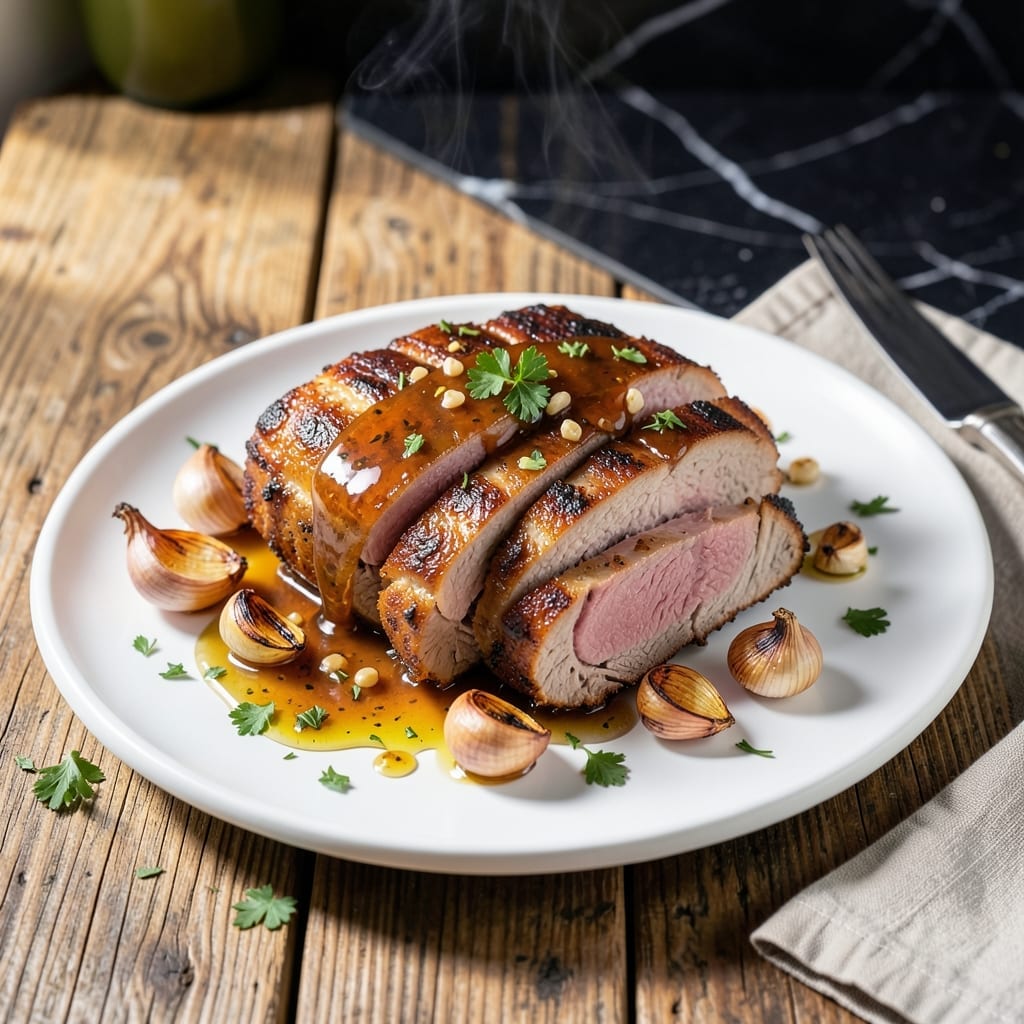
This recipe delivers tender pork tenderloin with a glossy honey garlic glaze that’s impossible to resist. The balance of sweet and savory creates a dish that feels special without complicated techniques.
With just a few ingredients and perfect timing, you’ll achieve juicy, flavorful meat every time. The glaze caramelizes beautifully, adding depth to each bite.
Ingredients for Honey Garlic Pork Tenderloin
Simple ingredients transform into restaurant-quality pork with a caramelized honey garlic finish.
| Ingredient | Amount | Notes |
|---|---|---|
| Pork Tenderloin 🥩 | 1 ½ lb | Trimmed of excess fat |
| Honey 🍯 | ½ cup | Pure, unprocessed preferred |
| Garlic Cloves 🧄 | 6 cloves | Minced for maximum flavor |
| Soy Sauce 🫒 | ⅓ cup | Low-sodium for balance |
| Olive Oil 🫒 | 2 tbsp | Divided for searing and glaze |
| Apple Cider Vinegar 🍏 | 1 tbsp | For acidity and depth |
| Dijon Mustard 🥄 | 1 tbsp | Smooth, not grainy |
| Kosher Salt 🧂 | 1 tsp | Diamond Crystal preferred |
| Black Pepper 🌶️ | ½ tsp | Freshly ground for best results |
| Dried Thyme 🌿 | ½ tsp | Rubbed between fingers to release oils |
| Dried Rosemary 🌿 | ½ tsp | Crushed for maximum aroma |
| Unsalted Butter 🧈 | 2 tbsp | For finishing the glaze |
[recipe_ingredient_scaler]
The pork tenderloin is the star—look for 1.5 pounds with even thickness and minimal fat. Whole Foods or Costco offer high-quality options. Trim any silver skin yourself for better texture. For the honey, local raw varieties add depth, but store-bought works. Fresh garlic is non-negotiable (the jarred stuff lacks punch). Soy sauce should be low-sodium to control the salt balance.
Need to swap soy sauce? Tamari or coconut aminos work at a 1:1 ratio. No honey? Maple syrup or agave can substitute, though the flavor will shift slightly. Dried herbs can be swapped for fresh at one-third the amount. Olive oil can be replaced with avocado oil for a neutral taste. The vinegar? Any mild variety like rice or white wine vinegar works in a pinch.
Store raw pork in its original packaging on a fridge shelf (not the door) and cook within 2-3 days. The glaze keeps for 1 week refrigerated. Leftovers? Portion and freeze for up to 3 months—the flavors actually deepen over time.
Why You’ll Love This Recipe
- I’ll be real: the pork tastes even better the next day in wraps or over rice for lunch.
- One Pan Wonder: I toss everything on a single sheet pan—pork, honey, garlic, soy—then let the oven do the work.
- Sticky Sweet Magic: The honey caramelizes with the garlic and soy into this glossy, finger-licking glaze that coats every bite.
- Feeds a Crowd: Honestly, it’s my go-to for Sunday dinner when the whole family’s over and I need something reliable.
Instructions
Follow this precise method to achieve perfectly tender pork with a glossy, caramelized honey garlic glaze.
Step 1: Prepare and Season the Pork Tenderloin
Pat the 1.5 lb pork tenderloin completely dry with paper towels to ensure a good sear. Trim any remaining silver skin or excess fat for even cooking. Rub the meat with 1 tsp kosher salt, 0.5 tsp black pepper, 0.5 tsp dried thyme, and 0.5 tsp dried rosemary—I crush the herbs between my fingers to release their essential oils.
Let the seasoned pork sit at room temperature for 15-20 minutes while you prepare the glaze. This step ensures the meat cooks evenly and the seasoning penetrates the surface for maximum flavor impact.
Step 2: Sear the Pork for a Golden Crust
Heat 1 tbsp olive oil in a large oven-safe skillet over medium-high heat until it shimmers. Add the pork tenderloin and sear on all sides for 2-3 minutes per side until uniformly golden brown. You’ll hear a satisfying sizzle when it hits the pan—this is the Maillard reaction creating deep flavor.
Resist the urge to move the pork frequently. Let it develop a proper crust before turning. Once browned on all sides, transfer the pork to a plate and reduce the heat to medium for the next step.
Step 3: Create the Honey Garlic Glaze
In the same skillet, add the remaining 1 tbsp olive oil and the 6 cloves minced garlic. Sauté for 30 seconds until fragrant but not browned—burnt garlic will make the glaze bitter. Immediately pour in the 0.5 cup honey, 0.33 cup soy sauce, 1 tbsp apple cider vinegar, and 1 tbsp Dijon mustard.
Stir to combine and bring to a gentle simmer. Cook for 2-3 minutes until the mixture thickens slightly and the honey takes on a deeper amber color. The vinegar will cut through the sweetness, balancing the glaze perfectly.
Step 4: Glaze and Finish the Pork
Return the pork tenderloin to the skillet and spoon the glaze over the top, coating it completely. Add the 2 tbsp unsalted butter and let it melt into the sauce, creating a rich, glossy finish. Turn the pork occasionally to ensure even coating.
Cook for an additional 3-5 minutes, basting frequently, until the internal temperature reaches 145°F on an instant-read thermometer. The pork should feel firm yet springy to the touch. Remove from heat and let rest for 5-10 minutes before slicing—this allows the juices to redistribute for maximum tenderness.
Pro Tips For Making Honey Garlic Pork Tenderloin
- Sear Hot, Then Bake: I learned this the hard way—start with a screaming hot pan for the sear, then finish at 375°F in the oven to guarantee tender pork without a dry center.
- Mince Garlic Fine: After burning three batches, I finally figured out that finely minced garlic (not just chopped) spreads evenly and prevents bitter, burnt bits in the honey sauce.
- Rest Before Slicing: Give it a solid 5-10 minutes under foil after baking, or all those juices will flood your cutting board instead of staying in the meat.
- Thin Honey First: Sounds weird, but it works: warm the honey for 10 seconds in the microwave so it blends smoothly with the soy sauce instead of clumping at the bottom.
Pro Cooking Tips for Perfect Results
Perfect Searing Technique
Heat your skillet until the olive oil shimmers—this ensures a proper Maillard reaction. I use a cast-iron skillet for even heat distribution. Don’t overcrowd the pan; give the pork space to develop that golden crust.
Temperature Control
Use an instant-read thermometer to monitor internal temp. Pull the pork at 145°F—it’ll rise to 150°F while resting. I swear by my ThermoWorks for accuracy. 🌡️
Glaze Timing
Add the glaze only after searing to prevent burning the honey. Simmer the glaze for 2-3 minutes until it coats the back of a spoon. The apple cider vinegar balances the sweetness perfectly.
Resting Matters
Let the pork rest for 5-10 minutes before slicing. This step is non-negotiable—it keeps the juices locked in. I tent mine loosely with foil to keep it warm.
Basting like a Pro
Spoon the glaze over the pork frequently during the final cook. The butter at the end adds a silky finish. Turn the pork every 1-2 minutes for even coating.
For extra shine, baste once more right before serving. ✨
Nutrition Facts
Frequently Asked Questions
What internal temperature should the pork reach?
Remove from heat when it hits 145°F internally. The temperature will rise to 150°F while resting. Use a thermometer for accuracy—overcooking dries out tenderloin.
Can I use a different sweetener?
Yes! Maple syrup or agave work at a 1:1 ratio for honey. Note that maple adds a deeper flavor, while agave is more neutral. Avoid granulated sugar—it won’t dissolve properly.
How do I prevent the glaze from burning?
Keep heat at medium after searing. Simmer the glaze for just 2-3 minutes and baste frequently. Burnt honey turns bitter fast, so stay attentive.
Should I marinate the pork first?
It’s not necessary—the dry rub and glaze provide plenty of flavor. If you want to marinate, limit it to 2 hours max; tenderloin absorbs flavors quickly and can become mushy.

Trained in classic French technique but raised on slow-cooked ribs and spicy rubs, she blends culinary skill with smoke and soul.
- Recipe for Boneless Pork Chops in Cast Iron Skillet: Sear and Baste to Juicy Perfection - October 3, 2026
- Recipe for Boneless Cross Rib Roast: Slow-Roasted Beef with Herb Crust - October 3, 2026
- Hamburgers in Sauce Recipe Crock Pot: Slow-Cooked Savory Delight - October 3, 2026