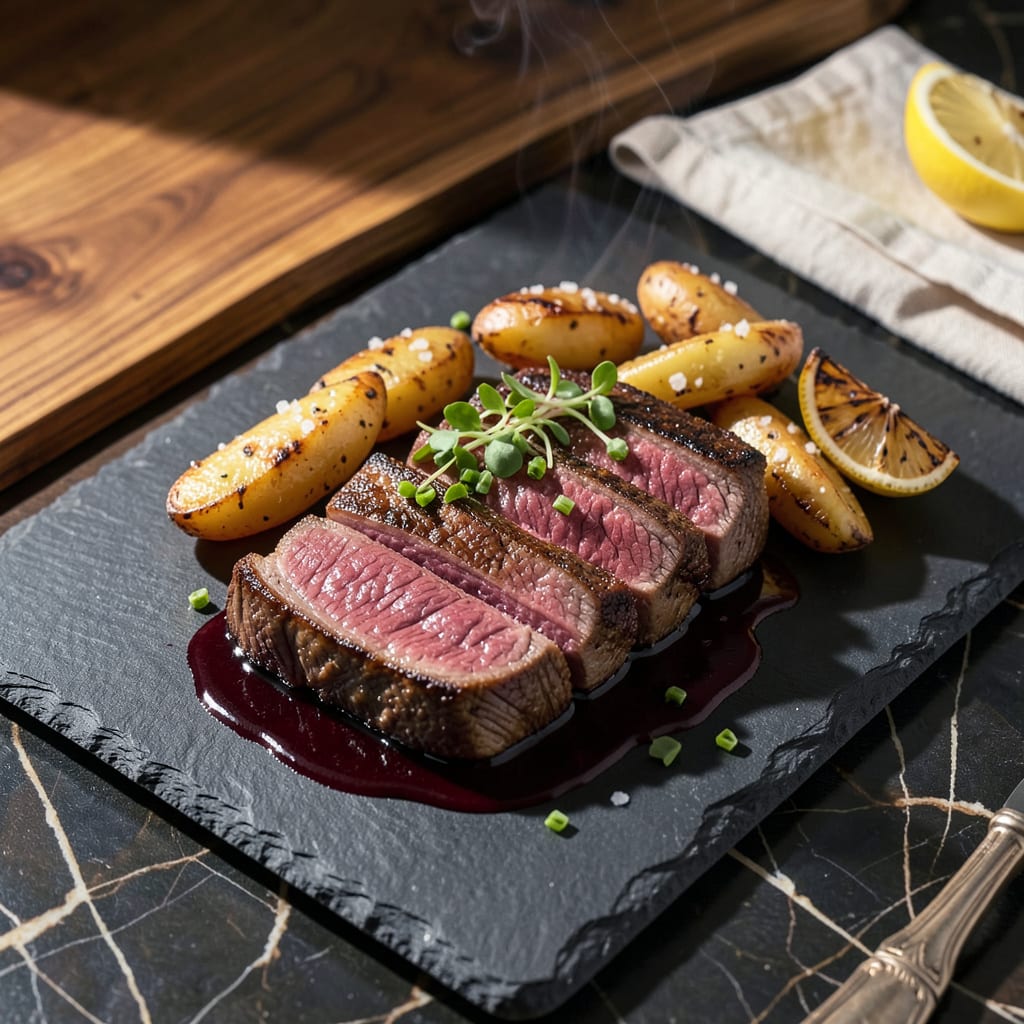
For thin New York strip steaks (½-inch or less), use high-heat methods like pan-searing or grilling for 2-3 minutes per side. Avoid overcooking by monitoring internal temperature (130°F for medium-rare) and resting briefly before slicing.
Thin cuts demand precision because their reduced mass means heat penetrates faster—what takes 10 minutes for a thick steak can happen in under 5 here. I’ve found that cast iron gives the best crust without overpowering the meat’s natural richness, while a screaming-hot grill adds that signature char. 🔥 The key is watching for the moment the edges just start to firm up—that’s your cue to flip and pull it off before the center climbs past 130°F.
What most home cooks miss is how thin steaks benefit from a lighter seasoning touch. A simple kosher salt and black pepper rub lets the beef’s flavor shine, while heavy marinades can mask its delicate texture. Resting for just 3-4 minutes keeps the juices where they belong—in the meat, not on your plate.
💡 In This Article
- Why Thin New York Strip Steaks Cook Differently Than Thick Cuts
- Pro Tips for Seasoning and Serving Thin New York Strip Steak
Why Thin New York Strip Steaks Cook Differently Than Thick Cuts
The magic—and challenge—of thin cuts lies in their reduced mass. A ½-inch New York strip has about 70% less volume than a standard 1.5-inch cut, meaning heat transfers through it almost instantly. While a thick steak develops a gradient (crusty exterior, rare center), thin cuts cook uniformly.
The muscle fibers contract faster, pushing juices outward unless you use high heat (450°F+) to seal the surface quickly. This is why your window for perfect doneness shrinks from minutes to seconds. ✨
Fat distribution plays a huge role too. Thin strips have the same marbling as thick cuts, but it’s concentrated in a smaller space. When exposed to heat, those fat pockets render rapidly—sometimes too fast. At 400°F, intramuscular fat melts in 90 seconds versus 3-4 minutes in thicker steaks. The result?
A richer flavor in less time, but also a higher risk of drying out if you overshoot your target temp. I’ve found that cast iron’s even heat gives better control than grill flare-ups for these delicate cuts. 🔥
Here’s what’s happening at the cellular level: Thin steaks have less connective tissue to break down, so their tenderness comes from fast, aggressive browning rather than slow rendering. The Maillard reaction (that delicious crust formation) occurs at 300°F+, but thin cuts hit this temp internally almost immediately.
That’s why you’ll see the surface caramelize within 60 seconds, while the center stays juicy—if you time it right. Miss that window, and you’re left with gray, overcooked meat. ⚡
The moisture retention game changes completely. Thick steaks can afford to lose 15-20% of their weight to evaporation during cooking, but thin cuts can’t spare that much. A ½-inch strip might lose only 5-8% if cooked properly, which is why resting becomes critical.
Those few minutes let the juices redistribute—skip this, and you’ll lose 30% more moisture when slicing. I rest mine on a warm plate (not cutting board) to prevent temperature shock. 💫
Compare this to a thick cut’s behavior: A 1.5-inch strip might take 8-10 minutes to reach 130°F internally, giving you time to develop a thick crust. Thin cuts hit that temp in 3-4 minutes total, so your crust has to form in the first 90 seconds or you’ll overcook the center.
This is why professional chefs use ripping-hot pans and avocado oil (smoke point 520°F) for thin steaks—it’s the only way to get that restaurant-quality sear without drying them out. 🌟
Pro tip from my pitmaster days: Thin strips benefit from a reverse sear approach in reverse. Start with a 30-second sear on each side to lock in juices, then finish in a 375°F oven for 2 minutes if needed. This hybrid method gives you more control than pure stovetop cooking.
The oven’s gentle heat lets the center come to temp without risking the exterior burning—something I wish I’d known before ruining my first batch of thin cuts! 💛
Remember, thin steaks are forgiving in one way: their small size means you can always cook another if the first attempt goes south. But when you nail it—a perfectly crusty exterior with a rosy, juicy center—you’ll understand why chefs love working with these quick-cooking cuts.
The secret is treating them like delicate seafood: fast, hot, and with constant attention. 🔥

Trained in classic French technique but raised on slow-cooked ribs and spicy rubs, she blends culinary skill with smoke and soul.
- Recipe for Boneless Pork Chops in Cast Iron Skillet: Sear and Baste to Juicy Perfection - October 3, 2026
- Recipe for Boneless Cross Rib Roast: Slow-Roasted Beef with Herb Crust - October 3, 2026
- Hamburgers in Sauce Recipe Crock Pot: Slow-Cooked Savory Delight - October 3, 2026