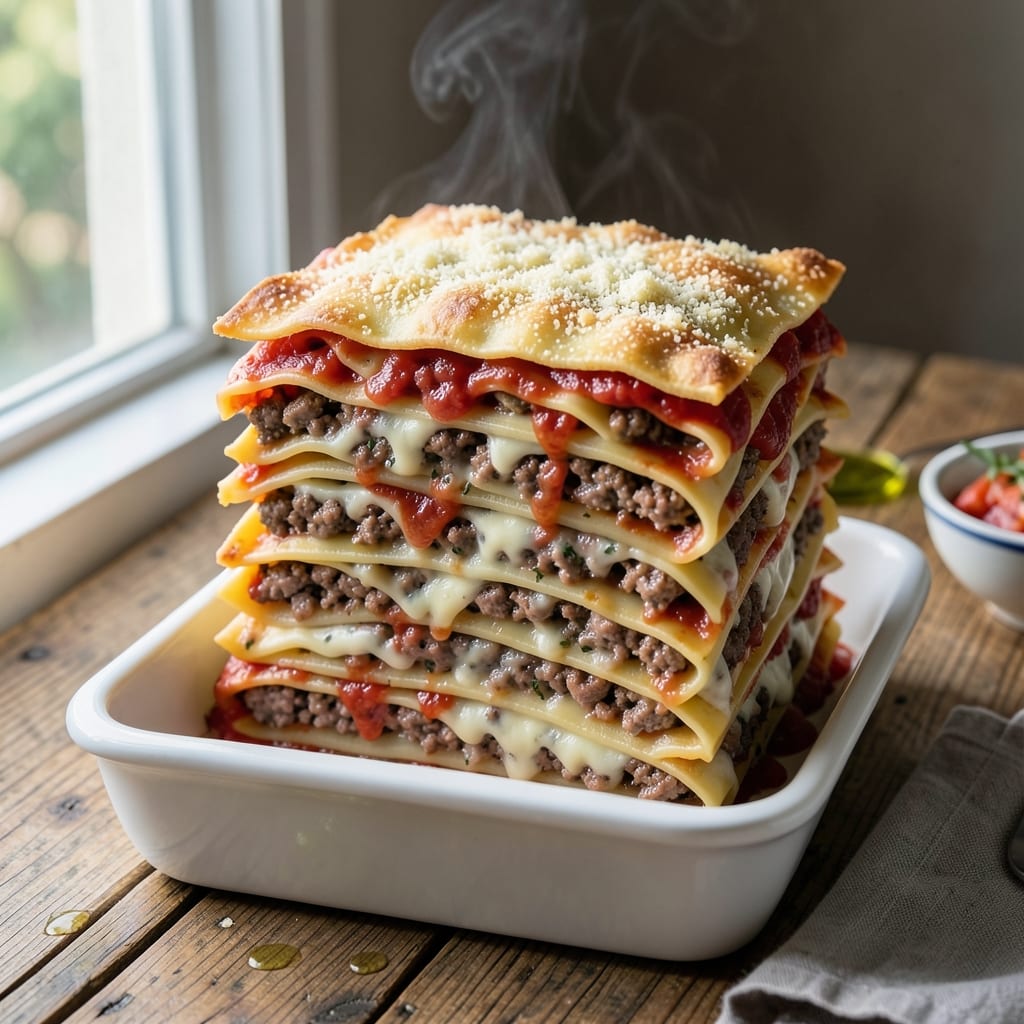
This lasagna redefines what you thought possible with 40 paper-thin pasta layers stacked between rich meat sauce and creamy béchamel. The secret lies in rolling the pasta sheets to an almost translucent thickness, creating a delicate texture that melts in your mouth.
Each layer builds upon the last, with the meat sauce becoming more concentrated as it cooks down. The béchamel adds a velvety counterpoint that prevents the dish from becoming too heavy, while the pasta itself absorbs flavors beautifully during baking.
What emerges from the oven is a towering masterpiece with perfectly defined layers that hold together when sliced. The edges develop a golden crust, while the center remains moist and tender—proof that patience and precision create extraordinary results.
Serve this showstopper at your next gathering and prepare for requests for seconds. The effort is substantial, but the payoff is unforgettable.
Ingredients for 40 Layer Lasagna
A few quality ingredients transform into this incredible layered masterpiece with precision and patience.
| Ingredient | Amount | Notes |
|---|---|---|
| All-Purpose Flour 🌾 | 3 cups | For homemade pasta sheets |
| Large Eggs 🥚 | 4 whole | Room temperature preferred |
| Olive Oil 🫒 | 1 tbsp | Extra-virgin for richness |
| Salt 🧂 | 1 tsp | Fine sea salt for pasta dough |
| Ground Beef 🥩 | 2 lb | 80/20 lean-to-fat ratio |
| Ground Pork 🥩 | 1 lb | Adds depth to meat sauce |
| Yellow Onion 🧅 | 1 whole | Finely diced for sauce |
| Garlic Cloves 🧄 | 6 cloves | Minced for meat sauce |
| San Marzano Tomatoes 🍅 | 2 cans | 28 oz cans, crushed by hand |
| Tomato Paste 🍅 | ½ cup | Double-concentrated preferred |
| Dry Red Wine 🍷 | 1 cup | Bold variety like Chianti |
| Whole Milk 🥛 | 4 cups | For creamy béchamel |
| Unsalted Butter 🧈 | ¾ cup | For béchamel roux |
| Parmesan Cheese 🧀 | 2 cups | Freshly grated from wedge |
| Nutmeg 🌰 | ¼ tsp | Freshly grated preferred |
[recipe_ingredient_scaler]
The pasta sheets are everything here. 00 flour from Eataly or Italian markets makes the most delicate sheets, but all-purpose works in a pinch (just roll them thinner). For the meat sauce, ground chuck and pork shoulder give the richest flavor—find them at Whole Foods or your local butcher. The San Marzano tomatoes are non-negotiable for that sweet, concentrated flavor (look for the DOP certification).
No red wine? Substitute beef broth with a splash of balsamic vinegar. Out of ground pork? Use all beef with an extra 1 tsp of fennel seeds for that sausage flavor. The béchamel needs whole milk for richness, but half-and-half with a splash of water works if that’s all you have. For the Parmesan, Parmigiano-Reggiano is ideal, but Grana Padano is a solid (and slightly cheaper) alternative.
Make the meat sauce a day ahead—it actually gets better overnight. The béchamel can sit for 2 hours before assembling. Once baked, the lasagna keeps for 4 days in the fridge or freezes beautifully for 3 months (slice before freezing for easy portions).
Why You’ll Love This Recipe
- Surprisingly Simple: I just roll out the fresh pasta sheets with flour and eggs, layer with beef, and let the oven do the rest.
- Rich Layers: The ground beef and olive oil create this deep, savory flavor that soaks into every single one of those 40 delicate layers.
- Feeds a Crowd: I made this for my son’s birthday and it disappeared—40 layers means everyone gets a perfect slice.
- Budget Stretcher: A little flour, a few eggs, and some ground beef go a long way. Honestly, it’s my most cost-effective dish for big gatherings.
Step-by-Step Instructions for 40 Layer Lasagna
Building this masterpiece takes patience, but every thin layer adds incredible depth of flavor and texture.
Step 1: Roll and Cut Ultra-Thin Pasta Sheets
Combine the 3 cups all-purpose flour with the 4 whole large eggs, 1 tbsp olive oil, and 1 tsp salt to form a smooth dough. Knead for 8-10 minutes until elastic, then wrap in plastic and rest for 30 minutes at room temperature.
Divide the dough into 8 portions and roll each through a pasta machine to the thinnest setting. You should end up with sheets so thin you can nearly see through them. Cut each sheet to fit your 9×13-inch baking dish—this precision ensures even layers throughout.
Step 2: Prepare the Rich Meat Sauce
In a large Dutch oven, brown the 2 lb ground beef and 1 lb ground pork over medium-high heat until deeply caramelized. This takes 8-10 minutes—don’t rush it. The fond that develops here is pure flavor.
Add the finely diced yellow onion and cook for 5 minutes until soft and translucent. Stir in the minced 6 cloves garlic cloves and cook for 30 seconds until fragrant. Pour in the 1 cup dry red wine and reduce by half.
Add the hand-crushed 2 cans San Marzano tomatoes and 0.5 cup tomato paste. Simmer uncovered for 1-1.5 hours until thickened to a spreadable consistency. The sauce should be rich, dark, and intensely savory.
Step 3: Craft the Silky Béchamel
Melt the 0.75 cup unsalted butter in a saucepan over medium heat. Whisk in the 3 cups all-purpose flour and cook for 2 minutes to create a blonde roux. This removes the raw flour taste and builds a sturdy base for your sauce.
Gradually whisk in the 4 cups whole milk, 1 cup at a time, ensuring each addition is fully incorporated before adding more. Cook for 5-7 minutes until the sauce thickens enough to coat the back of a spoon. Finish with 0.25 tsp nutmeg and season with salt to taste.
Step 4: Assemble the 40 Layers
Begin with a thin layer of meat sauce on the bottom of your dish. Add a pasta sheet, then another thin layer of sauce, followed by a dusting of parmesan cheese. Repeat this sequence, alternating between sauce and béchamel every 5 layers to maintain moisture and creaminess.
Press down gently as you build to eliminate air pockets, which can cause uneven cooking. The key is patience—thin, even layers are what make this dish extraordinary. You should end with a final layer of pasta topped with béchamel and a generous sprinkling of parmesan cheese.
Step 5: Bake to Perfection
Cover the dish tightly with foil and bake at 375°F for 30 minutes. Remove the foil and bake for another 25-30 minutes until the top is deep golden brown and bubbling around the edges.
Let the lasagna rest for 20 minutes before slicing. This allows the layers to set and makes serving neat portions possible. The top should have a beautifully browned crust, while the interior reveals perfectly stacked, tender layers with rich sauce oozing between each one.
Pro Tips For Making 40 Layer Lasagna
- Pre-Cook the Beef: Brown the ground beef first with a pinch of salt—this renders the fat and concentrates the flavor before layering, or you’ll end up with a greasy, loose lasagna.
- Thin Your Pasta: Roll the egg-and-flour dough as thin as possible, almost translucent. I learned this the hard way—thick layers turn doughy and ruin the delicate stack.
- Salt Each Layer: Lightly salt the pasta sheets as you build the layers, not just the meat. After my first bland attempt, I realized the middle layers need seasoning too.
- Rest Before Slicing: Let the lasagna sit for at least 20 minutes after baking—yes, even if you’re starving. Cutting too soon turns your 40 layers into a slide of cheese and sauce.
Perfect Pairings for This 40 layer lasagna
Wine Pairings
This dish demands bold Italian reds that can stand up to the rich meat sauce and creamy béchamel. I always reach for a Chianti Classico with its bright acidity and cherry notes that cut through the richness. A Barolo with its earthy complexity and tannic structure is another excellent choice for special occasions. 🍷
Side Dishes
A simple arugula salad with lemon vinaigrette provides a peppery contrast that refreshes your palate between bites. I toss 4 cups baby arugula with 2 tbsp olive oil, 1 tbsp lemon juice, and shaved Parmigiano-Reggiano. The bitterness balances the lasagna’s richness perfectly.
Bread Options
Warm, crusty ciabatta or a focaccia with rosemary makes excellent companions for soaking up any extra sauce. I like to brush mine with garlic butter and toast it lightly. The chewy texture contrasts beautifully with the tender pasta layers.
Vegetable Additions
Roasted asparagus or brussels sprouts with balsamic glaze add a welcome green element to the plate. Toss them with 1 tbsp olive oil and roast at 400°F for 15-20 minutes until caramelized. The slight char complements the lasagna’s depth. 🥗
Cheese Enhancements
Offer a small bowl of aged balsamic vinegar for drizzling over portions—it adds a sweet-tart note that elevates each bite. A sprinkle of fresh basil ribbons or microgreens adds color and freshness when serving.
Nutrition Facts
Frequently Asked Questions
Can I use store-bought pasta sheets instead of making my own?
You can, but they won’t be as thin. Look for the thinnest no-boil lasagna sheets available and roll them slightly thinner with a rolling pin. Homemade sheets allow for the paper-thin layers that define this dish.
How do I prevent the top from drying out?
Cover the dish tightly with foil for the first 30 minutes of baking. Also, ensure your final layer is béchamel, which acts as a protective barrier. Resting for 20 minutes after baking helps redistribute moisture.
Can I make this ahead of time?
Assemble the lasagna, cover tightly, and refrigerate for up to 24 hours before baking. You can also freeze the unbaked lasagna for up to 1 month. Add 10-15 minutes to baking time if cooking from cold.
What’s the trick to getting clean slices?
Let it rest for the full 20 minutes after baking. Use a sharp, thin-bladed knife and cut straight down—no sawing. Wipe the blade between slices for the cleanest presentation.

Trained in classic French technique but raised on slow-cooked ribs and spicy rubs, she blends culinary skill with smoke and soul.
- Recipe for Boneless Pork Chops in Cast Iron Skillet: Sear and Baste to Juicy Perfection - October 3, 2026
- Recipe for Boneless Cross Rib Roast: Slow-Roasted Beef with Herb Crust - October 3, 2026
- Hamburgers in Sauce Recipe Crock Pot: Slow-Cooked Savory Delight - October 3, 2026